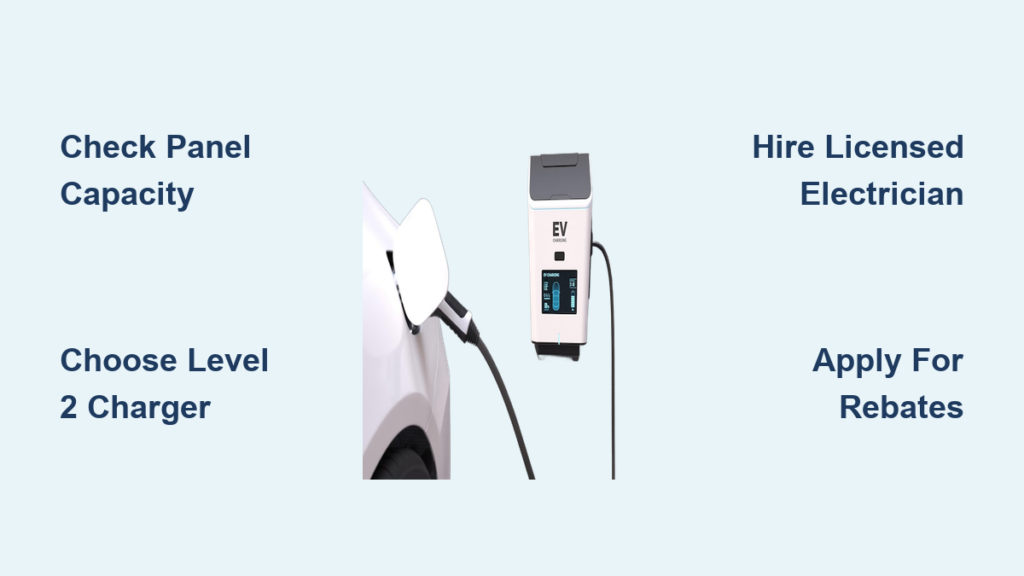
Charging your electric vehicle at home is one of the most convenient ways to keep your car powered. With approximately 80% of EV owners relying on home charging, it’s clear that a reliable setup isn’t just a luxury, it’s essential for daily driving. Unlike public stations, a home EV charger ensures your vehicle starts each day fully charged, reduces energy costs, and fits seamlessly into your routine. But installing one isn’t as simple as plugging in a cord. It involves understanding electrical requirements, choosing the right equipment, and deciding between DIY and professional installation.
This guide walks you through every step of installing a Level 2 charger, the gold standard for home charging. You’ll learn how to assess your panel capacity, select the best charger for your needs, avoid common mistakes, and save money with rebates. By the end, you’ll know exactly what it takes to get your EV charging safely and efficiently at home.
Choose the Right EV Charger Type for Your Home

Level 1 vs. Level 2 Charging Explained
Level 1 and Level 2 chargers differ significantly in speed, convenience, and installation needs. Level 1 uses a standard 120V outlet and delivers only 2 to 5 miles of range per hour, making it suitable for plug-in hybrids or short commutes. While it requires no installation, just plug into an existing outlet, it’s impractical for daily full-EV use.
In contrast, Level 2 chargers operate on 240V and provide 25 to 40 miles of range per hour, allowing most EVs to recharge overnight. A fully depleted battery can be restored in 4 to 10 hours, depending on the model and charger output. Because of this, Level 2 is strongly recommended for any EV used regularly.
| Feature | Level 1 | Level 2 |
|---|---|---|
| Voltage | 120V | 240V |
| Charging Speed | 2 to 5 miles per hour | 25 to 40 miles per hour |
| Full Charge Time | 40 to 50 hours | 4 to 10 hours |
| Installation Needed | None | Yes |
| Hardware Cost | $0 to $300 | $300 to $2,000 |
If you own a full battery-electric vehicle, skipping Level 2 charging means sacrificing convenience and efficiency.
Match Your Charger to Your Vehicle
Not all EVs use the same connector. The two main types are J1772 and J3400/NACS (Tesla).
J1772 serves as the standard for all non-Tesla EVs in North America, offering universal compatibility. J3400/NACS was originally Tesla-specific but is now being adopted by GM, Ford, and others starting in 2025.
While adapters exist, matching your charger to your vehicle’s native plug eliminates hassle. Tesla owners should choose a Tesla Wall Connector or NACS-compatible unit. Non-Tesla drivers should opt for J1772-equipped chargers. Some smart chargers support both via detachable cables or adapter kits, offering flexibility if you switch vehicles later.
Essential Features to Look for in a Home EV Charger

Smart vs. Dumb Chargers: What Fits Your Lifestyle
You can choose between smart and dumb EV chargers, each with distinct advantages.
Smart chargers like ChargePoint, JuiceBox, Emporia, and Myenergi Zappi connect via Wi-Fi or Bluetooth, allowing scheduling, energy monitoring, and app control. They integrate with solar panels and home energy systems, support time-of-use optimization so you can charge when electricity rates are lowest, and enable load balancing to prevent circuit overloads.
Dumb chargers like basic Grizzl-E models offer plug-and-charge simplicity with no app, no scheduling, and no data. They have a lower upfront cost.
While dumb chargers save money, smart models pay for themselves over time through energy savings and utility rebates. Some utilities offer $400 or more in rebates for installing smart chargers, so check your provider before buying.
Tethered vs. Untethered Chargers
Another key decision involves whether to go tethered (cable attached) or untethered (separate cable).
Tethered chargers mean no need to store a cord, making them faster to use. However, the fixed length offers less flexibility if changing cars. Untethered chargers work with multiple EVs and use your car’s cable, but the receptacle may fail under constant use.
For single-EV households, tethered is simpler. For multi-car homes or frequent upgraders, untethered offers more flexibility.
Safety and Certification Standards
Always choose a charger with UL or ETL certification, confirming it meets national safety standards. Look for ENERGY STAR certification for efficiency and IP65 or higher rating for outdoor installations (dust and water resistance). Built-in GFCI protection prevents shocks.
Avoid uncertified or off-brand units. Safety isn’t worth compromising.
Assess Your Home’s Electrical Capacity for EV Charging

Check Your Electrical Panel First
Before buying a charger, verify your electrical panel can handle the load. Most modern homes have 200-amp service, which supports Level 2 charging. Older homes may have 100-amp or 60-amp panels, requiring upgrades or load management.
Key questions to ask include whether you have an open double-pole breaker slot, whether your panel is near capacity (check if breakers trip frequently), and whether adding a 40 to 60A circuit exceeds 80% of total load. A licensed electrician should perform a NEC Article 220 load calculation to determine safe capacity.
Warning: Overloading your panel can cause fires. Never guess, get a professional evaluation.
Circuit and Wire Sizing Rules
Level 2 chargers typically draw 30 to 80 amps, but circuits must be sized for 125% of continuous load (NEC Rule 625.41).
| Charger Amps | Required Circuit | Example Wire |
|---|---|---|
| 30A | 40A circuit | 10 AWG |
| 40A | 50A circuit | 8 AWG |
| 48A | 60A circuit | 6 AWG |
| 80A | 100A circuit | 3 AWG |
Use copper wire only. Aluminum is cheaper but harder to terminate safely. For runs over 50 feet, consider upgrading wire size (for example, 4 AWG instead of 6 AWG) to reduce voltage drop.
Choose the Right Conduit and Cable
Protect your wiring with proper conduit. Liquid tight flexible conduit is waterproof and easy to route, ideal for garages and exterior walls. EMT (metal tubing) is rigid and durable but requires bending tools. MC (metal-clad) cable is pre-assembled with no separate conduit needed, great for indoor runs.
For outdoor or buried runs, use armored cable (SWA) with 450mm burial depth (750mm recommended). Add warning tape above the cable and include spare conduit for future data or solar lines.
Expert Note: Run Cat5E data cable alongside power if using smart chargers with load monitoring or solar integration.
Hardwired vs. Plug-In: Which EV Charger Installation Is Right for You
Plug-In Chargers: Pros and Cons
Plug-in EVSEs connect to a NEMA 14-50 or 6-50 outlet, similar to RVs or dryers.
The advantages include easier replacement or movement of the charger, lower labor cost if the outlet is pre-wired, and no need to open the panel during replacement. The disadvantages involve receptacles that can overheat under continuous load, the requirement for duty-rated outlets (not standard sockets), and the fact that plug-in chargers over 48 amps are not allowed in many jurisdictions.
Real Risk: Receptacle failures are a leading cause of EV charger fires. Use only high-quality, commercial-grade outlets.
Hardwired: The Safer Long-Term Choice
Hardwired chargers connect directly to the electrical system via a junction box with no plug.
The advantages include more reliable performance for 24/7 use, code requirement for 48A+ chargers, no receptacle to fail, and a cleaner, more professional appearance. The disadvantages involve requiring an electrician to replace and slightly higher initial cost.
For permanent installations, hardwired is the best choice, especially for high-power setups.
Step-by-Step Guide to Installing Your Home EV Charger
Step 1: Plan Location and Route
Choose a mounting spot 48 inches above floor (ergonomic height), near a wall stud for secure mounting, close to the electrical panel to minimize wire length, and away from doors, foot traffic, and water sources.
Measure the distance from panel to charger to estimate wire and conduit needs.
Pro Tip: Use a string to simulate the route to help visualize bends and obstacles.
Step 2: Turn Off Power and Prepare Panel
Shut off the main breaker before touching anything. Verify power is off using a non-contact voltage tester and multimeter (test phase-to-phase and phase-to-ground).
Open the panel by removing cover screws, locating an unused double-pole breaker space, knocking out a panel knockout at the bottom or side, and installing a liquid tight connector with O-ring and locking nut.
Never work on a live panel. Electricity can kill with no second chances.
Step 3: Mount the Charger Backplate
Remove the charger’s backplate and decide on wire entry direction (left, right, or center). Drill a 3/16-inch hole through the wall using a masonry bit if dealing with stucco or brick. Secure backplate to a wood stud with screws and attach liquid tight connector to charger’s bottom port.
Ensure the unit is level and stable before proceeding.
Step 4: Run Conduit and Pull Wires
Run 1-inch liquid tight conduit from panel to charger. Secure every 4 feet with EMT clamps to prevent sagging.
Feed three THHN copper wires: black (hot), red (hot), and green (ground). No neutral is needed for 240V EVSE. For a 60A circuit, use 6 AWG wire. For runs over 50 feet, use 4 AWG.
Trick: Tape the ground wire into a tight hook and secure with electrical tape to avoid snagging during the pull.
Step 5: Connect Wires at Charger
Label terminals: Line 1, Line 2, Ground.
Strip one-half inch of insulation, loosen terminal screws with the included hex bit, insert ground first, then red and black, torque screws to specification (for example, 50 inch-pounds for Tesla Wall Connector), and reattach cover and tighten screws.
Critical: Use a torque screwdriver. Loose connections cause overheating and fires.
Step 6: Connect Wires at Panel
Feed wires into the panel through the conduit. Connect green ground to grounding bar, black and red to double-pole breaker, insert breaker into bus bars, and push firmly. Label the breaker clearly: “EV Charger.”
Replace panel cover and leave breaker OFF until testing.
Step 7: Power On and Test Charging
Restore main power and flip the EV breaker to ON. Most chargers light up immediately.
For smart models, open the app (Tesla, JuiceNet, or similar), follow setup prompts, and press and hold charger button for 5 seconds. A pulsing light means ready.
Plug in your EV. The charger should flash blue, click, and turn green. Check vehicle display for charging rate (for example, 48A at 240V equals 11.5 kW).
If no response, double-check breaker position, wire connections, and grounding.
DIY vs. Professional Installation: What You Need to Know
When to Hire an Electrician
Most homeowners should hire a licensed electrician. Reasons include ensuring NEC and local code compliance, handling permits and inspections, performing accurate load calculations, and reducing risk of fire or shock.
Average cost ranges from $500 to $2,500, with $1,700 typical for standard installs. Installation time is 2 to 4 hours.
Call any electrician and tell them you want a 240V outlet for a water heater in the spot where the charger is going. This should cost between $1,000 and $1,500.
Trusted installer networks include Qmerit (works with GM, Chevrolet, and others), Tesla Certified Installers (available at tesla.com/support/certified-installers), and OZEV-approved installers (UK, required for grants).
DIY: Is It Feasible
DIY is possible if you have solid understanding of home electrical systems, tools including multimeter, torque driver, and conduit bender, knowledge of NEC Article 625, and confidence working with high-voltage circuits.
I did my own install. It’s actually not too complex if you have a solid basic understanding of home electricity.
But risks include fire from improper connections, voided EV or home insurance, failed inspections, and personal injury or death. If unsure, hire a pro.
Understanding Costs and Available Rebates
Charger and Installation Costs
| Item | Cost Range |
|---|---|
| Basic Level 2 Charger | $300 to $600 |
| Smart Level 2 Charger | $500 to $900 |
| Tesla Wall Connector | About $500 |
| Standard Installation | $500 to $1,500 |
| With Panel Upgrade | $2,000+ |
Real Example: Total cost was $849 for install and $550 for the charger.
Claim Available Rebates
Save money with incentives.
The U.S. Federal Tax Credit covers 30% of cost, up to $1,000 (through June 30, 2026). State and utility rebates range from $400 to $1,000 (for example, California and New York). Automaker offers from Hyundai and GM provide installer discounts. Some utilities pay extra for Wi-Fi-enabled smart chargers. The UK OZEV Grant was previously 350 pounds but expired as of 2023.
We went with JuiceBox because our utility offers a rebate if you install a smart charger.
Always apply before installation. Some programs require pre-approval.
Safety Requirements and Code Compliance for Home EV Charging
Follow Critical Safety Rules
Always turn off main power before working. Use torque screwdrivers because loose terminals overheat. Never use extension cords as they create fire hazards. Label all breakers clearly and install GFCI or AFCI protection where required.
Reminder: Electricity can kill instantly. If unsure, stop and call a pro.
Meet Code Requirements
Permits are required in most areas and an inspector must approve the work. DIYers must self-certify or hire third-party inspection. Follow NEC Article 625 and local amendments.
Skipping permits risks fines and insurance denial.
Future-Proof Your Setup
Think long-term. Install larger conduit for future solar or second EV. Choose smart chargers with load sharing. Consider three-phase power if available for 22kW charging. Run extra data lines (Cat5E) for monitoring.
Pro Move: Install a 60A circuit even if using a 48A charger to allow future upgrades.
Special Considerations for Renters and Apartments
Your Rights and Options
Many U.S. states have “Right to Charge” laws, allowing EV charger installation if you have dedicated parking.
Notify your landlord in writing, provide an installation plan, and offer to cover costs and repairs. Condo associations may restrict installations, so check bylaws.
Street Parking Solutions
Cities like Boston, Seattle, Portland, and Washington DC offer curbside EV charging programs. Options include municipal curb chargers, long cables if allowed, and requesting installation in your zone.
Check local rules. Some areas ban tripping hazards from cables across sidewalks.
International Variations
In the UK, many use three-pin plugs (2.3kW) and a 10-year electrical survey is advised. Canada (Alberta) requires permits and city inspection. Europe uses three-phase charging commonly with 22kW chargers standard.
Always follow local codes and utility guidelines.
Key Takeaways for Installing an EV Charger at Home
Installing a home EV charger is a smart, future-ready investment that enhances convenience, reduces fuel costs, and supports sustainable transportation.
The most important steps are choosing Level 2 charging for daily use, assessing your panel capacity before buying equipment, deciding between smart and dumb chargers based on your budget, using hardwired connections for reliability, and applying for rebates before installation.
Prioritize safety throughout the process. If you’re not comfortable with electrical work, hire a licensed electrician. The cost is worth the peace of mind knowing your charger is installed correctly and safely.
You’re doing the right thing by asking questions. If you’re not sure, ask more.
Frequently Asked Questions About Installing an EV Charger at Home
How long does it take to install an EV charger at home?
Standard installation takes 2 to 4 hours for most homes with adequate electrical capacity. Complex installations requiring panel upgrades or trenching can take a full day or longer.
Can I install an EV charger myself, or do I need an electrician?
DIY installation is possible if you have intermediate electrical knowledge and understand NEC Article 625 requirements. However, most homeowners should hire a licensed electrician to ensure code compliance and safety.
How much does it cost to install an EV charger at home?
Hardware costs range from $300 to $2,000 depending on charger type. Professional installation typically costs $500 to $1,500, with panel upgrades adding $2,000 or more.
What electrical panel do I need for a home EV charger?
Most homes built after the 1980s have 200-amp service, which supports Level 2 charging. A licensed electrician should perform a load calculation to verify your panel can handle the additional 40 to 60 amp circuit.
Are there rebates available for home EV charger installation?
Yes. The U.S. federal tax credit covers 30% of costs up to $1,000 through June 2026. Many states and utilities offer additional rebates ranging from $400 to $1,000. Some automakers also provide installer discounts.