You have seen them in tech stores and online listings. Slim, lightweight chargers that can power your laptop, phone, and tablet all at once. These compact power adapters are not magic. They use gallium nitride (GaN), a semiconductor material that is changing how we think about charging our devices. But how does a GaN charger work differently from the traditional brick you might still have plugged into your wall?
At its core, a GaN charger performs the same basic function as any other charger. It converts high-voltage AC power from your wall outlet into low-voltage DC power that your devices can use. What makes GaN chargers special is the material inside. Gallium nitride replaces silicon in the critical switching components that regulate power flow. This material swap enables faster switching, less heat generation, higher efficiency, and dramatically smaller size. The result is a charger that can deliver high wattage without the bulk.
Why GaN Chargers Outperform Silicon
The Science Behind Gallium Nitride
Gallium nitride is a wide-bandgap semiconductor with a band gap of approximately 3.4 eV, nearly triple silicon is 1.1 eV. This fundamental difference in electronic structure gives GaN remarkable properties that make it ideal for power conversion.
GaN can handle higher voltages before breaking down, operate at higher temperatures, and resist electrical failure better than silicon. The higher band gap also reduces electron leakage, which means less energy is lost during the conversion process. GaN also has higher electron mobility, allowing electrons to move through the material faster. When used in transistors, this translates to much faster on/off switching speeds.
Key Components That Change
In a traditional silicon charger, MOSFETs (metal-oxide-semiconductor field-effect transistors) handle the rapid switching needed to regulate power. These silicon components typically switch at frequencies of 100 to 300 kHz. GaN chargers replace these silicon transistors with gallium nitride equivalents that can switch at several megahertz. This dramatic increase in switching speed is the primary reason GaN chargers can be so much smaller.
The components that typically get upgraded to GaN include primary-side MOSFETs that regulate incoming AC power, PFC (power factor correction) circuits that improve energy efficiency, synchronous rectifiers that convert AC to DC, and VBUS switches in USB-C power delivery systems. Each of these GaN-based components performs the same job as silicon but with lower resistance, faster response, and less heat generation.
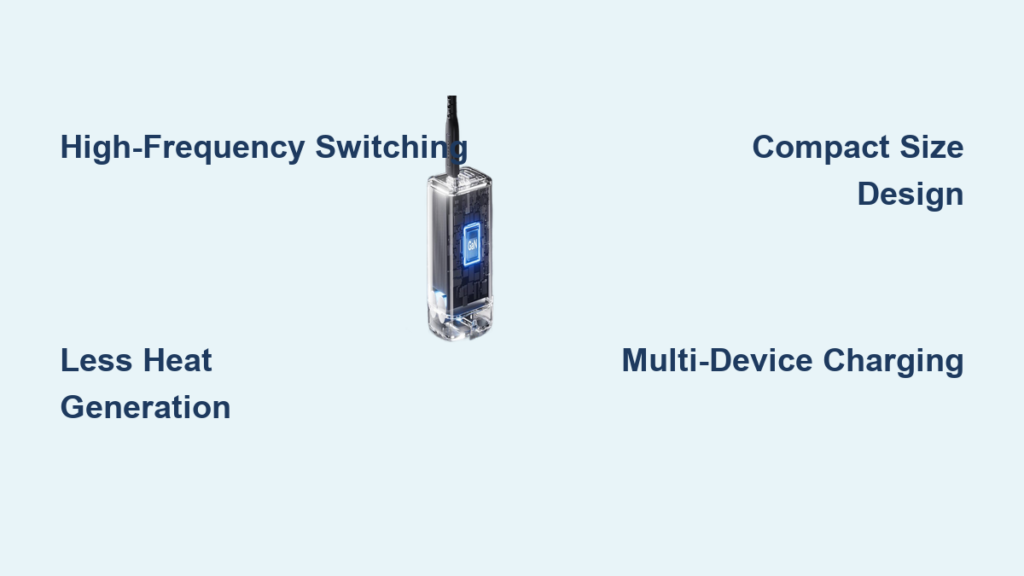
How High-Frequency Switching Enables Compact Design
Why Faster Switching Means Smaller Chargers
The biggest reason GaN chargers fit in your pocket while old chargers took up your entire bag comes down to switching frequency. Traditional silicon chargers operate at 100 to 300 kHz, which limits how small transformers and capacitors can be. These passive components are typically the bulkiest parts of any power adapter.
GaN transistors can switch at 1 to 5 MHz or even higher. This matters because transformer size is inversely proportional to switching frequency. Higher frequency means the magnetic field changes faster, allowing a much smaller transformer to transfer the same amount of power.
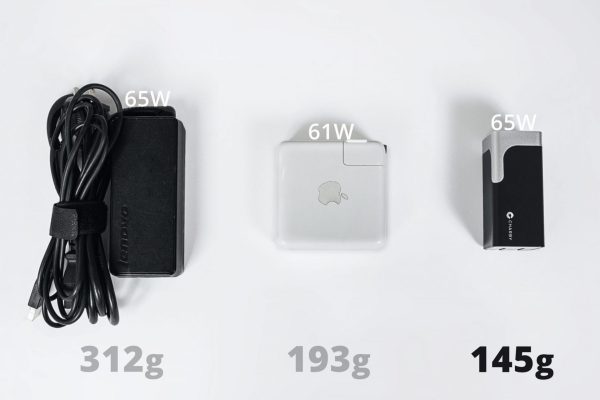
For example, a 65W silicon charger needs a relatively large transformer and substantial heatsink to manage the heat from lower efficiency. A 65W GaN charger uses a fraction of the space for the same transformer, thanks to megahertz-range switching. This miniaturization allows manufacturers to pack 100W or more of output into a device that fits easily in your pocket.
Real-World Size Comparisons
The synergy of high-frequency switching, low heat loss, and high power density enables radical downsizing. A traditional 65W laptop charger was often larger than a smartphone. Today’s GaN equivalents are up to 50% smaller and weigh significantly less.
The Anker Prime 100W charger with three ports measures just 1.7 by 1.1 by 2.7 inches and weighs only 6 ounces. Apple’s 140W USB-C GaN charger fits easily in a jeans pocket. This shrinkage is not just about convenience. It enables multi-port designs that can replace several different chargers with one compact unit.
Heat Management and Efficiency Gains
Power Conversion Without the Waste
Efficiency measures how much AC power from your wall gets converted to usable DC power for your devices. Most silicon chargers operate at 85 to 90% efficiency, meaning 10 to 15% of energy is lost as heat. That wasted energy requires bulky heatsinks and limits how many ports manufacturers can include.
GaN chargers consistently exceed 95% efficiency, with some reaching 96 to 97%. This means a 65W GaN charger loses only about 3W as heat, while a silicon charger might lose 6 to 10W under the same load. Less heat improves safety, reduces the need for cooling components, and allows denser circuit layouts.
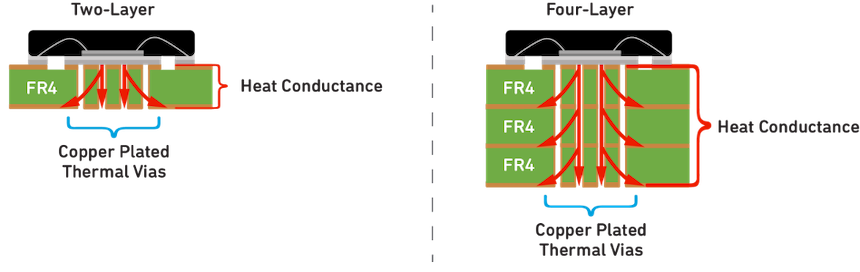
Even under full load, high-quality GaN chargers stay cool to the touch thanks to efficient thermal design. Top manufacturers include thermal vias to conduct heat away from chips, heat spreaders for even dissipation, and real-time monitoring systems. Anker’s ActiveShield technology, for instance, checks temperature up to 6 million times per day.
Built-In Protection Systems
Despite lower heat output, compact GaN chargers still need smart thermal management. Reputable GaN chargers include multiple safety layers such as overvoltage protection, overcurrent protection, overtemperature protection, and short-circuit protection. Advanced models add smart monitoring and have earned UL, CE, FCC, and RoHS certifications through third-party testing.
Fast Charging Capabilities and Device Compatibility
What Determines Charging Speed
A common misconception is that GaN itself makes devices charge faster. In reality, charging speed depends on wattage, charging protocol, and device capability. A 65W GaN charger and a 65W silicon charger will charge the same device at identical speeds if they support the same protocol.
Where GaN wins is in enabling higher-wattage designs in small, cool-running packages. Most users upgrading from an 18W or 30W silicon charger to a 65W GaN model experience faster charging. This happens not because of GaN, but because the new charger delivers more power than their old one could.
Supported Fast-Charging Protocols
GaN chargers support modern standards including USB Power Delivery 3.0 and PD 3.1, which can deliver up to 240W for laptops and monitors. They also support Programmable Power Supply (PPS) for fine-tuned voltage needed by Samsung’s fastest charging, and Qualcomm Quick Charge for compatible Android devices.
Top GaN models support multiple protocols simultaneously, ensuring compatibility across Apple, Samsung, Google, Dell, and other major brands. Thanks to USB-PD negotiation, devices only draw the power they support. A 100W GaN charger safely delivers 20W to an iPhone and 65W to a MacBook at the same time without risk of overcharging.
Multi-Device Fast Charging
GaN enables the engineering of high-wattage, multi-port adapters that can power a laptop, phone, and tablet simultaneously without slowing down. The Anker Prime 200W six-port GaN charger can deliver up to 100W from each USB-C port when used alone. With two devices connected, it dynamically splits power, capable of charging two MacBook Pros to 50% in under 30 minutes each. This level of performance in a single unit was impossible with silicon due to size and heat constraints.
Cable Requirements for Optimal Performance
Don’t Let a Cheap Cable Limit You
Even the best GaN charger cannot deliver full power with a low-quality cable. To unlock high-wattage charging, use USB-C to USB-C cables rated for the charger is wattage. Look for EPR (Electronically Marked) chips for 100W or more delivery under PD 3.1.
A 140W GaN charger needs a 5A, 48V cable to deliver full power. A 3A cable may cap output at 60 to 80W, slowing laptop charging significantly. Always pair your GaN charger with a certified cable matching its specifications. Check for USB-IF certification and appropriate current ratings when purchasing cables.
Common Myths About GaN Technology
Myth: GaN Chargers Overheat
High-quality GaN chargers actually run cooler than silicon equivalents due to higher efficiency. Poorly designed or counterfeit models may overheat, but reputable brands use advanced thermal management to prevent this. Under normal conditions, GaN chargers generate less heat than traditional chargers.
Myth: All Fast Chargers Are GaN
Many fast chargers still use silicon. GaN is one path to high efficiency, not a requirement. Some silicon-based chargers support the same fast-charging protocols as GaN models.
Myth: GaN Chargers Are Always Faster
Speed depends on wattage and device support, not the semiconductor material. However, GaN makes high-wattage, portable fast chargers practical in ways silicon cannot achieve.
Myth: GaN Replaces USB-PD
GaN and USB-PD are independent technologies. Most GaN chargers rely on USB-PD for smart power delivery. The charger uses GaN for efficient power conversion, while USB-PD handles the negotiation between charger and device.
The Future of GaN in Power Electronics
Beyond Chargers
GaN technology is expanding into portable power stations like the EcoFlow RIVER 3, solar inverters, electric vehicle charging systems, and data center power supplies. Its high efficiency and power density make it ideal for any system where size, weight, and heat matter.
Cost and Adoption Trends
Early GaN chargers were expensive due to complex crystal growth and fabrication. Production involves growing GaN crystals at temperatures exceeding 1000°C. However, as production scales, prices are dropping fast. Major brands like Apple, Anker, Belkin, and UGREEN now offer GaN as standard.
Industry experts predict GaN will dominate the power adapter market within the decade, replacing silicon in most high-efficiency applications. As device power demands increase with new technologies, GaN will become the standard for modern power adapters.
Key Takeaways for GaN Charger Buyers
A GaN charger works by replacing silicon with gallium nitride in key power components, enabling smaller size through high-frequency switching, higher efficiency exceeding 95% with less heat, multi-device fast charging in a single compact unit, and universal compatibility with smart power negotiation.
While GaN does not directly increase charging speed, it enables the design of powerful, portable, and safe chargers that deliver fast charging where silicon cannot. Upgrading means replacing multiple chargers with one, charging devices faster by using higher-wattage models, reducing clutter and travel weight, and future-proofing for high-power devices.
When choosing a GaN charger, match wattage to your highest-power device, look for enough ports for your devices, ensure protocol compatibility with your devices, and stick to trusted brands with proper safety certifications.
Frequently Asked Questions About GaN Chargers
Does GaN actually make charging faster?
GaN itself does not increase charging speed. Charging speed depends on the wattage your charger can deliver and your device is ability to accept that power. GaN enables higher-wattage chargers in smaller sizes, so if you upgrade from an 18W charger to a 65W GaN charger, you will experience faster charging.
Can I use a 100W GaN charger for my phone?
Yes. Devices negotiate power delivery through protocols like USB-PD. Your phone will only draw the power it needs, typically 5 to 30W. The charger will not damage your phone.
Do GaN chargers overheat?
High-quality GaN chargers run cooler than silicon chargers due to higher efficiency. Poorly designed or counterfeit models may have thermal issues. Stick to reputable brands with good thermal management systems.
Are all GaN chargers the same quality?
No. Some brands use GaN as a marketing term without quality components. Performance depends on the quality of GaN ICs, circuit design, thermal management, and safety certifications. Trusted brands include Anker, Belkin, UGREEN, and Baseus.
Why are GaN chargers more expensive than silicon ones?
GaN technology involves higher manufacturing costs, including crystal growth at extreme temperatures and complex fabrication processes. Prices are decreasing as production scales and technology matures.
How long do GaN chargers last?
With proper design and quality components, GaN chargers are as reliable as silicon. Top-tier models undergo rigorous testing and use flame-retardant casings. Most reputable chargers carry warranties of 18 months to 2 years.