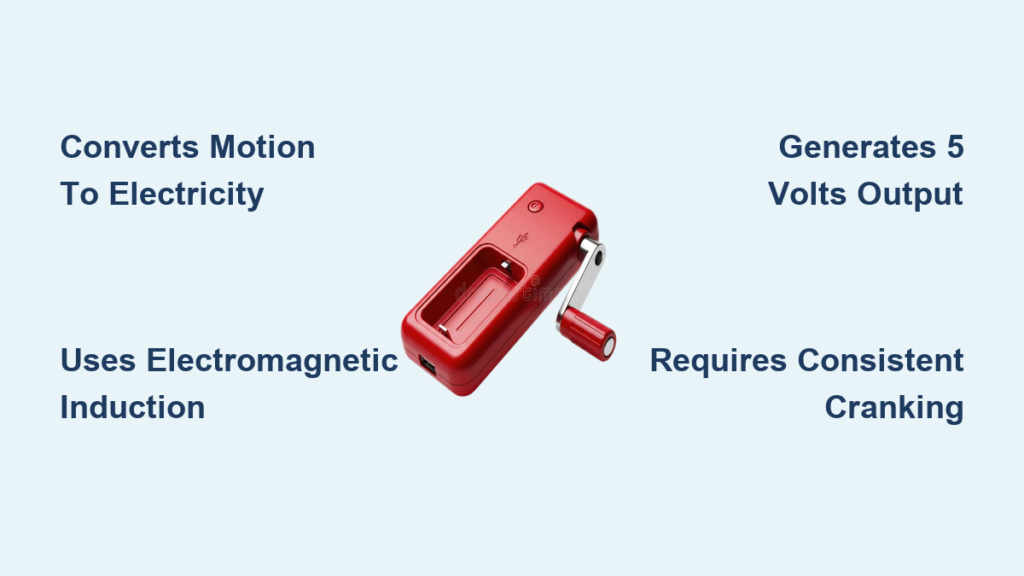
Imagine your phone battery is dying during a blackout, a hiking trip, or an emergency situation with no power outlets in sight. You pull out a small device, turn a crank for a minute, and your phone starts charging. That’s the power of a hand crank charger in action. A hand crank charger converts your physical effort into electricity using electromagnetic induction, turning arm strength into usable power for small electronics.
In this guide, you’ll learn exactly how hand crank chargers generate electricity, what components make them work, how much power they actually produce, and whether buying or building one makes more sense for your needs. Whether you’re preparing for emergencies or curious about the science behind human-powered energy, this article covers everything you need to know.
The Science Behind Hand Crank Power Generation
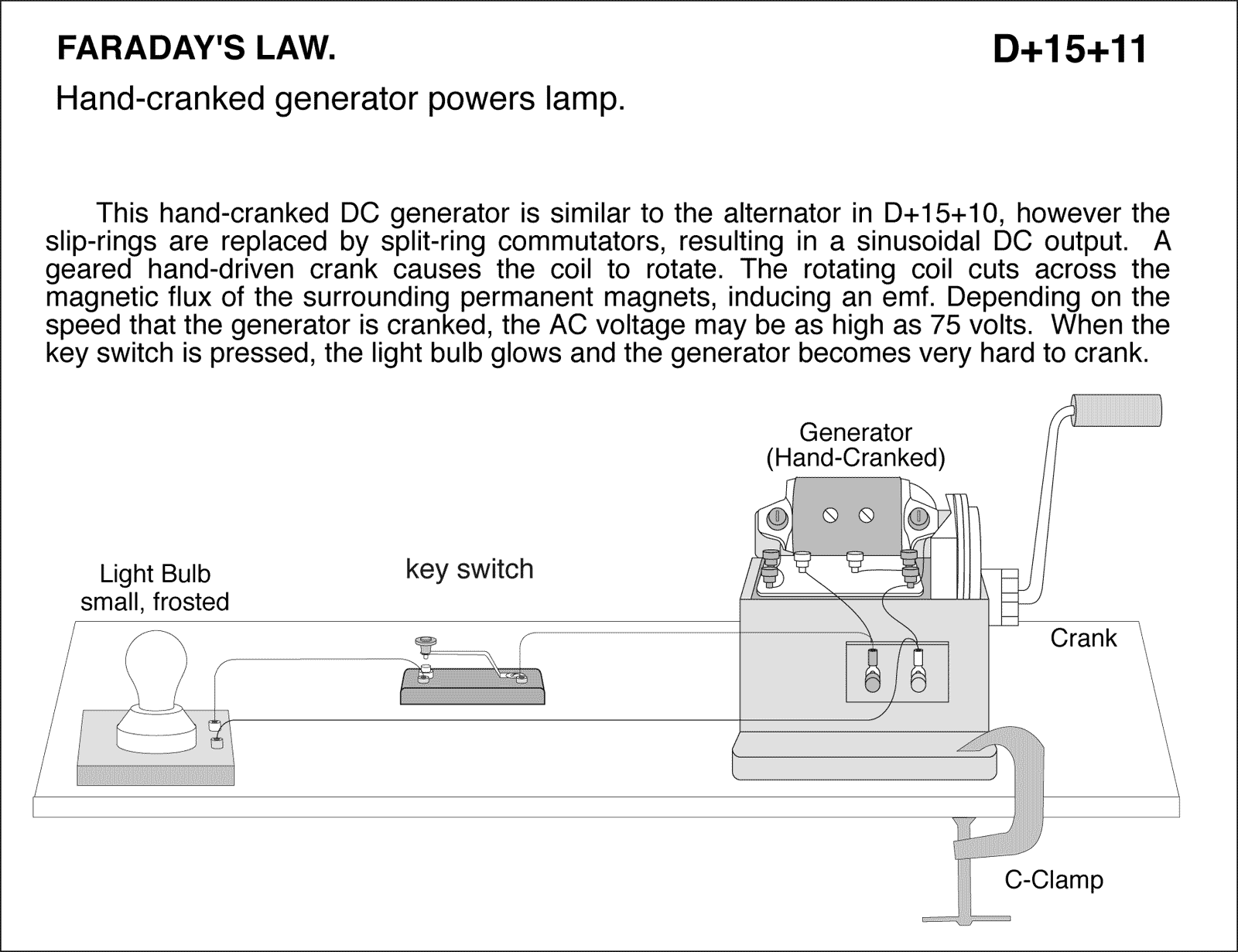
When you turn the crank on a hand crank charger, you’re applying mechanical energy to a system designed to convert motion into electricity. This process relies on Faraday’s Law of Induction, which states that a changing magnetic field around a coil of wire induces a voltage across it. Inside the charger, rotating permanent magnets pass by stationary copper coils, creating a rapidly changing magnetic field that generates an alternating current in the wire.
The raw electricity produced is alternating current, constantly reversing direction. But your phone needs direct current to charge safely. A full-bridge rectifier made of four diodes converts the AC to pulsating DC by flipping the negative parts of the wave to positive. An electrolytic capacitor then smooths out the ripples, delivering steady power. Finally, a voltage regulator ensures output stays at a stable 5 volts, matching USB standards, even if your cranking speed varies.
Pro Tip: Inconsistent cranking causes voltage drops. A good regulator keeps power delivery stable, preventing disconnects during slow turns.
Key Components Inside a Hand Crank Charger
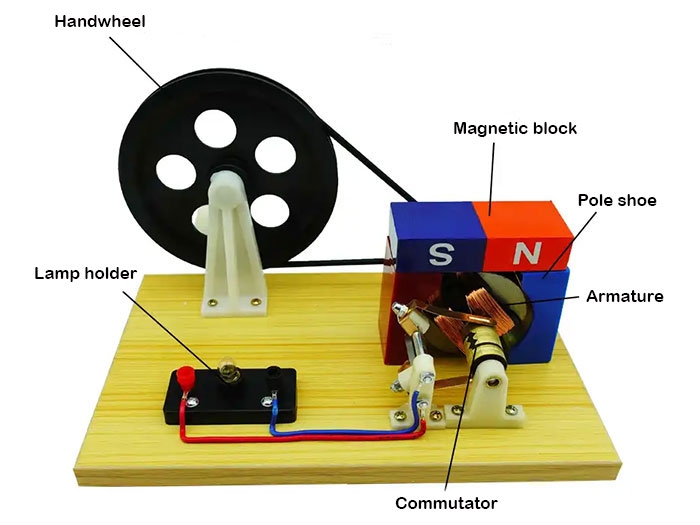
The hand crank serves as your input interface, but human arms can only spin at about 100 to 200 RPM, which isn’t enough to generate useful voltage in most motors. That’s why nearly all functional designs include a gear train. Gears amplify rotational speed, so a 1:10 gear ratio means every full turn of the crank spins the generator shaft ten times, allowing the internal motor to reach the thousands of RPM needed for efficient power generation.
Three main generator types exist in hand crank chargers. Brushed DC motors are common in cheap units but require high RPMs and suffer from brush wear. Geared DC motors include built-in gearboxes to multiply input speed and generate usable voltage even at slow cranking. Axial flux alternators use flat disc-shaped designs with neodymium magnets that generate significant power at low RPMs due to optimized flux paths.
In advanced DIY builds, the rotor is typically made from 3D-printed PLA and equipped with eight neodymium magnets arranged in alternating north-south polarity. The stator is a fixed platform holding copper coils positioned within 1 to 2 mm of the rotating magnets to capture maximum flux. Coil winding uses 0.8 mm enamel-coated copper wire with about 350 turns per coil, totaling approximately 2,800 turns, with two coils wired in series to increase voltage and four pairs in parallel to increase current capacity and reduce heat.
Expert Note: Axial flux designs outperform traditional motors because they maximize magnetic field changes per rotation, making them ideal for hand-powered systems.
Realistic Power Output and Charging Capabilities

Don’t believe the 10W output claims on some product boxes. Real-world performance is far more modest. Most hand crank chargers deliver around 5 watts of actual sustained output, which is 1 amp at 5 volts, comparable to a basic wall charger but only if you keep cranking steadily. Efficiency ranges from 20% to 60% depending on the design quality.
Here’s what you can realistically expect from hand cranking:
| Device | Charging Feasibility | Cranking Time for Use |
|---|---|---|
| Wireless Earbuds | High | 2 to 5 minutes for full charge |
| LED Flashlight | Very High | 30 seconds to power on |
| 4G Feature Phone | Good | 5 to 10 minutes for emergency calls |
| Smartphone | Limited | 10 to 15 minutes for 1 to 2% battery |
| Power Bank | Possible | 30+ minutes for partial charge |
| Tablet | Not Feasible | Requires hours, impractical |
Reality Check: You won’t fully charge a modern smartphone with hand cranking alone, but a few minutes can give you enough power for GPS, SOS messages, or a short emergency call.
When Hand Crank Chargers Make Sense
Hand crank chargers aren’t daily drivers. They’re lifelines when everything else fails. Ideal scenarios include power outages in rural areas, backcountry hiking or camping where solar isn’t reliable, disaster kits for earthquakes or hurricanes, off-grid living situations, and educational demonstrations in physics classes.
Many store-bought hand crank devices underperform because they use low-efficiency brushed motors, lack proper voltage regulation, have flimsy gears that strip under stress, and prioritize compact size over usable output. Users report dim lights, failed charging attempts, and frustration after just minutes of cranking with cheap models.
“It’s not about convenience. It’s about having some power when you have none.”
Building Your Own vs. Buying
Consider buying a commercial unit if you want a plug-and-play emergency tool, value weather resistance and durability, and need to charge low-power devices like radios or earbuds. Look for models with geared motors, USB output with voltage regulation, and reinforced casing. Avoid gimmicks claiming to charge tablets in minutes.
Build your own if you have access to 3D printing and basic tools, want custom performance and higher output, are learning about energy conversion, or need a teachable, repairable system. DIY builds using axial flux alternators can achieve around 5 watts output, matching a standard USB charger with smooth, sustainable cranking. Open-source projects on platforms like Hackster.io and YouTube offer complete build guides with printable parts, magnet specifications, and circuit diagrams.
Limitations and Practical Challenges
Manual effort is real. You can’t generate power without putting in work. Cranking for more than a few minutes becomes tiring, especially with poor ergonomics or high resistance. Fatigue limits usable output, and inconsistent speed creates unstable voltage without proper regulation. Poorly designed handles cause hand strain.
Mechanical wear over time is also a concern. Brushed motors wear out due to friction, plastic gears may crack or strip, and shafts loosen without maintenance. For long-term reliability, use metal gears where possible, apply light lubrication to moving parts, and store in dry conditions to prevent corrosion.
Every design choice involves trade-offs. Higher gear ratios boost voltage but increase resistance. More magnets and coils improve output but add weight. Larger capacitors store more energy but increase size. The best designs prioritize user comfort and consistent output over peak numbers.
The Future of Human-Powered Charging
The rise of 3D printing, affordable neodymium magnets, and modular electronics has revived interest in human-powered energy. Projects on YouTube and Hackster.io now offer full build guides for high-efficiency axial flux chargers, including printable rotor and stator housings, magnet layout templates, coil winding calculators, and circuit diagrams for rectifiers and regulators. This democratization means anyone can build, test, and improve their own generator.
Hand crank chargers won’t go mainstream for everyday use, but in niche applications they remain unbeatable. They’re valuable for humanitarian aid kits in off-grid regions, school science projects teaching energy conversion, and military or rescue gear where reliability trumps convenience.
Key Takeaways for Understanding Hand Crank Chargers
A hand crank charger works by turning your arm strength into electricity through electromagnetic induction. While most commercial versions are underpowered, well-designed systems, especially custom axial flux alternators, can deliver up to 5 watts, enough to charge critical devices in emergencies. Output depends on design quality, not just cranking speed. Geared motors and axial flux alternators outperform basic brushed units, and you can build one yourself with 3D printing and simple electronics. It won’t replace wall charging, but it could save your life when no other power exists.
In a world powered by batteries, a hand crank charger proves that human energy still has a place. When the lights go out and every volt counts, your muscles become the most reliable power source you have.
Frequently Asked Questions About Hand Crank Chargers
How long do you need to crank to charge a phone?
For a smartphone, you’d need to crank continuously for 10 to 15 minutes to add just 1 to 2% battery. Fully charging a phone would require several hours of cranking, making it impractical for daily use but useful for emergencies.
Can a hand crank charger power a laptop?
No. Laptops require 30 to 100 watts or more, far beyond what hand crank chargers can produce. Even the most efficient hand crank designs max out around 5 to 10 watts, making them suitable only for small devices like phones, earbuds, and flashlights.
Do hand crank chargers work in cold weather?
Yes, but efficiency may decrease slightly. Cold temperatures can affect battery performance in devices being charged and potentially stiffen lubricants in the gear mechanism. However, the basic electromagnetic principle works regardless of temperature.
What is the most efficient type of hand crank generator?
Axial flux alternators are the most efficient for hand-powered applications. They generate significant current at low RPMs due to optimized magnetic flux paths, making them ideal for hand cranking where input speed is limited to 100 to 200 RPM.
Can I build a hand crank charger without special equipment?
Yes. With access to a 3D printer, basic electronics tools, and neodymium magnets, you can build an axial flux hand crank charger using open-source designs. The core components are printable, and the electronics require only standard soldering skills.
Are hand crank chargers worth the investment?
For emergency preparedness, yes. They provide peace of mind for power outages, outdoor adventures, and disaster scenarios where grid power is unavailable. For everyday charging, no. The effort required makes them impractical as a primary charging method.