Imagine your emergency sump pump failing during a storm because the backup battery died, not from use, but from sitting idle too long. This is exactly what a battery float charger prevents. A float charger keeps batteries fully charged and ready by delivering just enough voltage to counteract natural self-discharge, without overcharging. Unlike standard chargers that stop or continue pumping current unchecked, a float charger switches to a safe, low-maintenance mode once the battery reaches full capacity. This makes it ideal for systems that must stay operational 24/7, like UPS units, solar storage, and emergency lighting.
In this guide, you will learn how float charging works across different battery types, why it matters technically, and how to use it safely and effectively.
The Three-Stage Charging Process

Smart chargers do not simply top off a battery and stop. They follow a precise multi-stage cycle to maximize lifespan and performance, with float charging serving as the final critical stage.
Bulk Charge: Fast Replenishment
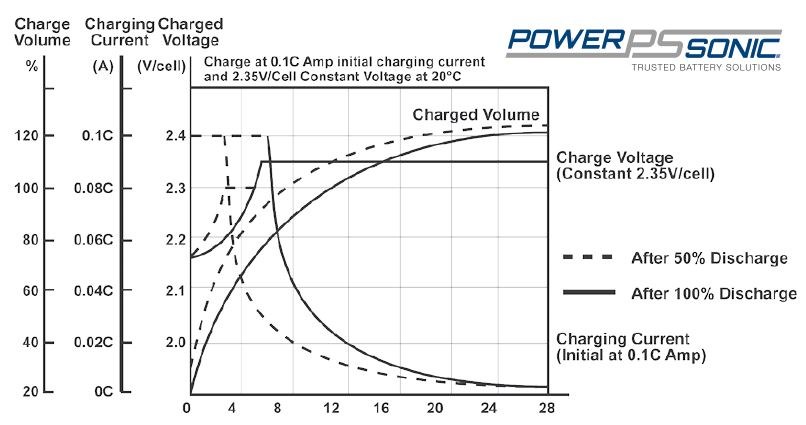
In the bulk phase, the charger delivers maximum current while voltage steadily rises. This is the fastest part of charging, typically restoring 70 to 80 percent of capacity in a short time. For example, a 10-amp charger on a 100Ah battery will push 10 amps until voltage nears the absorption threshold around 14.4 volts for AGM. During this stage, most of the energy lost during discharge is recovered quickly.
Absorption Phase: Topping Off
Once voltage hits the set point, the charger enters absorption mode, holding voltage constant while current tapers down. This ensures the battery reaches 100 percent state of charge without overheating or gassing. The duration depends on battery size and depth of discharge, typically lasting 1 to 3 hours. Charging ends when current drops below a threshold, such as 0.5 amps for small systems or C/100 for larger ones.
Float Mode: Long-Term Maintenance
After absorption, the charger switches to float mode, reducing voltage to a safe maintenance level around 13.5 volts for AGM. At this point, only a tiny trickle of current flows, just enough to offset self-discharge and small parasitic loads. This allows the battery to remain connected indefinitely, always ready for action.
Float is not idle. It is active readiness that prevents sulfation in lead-acid batteries and supports cell balancing in lithium systems.
Lead-Acid Float Charging Explained
Lead-acid batteries are the most common beneficiaries of float charging due to their relatively high self-discharge rate of 3 to 5 percent per month. Without maintenance charging, they degrade quickly when stored or used in standby applications.
Float Voltage Requirements by Battery Type
Each lead-acid variant requires a specific float voltage to avoid damage. Using the correct voltage prevents water loss, grid corrosion, and sulfation.
| Battery Type | Float Voltage (12V) | Volts per Cell |
|---|---|---|
| AGM | 13.20 – 13.80 V | 2.25 – 2.30 V/cell |
| Gel | 13.35 – 13.80 V | 2.23 – 2.30 V/cell |
| Flooded | 13.40 – 13.70 V | 2.23 – 2.28 V/cell |
AGM batteries tolerate slightly higher voltages than gel types, which are more sensitive to overcharging. Flooded batteries sit in the middle but require periodic water checks and ventilation due to gassing.
Temperature Compensation: Why It Matters
Float voltage must change with temperature. For every degree Celsius above or below 25 degrees Celsius, adjust voltage by 3 to 5 millivolts per cell. For a 12-volt battery with 6 cells, that is 18 to 30 millivolts per degree Celsius.
At 35 degrees Celsius, reduce float voltage by approximately 180 millivolts. At 15 degrees Celsius, increase by approximately 180 millivolts. Without compensation, high temperatures cause overcharging with water loss and heat buildup, while low temperatures lead to undercharging with sulfation and stratification.
Use a charger with built-in temperature sensor for automatic adjustment, especially in garages or outdoor enclosures.
Dangers of Incorrect Float Settings
Overvoltage causes water electrolysis, producing hydrogen and oxygen gas. This leads to increased internal pressure, venting in sealed types, and grid corrosion causing permanent capacity loss. Undervoltage leads to sulfation, where hard sulfate crystals form on plates, reducing capacity and shortening cycle life. The battery may then struggle to accept a charge even with correct settings later.
Equalization for Flooded Batteries
Some smart chargers include an equalization mode, a periodic controlled over-voltage of 15.6 to 16.0 volts for 12-volt flooded batteries. This stirs the electrolyte and breaks down sulfate crystals. Only use this on flooded lead-acid batteries with duration of 1 to 8 hours following manufacturer guidelines. Equalization requires ventilation since gases are explosive, and monitor specific gravity to confirm effectiveness.
Never equalize AGM or gel batteries, as this can cause irreversible damage.
Lithium Batteries and Float Charging
Lithium-based batteries, especially LiFePO4, behave very differently from lead-acid. Their ultra-low self-discharge of less than 1 to 3 percent per month means they do not need float charging in the traditional sense.
Do Lithium Batteries Need Float Charging
Once fully charged via CC/CV method, a lithium battery can be safely disconnected. However, many systems maintain a low-voltage hold around 13.3 to 13.6 volts for 12-volt LiFePO4 to support system stability or BMS functions. Leaving a smart charger on float will not hurt lithium. It just holds voltage, but true float is not needed.
What looks like float charging in lithium systems is often active cell balancing, not maintenance charging.
Balancing vs. Float: What Is Really Happening
In a multi-cell lithium pack, individual cells rarely charge at the exact same rate. Even at 100 percent state of charge, some cells may lag. The BMS addresses this by bypassing current around fully charged cells, continuing to charge lower cells using resistive or active balancing, and dissipating excess energy as heat.
This process can draw significant power temporarily, up to hundreds of watts, until all cells are equalized. A 48-volt system showing 21 amps input at 54 volts equals 1.1 kilowatts of draw after full charge. This drops to near zero once balancing completes.
This mimics float behavior but serves a different purpose: cell-level precision rather than long-term charge maintenance.
Voltage Settings for LiFePO4
| Mode | Voltage (12V System) |
|---|---|
| Absorption | 14.2 – 14.6 V |
| Float / Hold | 13.3 – 13.6 V (or disabled) |
Some hybrid inverters keep float active to supply small DC loads without waking up the main inverter. Others disable charging entirely after full charge.
How a Float Charger Operates Technically
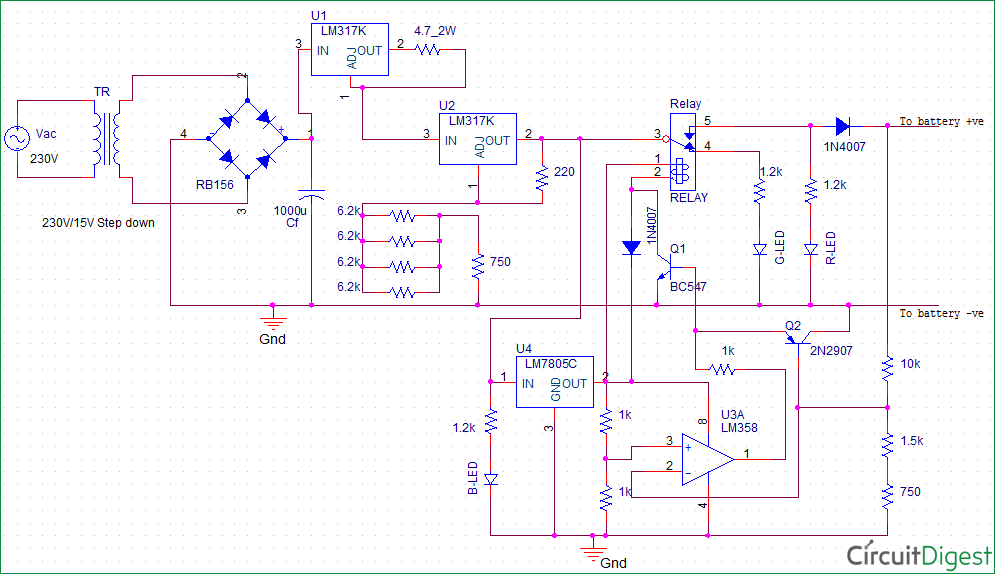
A float charger is not just a power supply. It is a smart regulator designed to protect and maintain batteries over months or years.
Voltage Regulation and Control
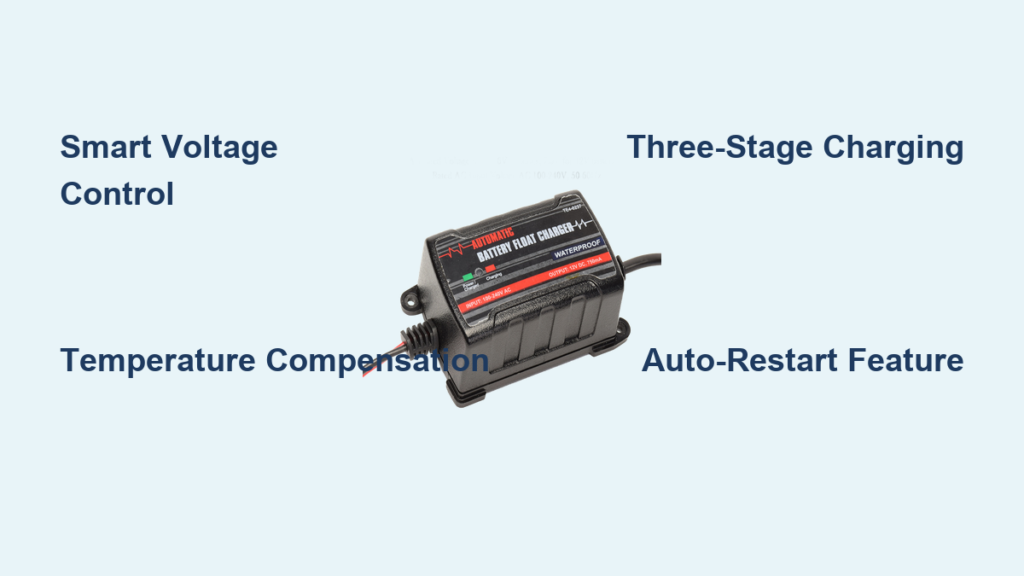
The core function is precise voltage control. Using microprocessor-based circuitry, the charger monitors battery voltage in real time, adjusts output to maintain exact float voltage, and prevents overshoot that could damage the battery. Modern units use switch-mode power supplies for high efficiency and compact design.
Temperature Compensation Built-In
Many chargers include a temperature sensor that automatically adjusts float voltage based on ambient conditions. This is essential for lead-acid and beneficial for lithium in extreme climates. Without it, a battery in a hot garage may degrade twice as fast due to overvoltage stress.
Current Limiting and Auto-Restart
Float chargers limit current to match self-discharge rates, typically 1 to 5 percent of Ah capacity. For a 100Ah battery, that is 1 to 5 amps. They also feature auto-restart. If a load causes voltage to drop, such as starting a pump, the charger detects this and re-enters bulk or absorption mode, then returns to float after recharge.
Watch for the charge indicator to flicker when a load runs. This shows the system responding dynamically.
Key Applications of Float Charging

Float charging shines in systems where failure is not an option.
Uninterruptible Power Supplies
Data centers and home offices rely on UPS units to bridge power gaps. Float charging keeps the internal battery ready so it can take over instantly during an outage. A UPS battery left uncharged for 6 months can lose up to 30 percent capacity due to self-discharge.
Emergency and Backup Systems
Fire alarms, emergency lighting, and medical devices use float charging to ensure instant activation. These systems often run on AGM or gel batteries in wall-mounted cabinets connected to smart chargers.
Solar and Off-Grid Energy Storage
In solar setups, float mode engages when generation exceeds demand. While modern systems often use adaptive charge control instead of fixed float, many still employ float-like voltage to maintain full state of charge. In off-grid cabins, float prevents sulfation during winter months when loads are minimal.
Marine and RV Use
Boats and RVs sit unused for weeks. Float chargers prevent battery degradation during storage while keeping onboard systems powered. Use a dual-bank charger to maintain both engine and house batteries independently.
Telecom and Industrial Control
Remote cell towers and industrial sensors depend on reliable backup power. Float charging ensures batteries remain at peak readiness across wide temperature ranges.
Power Use and Efficiency in Float Mode
Float charging consumes very little power under normal conditions.
Lead-Acid: Minimal Draw
A typical 12-volt 100Ah AGM battery draws 0.1 to 1 amp in float mode, just enough to offset self-discharge. That is 1 to 12 watts, costing pennies per month.
Lithium: Apparent Draw Explained
In lithium systems, post-charge power draw can be high, but it is not inefficiency. It is cell balancing. Initial draw reaches up to 1 to 2 kilowatts in large systems. It gradually declines as cells equalize, dropping to near zero once balanced. Final state involves near-zero consumption unless loads are present.
High post-charge draw does not mean waste. It is internal battery management doing its job.
Best Practices for Safe Float Charging
Follow these guidelines to extend battery life and avoid hazards.
Use Smart Chargers Only
Avoid dumb or trickle chargers that deliver unregulated current. These can overcharge batteries, cause gassing, and create fire risks. Choose microprocessor-controlled chargers with three-stage charging, reverse polarity protection, and thermal shutdown.
Recommended models include the Deltran Battery Tender for motorcycles and small AGM, the Duracell 7.5A Smart Charger for deep-cycle batteries, and Victron Energy chargers with temperature compensation.
Match Charger to Battery Chemistry
Never use a lead-acid charger on lithium batteries without BMS compatibility. Voltage mismatches can cause fires. Use the correct charger for AGM, Gel, Flooded, or LiFePO4 batteries, ensuring proper voltage profiles.
Enable Temperature Compensation
For lead-acid, this is non-negotiable. For lithium, it is helpful in extreme environments. Use a remote temperature sensor mounted on the battery terminal for accuracy.
Size the Charger Correctly
Follow the 5 to 10 percent rule for lead-acid. A 100Ah battery needs a 5 to 10-amp charger. A 200Ah battery needs a 10 to 20-amp charger. Lithium can use smaller chargers due to higher efficiency and lower self-discharge.
Monitor System Performance
Use a battery monitor to track voltage trends, float current, and time spent in each charge stage. Sudden changes may indicate aging batteries or charger faults.
Ensure Proper Ventilation
This is critical for flooded lead-acid during equalization or fault conditions. Hydrogen gas is explosive, so keep away from sparks or flames. Sealed types are safer but can still vent under extreme overcharge.
Avoid Indefinite Trickle Charging
Set and forget only works with smart chargers. Dumb chargers cause electrolyte loss, plate corrosion, and thermal runaway. If the battery feels warm after days on charge, disconnect immediately.
Frequently Asked Questions About Battery Float Chargers
What is the purpose of a float charger?
A float charger maintains a fully charged battery at a safe, low voltage to prevent self-discharge without overcharging. It supplies just enough current to counteract natural battery loss while keeping the battery ready for immediate use in emergency or standby applications.
Can I leave a float charger on all the time?
Yes, you can leave a smart float charger connected indefinitely, provided it is a microprocessor-controlled multi-stage charger. Dumb trickle chargers should not be left on long-term as they can cause overcharging, heat buildup, and potential damage.
Do lithium batteries need float charging?
Lithium batteries do not need traditional float charging due to their extremely low self-discharge rate. However, many systems use a maintenance hold voltage to support BMS functions and cell balancing. The apparent float in lithium systems is often active balancing, not continuous maintenance charging.
What voltage should a float charger be set to?
Float voltage varies by battery chemistry. For 12-volt systems, AGM floats at 13.2 to 13.8 volts, Gel at 13.35 to 13.8 volts, Flooded at 13.4 to 13.7 volts, and LiFePO4 at 13.3 to 13.6 volts or disabled. Always check manufacturer specifications.
How does temperature affect float charging?
Float voltage must decrease in high temperatures and increase in low temperatures. For every degree Celsius above or below 25 degrees Celsius, adjust by approximately 3 to 5 millivolts per cell. Without temperature compensation, batteries can suffer from overcharging damage or sulfation.
What is the difference between float charging and trickle charging?
Float chargers use smart voltage regulation to maintain a precise maintenance voltage. Trickle chargers deliver constant unregulated current regardless of battery state. Trickle chargers risk overcharging and should not be used for long-term maintenance.
Key Takeaways for Understanding Battery Float Chargers
Float charging maintains full charge at a safe, low voltage to prevent self-discharge without overcharging. It serves as the third stage in smart charging: bulk, absorption, then float. Lead-acid batteries benefit greatly from float charging when using correct voltage settings and temperature compensation. Lithium batteries do not need float charging, but many systems use a maintenance hold for BMS balancing. The apparent float in lithium is often active cell balancing, not continuous charging. Trickle chargers are dangerous, and only smart multi-stage chargers should be used for float mode. Proper float charging extends battery life and ensures reliability in UPS, solar, emergency, and industrial systems.