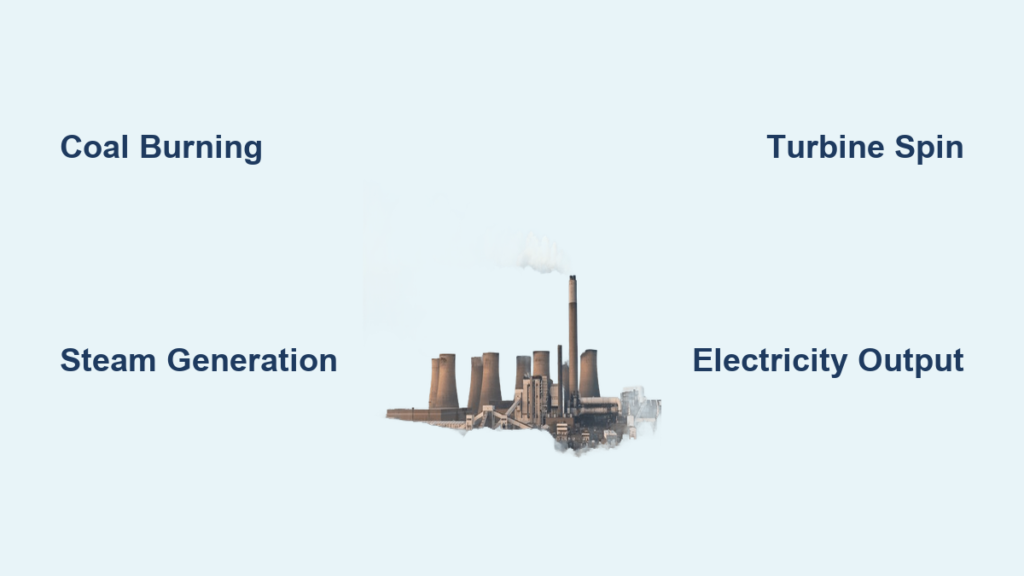
Every time you flip a light switch or charge your phone, there is a chance that coal is helping generate the electricity powering your life. Though renewable energy is rising, coal power stations still produce about one-third of the worlds electricity, making them a cornerstone of global energy systems. But how exactly does burning a black rock turn into the electricity that powers homes and industries? The answer lies in a carefully engineered sequence: coal is burned to create heat, which boils water into steam, spinning a turbine connected to a generator that produces electricity. This process, rooted in the Rankine cycle, transforms coals stored chemical energy into usable electrical power through a series of precise, interdependent stages. In this guide, you will learn how coal gets from mine to megawatt, how steam drives turbines, and why these plants remain both vital and controversial in todays energy landscape.
Coal Delivery and On-Site Handling
Getting coal to the plant is the first step in power generation. Most coal arrives by rail, ship, barge, or conveyor, depending on the plants location and fuel source.
Rail and Maritime Transport
Large power stations often rely on unit trains dedicated coal trains up to 2 kilometers long, carrying 130 to 140 railcars with over 10,000 tonnes of coal. At full capacity, a 500 MWe plant may need one train per day, with three to five deliveries during peak demand. Unloading takes 1 to 3 hours, using either rotary dumpers which invert each car over a hopper or air-dump systems where bottom doors open over a trestle.
For coastal or riverside plants, colliers coal ships deliver up to 41,000 tonnes per voyage, taking several days to unload using onboard or shore-based conveyors. Barges, towed by tugboats, serve inland waterways and are common in regions like the U.S. Midwest.
On-Site Fuel Storage and Transfer
Once delivered, coal is stored in open storage yards or covered silos to prevent moisture absorption and spontaneous combustion. Plants near mines especially those burning lignite brown coal often receive fuel via conveyor belts or massive diesel-electric trucks, reducing transport costs and ensuring continuous supply.
Auxiliary Fuel Systems
For startup or flame stabilization, many coal plants use fuel oil, stored in vertical steel tanks up to 14,000 cubic meters. Heavier fuels like number 6 bunker oil are steam-heated before pumping in cold weather to maintain flow.
Coal Preparation for Combustion
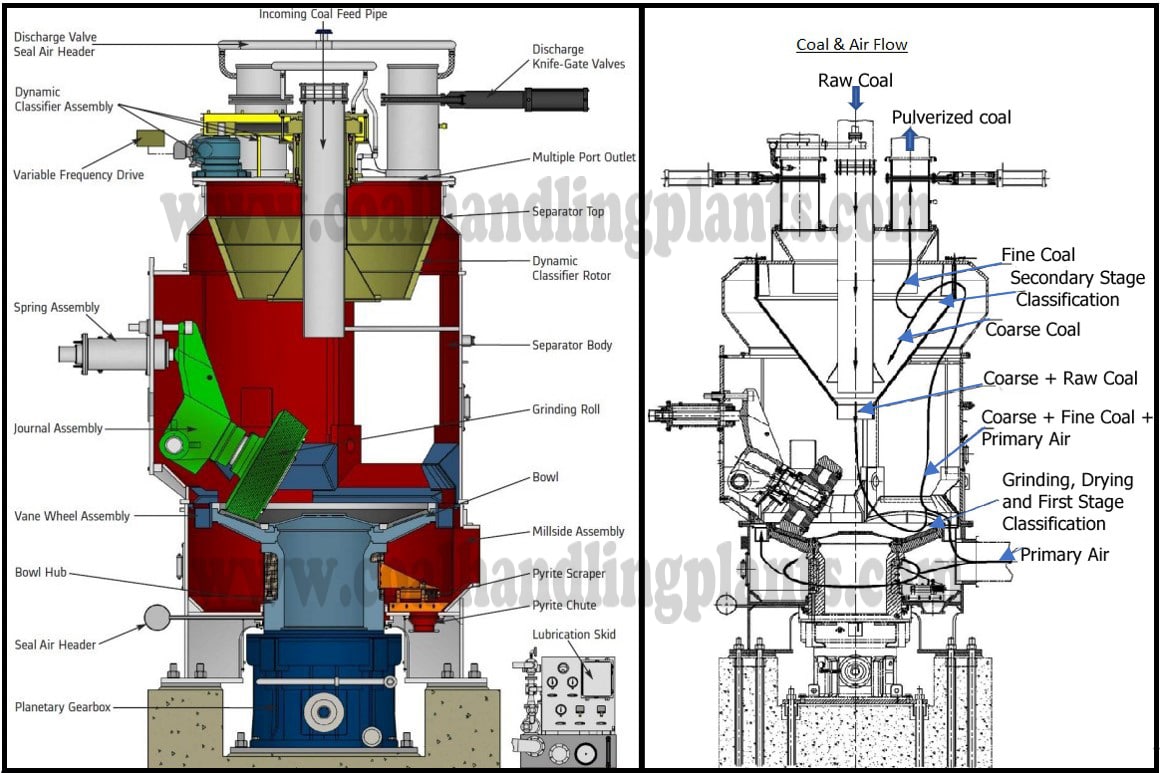
Raw coal must be processed before burning to improve efficiency and reduce emissions.
Crushing and Conveying
Coal arrives in large chunks, typically up to 30 centimeters, and is first crushed to less than 5 centimeters using jaw or roll crushers. It is then conveyed at rates up to 4,000 tonnes per hour from storage to the boiler building.
Pulverization: Turning Coal to Powder
In pulverized coal-fired plants the most common type coal is fed into coal mills pulverizers that grind it into a fine powder under 100 microns, similar to talcum. This increases surface area for more complete combustion.
A typical 500 MWe plant uses six pulverizers, with five operating at full load, each processing approximately 250 tonnes per hour. The powdered coal is mixed with primary air, which dries the coal and transports it to the boiler burners.
Alternative Combustion Methods
Not all plants use pulverized coal. Stoker-fired boilers feed 5 centimeter coal pieces onto a traveling grate, where they burn in a bed. Cyclone furnaces spin coal at high speed for intense, efficient combustion of low-grade coal or high-ash fuels.
Boiler Combustion and Steam Generation
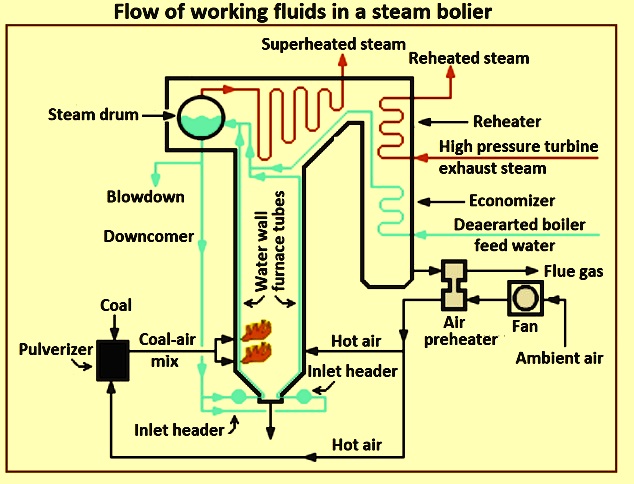
The boiler is where energy conversion begins, transforming chemical energy to thermal energy.
Ignition and Heat Release
Pulverized coal is blown into the furnace with preheated secondary air and ignited. Combustion temperatures exceed 1,300 degrees Celsius, releasing intense heat. The furnace walls are lined with water-filled tubes that absorb this heat, protecting the structure and generating steam.
Water Circulation and Steam Formation
The Rankine cycle relies on a closed-loop water system. Makeup water enters the plant and is filtered to remove solids. It passes through a deaerator, where steam strips out oxygen and carbon dioxide to prevent corrosion. A multi-stage feedwater pump pressurizes the water to over 200 bar, or 3,000 psi. The high-pressure water flows into the economizer, where it is preheated using waste heat from flue gases.
From the economizer, water enters the boiler drum, where it circulates through riser tubes in the furnace walls. Heat turns it into saturated steam, which separates in the drum.
Superheating for Maximum Efficiency
The saturated steam is sent to the superheater, where it absorbs more heat, reaching temperatures over 540 degrees Celsius and pressures above 150 bar. This dry, high-energy steam is essential for efficient turbine operation.
Lignite and Low-Rank Coal Challenges
Plants burning lignite, which contains up to 70 percent moisture, require special handling. Fan-type mills mix coal with hot recirculated flue gas to dry it before pulverizing. Larger furnaces and higher airflow compensate for low energy density.
Steam Turbine and Power Generation
Now that steam is ready, it is time to convert thermal energy into mechanical and then electrical energy.
Turbine Operation: High-Pressure to Low-Pressure Stages
The high-pressure steam enters the turbine, expanding through three main sections. The high-pressure turbine spins the first set of blades at full pressure. The reheater returns steam to the boiler for reheating, then it enters the intermediate-pressure and low-pressure turbines, where steam expands further, driving more blades. The entire turbine shaft spins at 3,000 or 3,600 rpm, depending on grid frequency.
Generator: Electromagnetic Induction in Action
The turbine shaft is directly coupled to a generator. Inside, the rotor an electromagnet spins inside the stator, which contains copper windings. This motion induces an alternating current via electromagnetic induction. Output voltage is typically 15,000 to 20,000 volts.
Step-Up Transformers and Grid Connection
Before transmission, electricity passes through a generator step-up transformer, boosting voltage to 275,000 volts or higher. This reduces current and minimizes line losses during long-distance transmission.
Condensation and Water Recovery
To maintain efficiency, steam must be recycled. This happens in the condenser.
Condenser Function
After exiting the low-pressure turbine, low-pressure steam enters the condenser, a large heat exchanger cooled by either once-through cooling using river, lake, or ocean water, or closed-cycle cooling using cooling towers. The steam condenses into liquid water, creating a partial vacuum that improves turbine efficiency.
Cooling Systems Compared
The type of cooling system affects water use and environmental impact. Once-through cooling has high water withdrawal but causes thermal pollution and fish entrainment. Wet recirculating cooling towers have lower withdrawal but lose significant water to evaporation. Dry cooling uses minimal water but operates less efficiently in hot weather.
Feedwater Return
The condensate is pumped back through low-pressure heaters, deaerator, and high-pressure heaters before re-entering the boiler, completing the Rankine cycle.
Emissions Control and Pollution Management
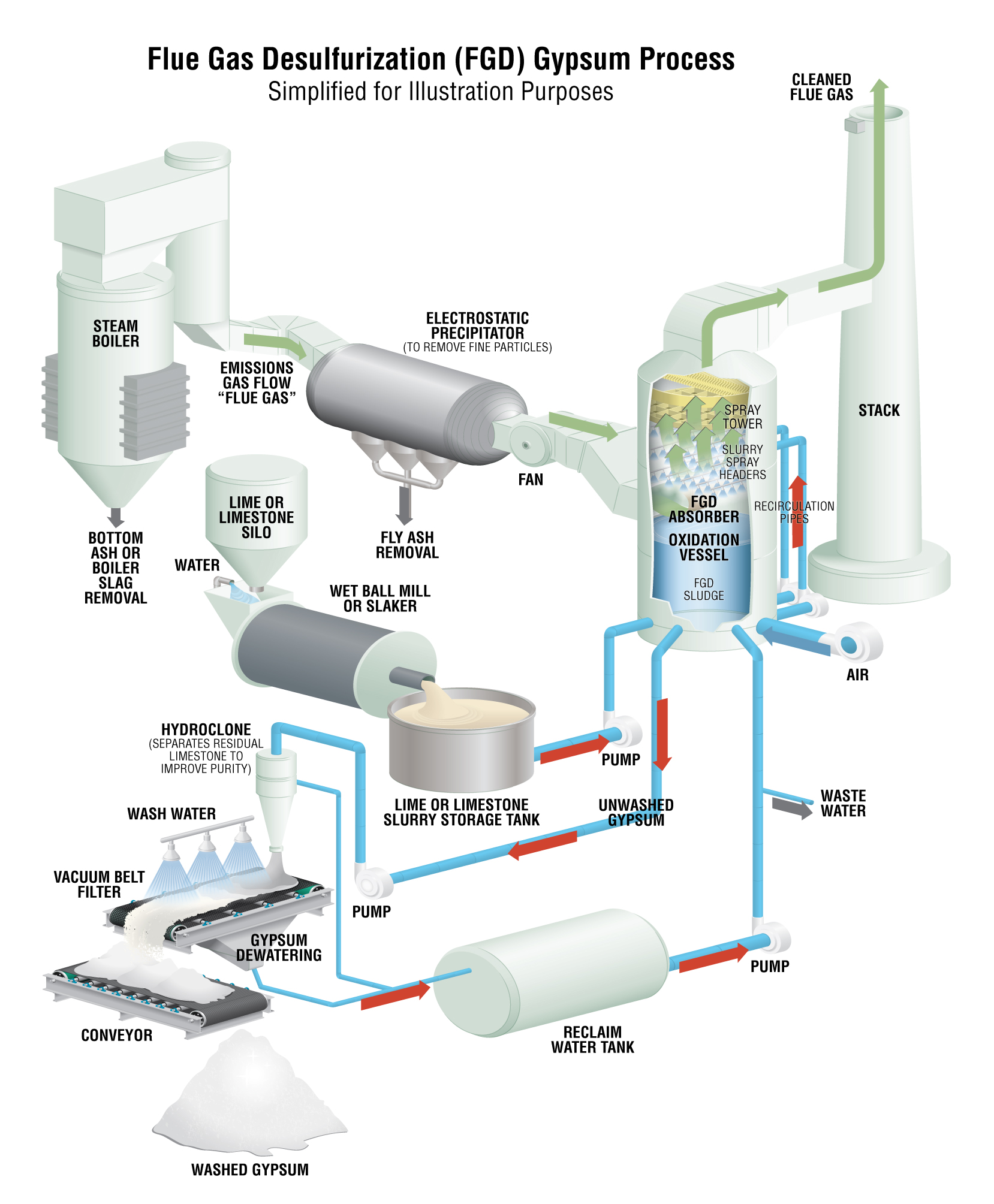
Burning coal produces harmful byproducts. Modern plants use advanced systems to reduce their impact.
Flue Gas Treatment Systems
As exhaust gases rise, they pass through multiple cleaning stages. Electrostatic precipitators or baghouses remove 99.99 percent of fly ash, the fine particulate matter. Electrostatic precipitators use high-voltage electrodes to charge particles, which are then collected on plates. Baghouses use fabric filters and are more effective for fine PM2.5.
Flue gas desulfurization, also called scrubbers, removes sulfur dioxide using a limestone slurry. The reaction produces gypsum, which can be sold for wallboard production. Selective catalytic reduction reduces nitrogen oxides by injecting ammonia over a catalyst, converting nitrogen oxides to nitrogen and water.
Mercury and Trace Metal Control
Activated carbon injection captures mercury, which can otherwise convert to toxic methylmercury in water bodies. Bottom ash and fly ash are tested for arsenic, lead, selenium, cadmium, and chromium.
Ash Handling and Disposal
Two types of ash are produced. Fly ash is collected by electrostatic precipitators or baghouses and stored in silos. Approximately 70 million tonnes per year are reused in concrete, grout, and road construction. Bottom ash falls to the furnace floor, is quenched with water, crushed, and sent to ash ponds or lined landfills. Unlined ash ponds risk groundwater contamination, which is a major environmental concern.
Plant Efficiency and Technology Types
Not all coal plants are equal. Efficiency depends on design and operating conditions.
Efficiency by Plant Type
Subcritical plants operate below 22.1 megapascals and 570 degrees Celsius, achieving 33 to 37 percent efficiency. Supercritical plants exceed these thresholds, reaching 38 to 42 percent efficiency. Ultra-supercritical plants operate above 30 megapascals and 600 degrees Celsius, achieving 43 to 48 percent efficiency. Integrated gasification combined cycle plants gasify coal and use a combined cycle, reaching 40 to 45 percent efficiency but at higher cost.
High Efficiency, Low Emissions Plants
High efficiency, low emissions plants, like Tarong North in Queensland, use supercritical boilers to burn less coal per megawatt-hour, cutting carbon dioxide, sulfur dioxide, and nitrogen oxides. Australia has four high efficiency, low emissions plants, but no ultra-supercritical units yet.
Integrated Gasification Combined Cycle
Coal is gasified under high pressure into syngas, which contains carbon monoxide and hydrogen. Syngas is cleaned to remove sulfur and mercury before combustion. It drives a gas turbine, then waste heat powers a steam turbine in a combined cycle. This approach offers higher efficiency but costs 20 to 30 percent more than conventional plants.
Environmental and Health Impacts
Coal power comes with significant costs beyond fuel.
Air Pollution and Public Health
PM2.5, sulfur dioxide, and nitrogen oxides cause asthma, heart disease, stroke, and cancer. In the United States, coal PM2.5 caused at least 460,000 premature deaths from 1999 to 2020. Globally, coal pollution causes approximately 200 early deaths per gigawatt-year, rising in densely populated areas.
Climate Impact
Coal power emits approximately 12 billion tonnes of carbon dioxide annually, about 20 percent of global greenhouse gases. Without rapid phase-out, coal use is incompatible with 1.5 degrees Celsius climate targets.
Water and Land Use
A 500 MWe plant uses approximately 2 billion gallons of water per year. Coal washing reduces ash and sulfur but consumes significant water. Ash ponds cover vast areas and risk toxic leaks.
Grid Role and Transition Trends
Despite its drawbacks, coal still plays a critical role in power systems.
Dispatchable Baseload Power
Coal plants provide steady, on-demand electricity, ideal for baseload supply. Unlike solar and wind, they can ramp up or down, though slowly, supporting grid stability.
System Inertia and Frequency Control
Coal generators are synchronous machines that provide rotational inertia, helping maintain grid frequency during sudden load changes. Inverter-based sources like solar and wind lack this inertia, increasing reliance on coal or gas for system strength.
Repurposing for the Future
In Queensland, Australia, retiring coal plants are being converted into clean energy hubs. Synchronous condensers provide inertia without burning fuel. Sites host batteries, green hydrogen, and gas peakers. Existing transmission lines and substations are reused.
Future of Coal Power
The era of coal is changing, but not ending overnight.
Phase-Out Pledges
OECD countries are urged to phase out coal by 2030, with the rest of the world by 2040, according to the United Nations. China will cap coal use until 2025, then decline. Vietnam will end unabated coal by the 2040s. Japan is testing 20 percent ammonia co-firing to cut carbon dioxide emissions.
Carbon Capture and Storage
Carbon capture and storage is technically feasible but expensive and energy-intensive. It can require up to 30 percent of plant output for capture. Few commercial deployments exist, and high cost and storage risks limit adoption.
Economics and Stranded Assets
In 2020, 39 percent of coal plants were more expensive than renewables plus storage. By 2025, 73 percent will be uncompetitive, according to Carbon Tracker. Over 500 billion dollars in coal assets could be stranded by 2050, mostly in China.
Frequently Asked Questions About How a Coal Power Station Works
How does a coal power station generate electricity?
A coal power station generates electricity through a multi-step process. Coal is burned in a boiler to produce high-pressure steam. This steam drives a turbine, which spins a generator. The generator uses electromagnetic induction to produce electricity, which is then stepped up in voltage and sent through transmission lines to the grid.
What is the Rankine cycle in coal power plants?
The Rankine cycle is the thermodynamic cycle that coal power plants use to convert heat into electricity. It involves four main stages: water is heated to produce steam, the steam expands through a turbine to generate mechanical work, the mechanical work drives a generator to produce electricity, and the steam is condensed back into water for reuse in the boiler.
How efficient are modern coal power plants?
Modern coal plants achieve varying efficiency levels depending on their technology. Subcritical plants reach 33 to 37 percent efficiency. Supercritical plants reach 38 to 42 percent. Ultra-supercritical plants, the most efficient, reach 43 to 48 percent efficiency. Higher efficiency means less coal is burned per unit of electricity produced, resulting in lower emissions.
What pollutants do coal power stations emit?
Coal power stations emit several harmful pollutants. Sulfur dioxide causes acid rain and respiratory problems. Nitrogen oxides contribute to smog and respiratory issues. Particulate matter, especially PM2.5, causes heart disease and lung problems. Mercury accumulates in water and food chains. Carbon dioxide is the primary greenhouse gas contributing to climate change.
How do coal plants control emissions?
Coal plants use multiple systems to control emissions. Electrostatic precipitators and baghouses remove fly ash particles. Flue gas desulfurization scrubbers remove sulfur dioxide using limestone. Selective catalytic reduction reduces nitrogen oxides using ammonia. Activated carbon injection captures mercury. These systems significantly reduce pollutants but add cost and complexity to plant operations.
Why is coal being phased out in many countries?
Coal is being phased out because it is the largest single source of carbon dioxide emissions and causes significant air pollution and health problems. Renewable energy costs have fallen dramatically, making wind and solar cheaper than coal in many markets. Climate commitments require reducing emissions, and coal plants are becoming economically uncompetitive as stranded asset risk grows.
Key Takeaways for Understanding How a Coal Power Station Works
A coal power station works by converting coals chemical energy into electricity through a carefully orchestrated process. Coal is first transported to the plant, then crushed and pulverized into a fine powder. This powder is blown into a boiler furnace, where it burns at temperatures exceeding 1,300 degrees Celsius. The heat transforms water into high-pressure steam, which spins turbines connected to generators. The generators produce electricity through electromagnetic induction, which is then stepped up in voltage and transmitted to the grid. Steam is condensed back into water and recycled through the system.
While coal power stations have provided reliable baseload electricity for over a century, they face increasing pressure from climate concerns, air pollution regulations, and economics. High efficiency, low emissions plants and emissions control technologies have improved performance, but the fundamental challenge remains: coal combustion releases large amounts of carbon dioxide and other pollutants. The transition away from coal is accelerating globally, with many countries pledging phase-outs by the 2030s or 2040s. For those interested in energy systems, understanding how a coal power station works provides essential context for why this transition is happening and what it means for the future of electricity generation.