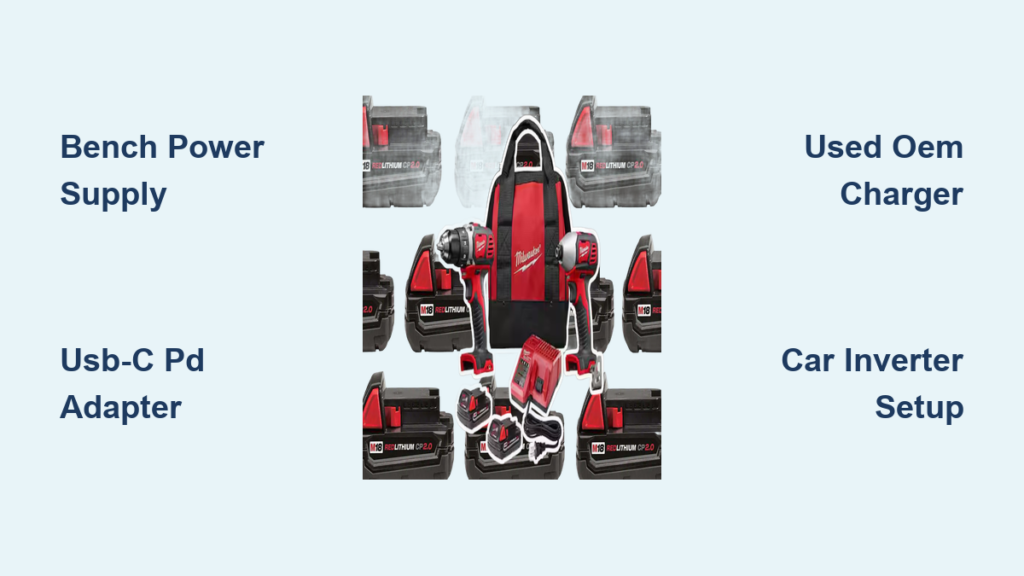
You’re on a job site, your Milwaukee M18 or M12 battery is dead, and you realize you left the charger at home. No power, no tools, no progress. But before you call it a day, there is good news: you can charge a Milwaukee battery without its original charger, though not all methods are safe or effective. While Milwaukee officially advises against any non-OEM charging, technical workarounds exist for emergency use, field repairs, or off-grid scenarios. This guide reveals the only viable methods, backed by technical specs and expert warnings.
Use a Bench Power Supply (CC/CV Mode)

The most reliable way to charge a Milwaukee battery without its charger is with a constant current/constant voltage (CC/CV) bench power supply. This method gives full control over voltage and current, mimicking professional charging circuits.
Set Correct Voltage and Current
Configure your bench supply to 21.6V max for M18 batteries or 12.6V for M12. Set the current limit to 3A for standard charging, up to 5A if you are in a hurry and monitoring temperature. Exceeding 4.2V per cell (21.6V total) risks permanent damage.
Connect to Battery Terminals Safely
Milwaukee batteries have a 4-pin layout. Pin 1 is negative, pin 3 is positive. Use alligator clips or spade connectors to attach red (positive) to pin 3 and black (negative) to pin 1. Skip pins 2 (thermistor) and 4 (data) because you are bypassing BMS communication, so monitor temperature manually.
Monitor Charging and Stop at Full
Start charging in CC mode. As voltage rises, the current will taper under CV mode. Stop when current drops to 0.1A to 0.3A, which indicates the battery is nearly full. Never leave it unattended. If the battery surface exceeds 45°C, disconnect immediately.
Pro Tip: Use a multimeter to verify voltage before and during charging. A sudden spike or drop means stop immediately.
Try USB-C Power Delivery (20V Top-Up)
You cannot charge a Milwaukee battery to 100% via USB-C, but you can top it up to 90 to 95% using a high-power USB-C PD source. This is ideal for emergencies.
Use a 20V USB-C PD Charger
Only USB-C chargers supporting 20V output (65W+) work, like those for MacBooks or Dell laptops. A standard 5V phone charger will not do anything. You will need a 65W+ USB-C wall charger, a USB-C to barrel cable (5.5mm × 2.5mm), and optionally an inline power meter.
Build or Buy a Custom Adapter
DIY kits or pre-made cables convert USB-C 20V into a form that triggers the battery internal charging circuit. These are sold by niche electronics vendors for $40 to $55. While not official, they are widely used by field technicians.
Expect Slower, Partial Charging
Since 20V is below the full 21.6V charge, you will only reach 90 to 95% capacity. Charging current is around 1.5A, so it is half as fast as a Milwaukee Rapid Charger. A 5Ah battery may take 1.5 to 2 hours from half charge.
Warning: This method skips cell balancing and temperature monitoring. Use only occasionally, not for daily charging.
Avoid Third-Party Chargers (High Risk)
Many cheap chargers claim Milwaukee compatibility, but most lack proper BMS communication, voltage regulation, or safety cutoffs.
Spot the Red Flags
Watch out for these warning signs:
- No recognition of 9.0Ah or 12.0Ah batteries
- Overheating during use
- Inconsistent charging (stops mid-cycle)
- No auto-shutoff
Brands like BSlite and Gooloo may work short-term but often fail under heavy use. Some users report smoke, swelling, or fire after repeated charging.
Why OEM Beats Aftermarket
Milwaukee chargers use smart ICs to communicate with the battery data pin (pin 4), adjusting charge rate and verifying cell health. Third-party units skip this, risking overcharge and reduced lifespan.
Expert Verdict: A used OEM charger is safer and more reliable than a new third-party one.
Buy a Used OEM Milwaukee Charger
The smartest workaround is to get a used official charger. It is cheaper, safer, and fully compatible.
Where to Find One
Check these sources:
- eBay
- Facebook Marketplace
- Mercari
- Pawn shops or construction surplus sales
Prices range from $30 to $60, often half the retail cost of new.
Test Before Trusting
Always test a used charger by plugging it in with a known-dead battery. Watch for solid green or blinking indicator and confirm full charge within expected time (30 to 60 minutes for rapid models). Avoid units with cracked housings or flickering lights, which are signs of internal damage.
Bottom Line: A used OEM charger is the best balance of cost, safety, and performance.
Use a Car Inverter + Original Charger
If you have your Milwaukee AC charger but no wall outlet, use a car inverter to run it from your vehicle.
Choose a Pure Sine Wave Inverter
The minimum you need is 150W, but 300W+ pure sine wave is recommended. Avoid square or modified sine wave inverters because they can damage sensitive electronics in the charger.
Connect and Charge Safely
Plug the inverter into the 12V socket or clamp to battery terminals. Start the engine to avoid draining the car battery, then plug in your Milwaukee charger. Milwaukee M18 chargers draw 60 to 100W, so a 300W inverter handles it easily.
Field Proven: Contractors like Keith Outten use 1000W inverters in work vans for on-the-go charging.
Try a Dedicated DC Vehicle Charger
Skip the inverter altogether with a 12V/24V DC vehicle charger designed for Milwaukee-style batteries.
How It Works
These chargers convert car power directly to regulated 18V or 12V DC, bypassing the inefficiency of DC to AC to DC conversion. They often include a cigarette lighter plug, alligator clips for direct battery connection, and built-in safety cutoffs.
Top Brands and Use Cases
While Milwaukee does not heavily market one, brands like NOCO, DeWalt, and Bosch offer compatible units. This is ideal for emergency responders, off-grid workers, and disaster recovery crews.
Expert Tip: Mark Bolton confirms all manufacturers have vehicle charger options.
Use a Generator with Clean Power

When the grid is down, a portable inverter generator can power your Milwaukee charger.
Pick the Right Generator
You must use an inverter type that outputs pure sine wave. The minimum capacity should be 2000W (like Honda EU2200i). Avoid conventional generators because their dirty power can fry charger circuits.
Real-World Applications
Contractors have used generators successfully in hurricane recovery (Malcolm Schweizer after a storm), remote job sites (Dave Zellers powers tools via solar + battery systems), and welding rigs (Keith Outten uses a Miller Bobcat 11,000W generator).
Bonus: Pair with a lithium power station for silent, emission-free charging.
Charge Individual Cells (Advanced Only)
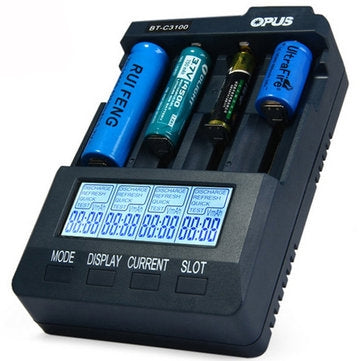
If the battery pack is disassembled, you can charge individual 18650 or 21700 cells safely.
Use a Multi-Cell Charger
Devices like the Opus C3100 or C3400 charge each cell independently with CC/CV profile, voltage cutoff at 4.2V per cell, and discharge protection (do not go below 3.0V).
Rebuild Old Packs
Replace weak or dead cells, then reassemble. This is far cheaper than buying a new 12.0Ah battery. This method is common in DIY communities for tool restoration or custom power projects.
Maximize Battery Life
Charge cells to only 80% (3.8 to 4.0V) when possible because this can double cycle life. Save full 100% charges for when you need maximum runtime.
Pro Insight: Charging to 80% can double cycle life.
Never Try These Dangerous Methods
Some hacks promise quick fixes but lead to fire, explosion, or permanent damage.
Direct 12V Car Battery Connection
A 12V car battery cannot charge an 18V Milwaukee pack. Voltage is too low, and the battery protection circuit blocks unauthorized input. Attempting this may cause overheating, swelling, or fire.
Strong Warning: FIRE HAZARD. Take care if you try this.
USB Back-Feeding Through Milwaukee Top Off
The Milwaukee Top Off is a power output device (5V USB from the battery). It cannot reverse-charge the battery. No amount of cable trickery will make it work.
Fact Check: No, you cannot back feed to the battery through the USB.
Square Wave Inverters
These produce jagged, unstable power that can damage your charger internal electronics. Use only pure sine wave inverters for safe operation.
Final Recommendations by Scenario
Here is the best method for each situation:
- Emergency top-up in the field: USB-C PD adapter (20V) because it is fast, portable, and charges to 95%
- Technical user with tools: Bench power supply because it gives full control and is safe if monitored
- Budget-conscious user: Used OEM charger because it is reliable, compatible, and affordable
- Off-grid or vehicle use: Inverter + original charger because it is safe and preserves battery health
- Disaster prep: Generator + charger or DC vehicle unit because it works without grid power
- Battery repair: Charge individual cells because it is cost-effective and precise
Keep Your Batteries Safe and Lasting Longer
No alternative charging method matches the safety, speed, and intelligence of a genuine Milwaukee charger. But when you are stuck, these options can save the day if used wisely. Always double-check polarity before connecting, monitor temperature during charging, never leave batteries unattended, and avoid charging swollen or damaged packs.
For long-term use, stick to OEM chargers. For emergencies, prepare in advance with a used charger, USB-C adapter, or inverter setup. Remember that lithium-ion batteries demand respect. A little improvisation is okay, but never compromise on safety.
Frequently Asked Questions About Charging Milwaukee Batteries Without a Charger
Can I charge my Milwaukee battery with a USB-C cable?
You can partially charge a Milwaukee battery using a USB-C Power Delivery adapter that outputs 20V. This will charge the battery to approximately 90 to 95% capacity. You need a 65W+ USB-C charger and a custom adapter cable. This method is only suitable for occasional emergency top-ups because it bypasses cell balancing and temperature monitoring.
Is it safe to use a third-party charger for Milwaukee batteries?
Third-party chargers are not recommended for regular use. Many lack proper BMS communication, voltage regulation, and safety cutoffs. Some users report smoke, swelling, or fire after repeated use. A used OEM Milwaukee charger is safer and more reliable than any new third-party option.
Can I charge my Milwaukee battery directly from a car battery?
No, you cannot charge an 18V Milwaukee battery directly from a 12V car battery. The voltage is insufficient, and the battery internal protection circuit will block the charging attempt. This method is ineffective and dangerous, risking overheating or fire.
What is the fastest way to charge a Milwaukee battery without the original charger?
The fastest alternative method is using a bench power supply configured to 21.6V at 3A to 5A. This gives you full control and is nearly as fast as the original charger. For field use, a 65W+ USB-C PD adapter with a 20V output provides the next fastest option, though it only reaches 90 to 95% capacity.
How long does it take to charge a Milwaukee battery with USB-C?
Charging via USB-C at 20V takes approximately 1.5 to 2 hours to reach 90 to 95% from half charge for a 5Ah battery. This is roughly half the speed of a Milwaukee Rapid Charger. The exact time depends on the battery capacity and the amperage of your USB-C source.
Can I use an inverter in my car to charge Milwaukee batteries?
Yes, you can use a pure sine wave inverter (300W or higher) connected to your vehicle to power a standard Milwaukee AC charger. This is a safe and effective method for on-the-go charging. Start the engine to avoid draining your car battery, and use only pure sine wave inverters to protect the charger electronics.
Key Takeaways for Charging Milwaukee Batteries Without a Charger
When your Milwaukee charger is unavailable, you have several viable alternatives. A bench power supply offers the most control and reliability for technical users, while a USB-C PD adapter provides quick emergency top-ups in the field. Purchasing a used OEM charger remains the safest and most cost-effective long-term solution. For vehicle-based charging, a pure sine wave inverter paired with your original charger or a dedicated DC vehicle charger both work well. Always avoid dangerous methods like direct 12V connections or USB back-feeding, and never leave batteries unattended during alternative charging. Prioritize safety, monitor temperatures, and reserve these methods for emergencies rather than daily use.