If you’re planning to install or understand what it takes to operate a Level 3 charging power station, you’re dealing with the high-performance end of electric vehicle (EV) infrastructure. Unlike Level 1 or Level 2 chargers, Level 3 charging power stations deliver direct current (DC) at high speeds, capable of adding hundreds of miles of range in under 30 minutes. However, this speed comes with significant technical, electrical, and financial demands that set Level 3 apart from simpler charging solutions.
This comprehensive guide breaks down every critical requirement for Level 3 charging stations, from voltage and amperage needs to site design, connector types, and future trends. Whether you’re a fleet operator, developer, or municipality evaluating DC fast charging (DCFC), this overview ensures you understand the full scope of what’s required to deploy and maintain a functional, compliant, and scalable Level 3 charging power station.
Power Output and Charging Speed Capabilities
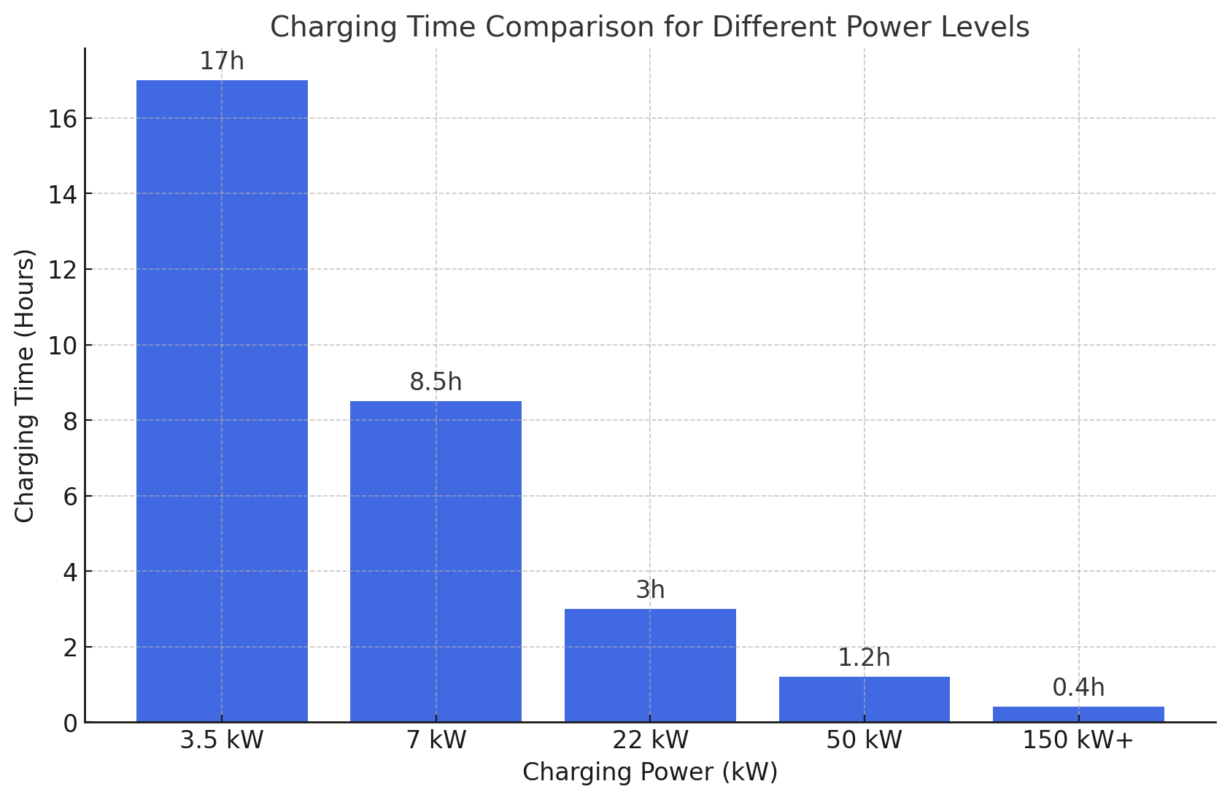
Level 3 charging power stations operate across a wide power spectrum, starting at 50 kW for legacy systems and scaling up to 600 kW or more for next-generation ultra-fast chargers. The higher the output, the faster the charge, but not all EVs can accept peak rates. Most modern DCFC stations fall into these categories.
50 to 600+ kW Charging Ranges
Power levels determine charging speed and vehicle compatibility. Here are the main tiers:
• 50 to 100 kW: Suitable for older EVs or low-demand locations
• 150 to 175 kW: Common in public networks like ChargePoint or EVgo
• 250 to 350 kW: Found on highways and supports 800V architectures like Porsche Taycan and Hyundai Ioniq 5
• 400 to 600 kW: Emerging standard for 10-minute charging by 2027
• 1 MW+: Megawatt Charging System (MCS) for electric trucks and buses
Ultra-fast charging at 400 to 600 kW is only effective when paired with compatible vehicles and proper thermal preconditioning.
Real-World Charge Times
While marketing materials tout 10-minute charges, real-world performance depends on battery size, temperature, and charge curve tapering. Here’s what to expect under optimal conditions.
| Power Level | 10%–80% Charge Time | Range Added in 30 Min |
|---|---|---|
| 50 kW | 45–60 minutes | ~75 miles |
| 150 kW | 20–35 minutes | ~180 miles |
| 350 kW | 15–25 minutes | 200+ miles |
Most EVs gain 3 to 10 miles per minute, while high-end models like the Ioniq 5 can reach up to 20 miles per minute. However, charging slows dramatically after 80% state of charge to protect battery health, and reaching 100% may take an additional 15 to 20 minutes.
Vehicle Compatibility Limits
Even at a 350 kW station, your EV won’t charge that fast unless it supports the higher rate. Key limiting factors include battery voltage architecture, where 800V systems sustain higher rates longer than 400V systems. Battery temperature also matters significantly, as cold batteries throttle charging speed. The Battery Management System dictates the maximum safe charge rate, and thermal management onboard affects sustained performance. A Tesla Model 3 Long Range accepts up to 250 kW on V3 Superchargers, while a Nissan Leaf with CHAdeMO maxes out at 50 kW.
Electrical Service and Voltage Requirements

Level 3 charging power stations require substantial electrical infrastructure that goes far beyond standard commercial power setups. Understanding these requirements is essential before committing to installation.
Three-Phase Power at 480V
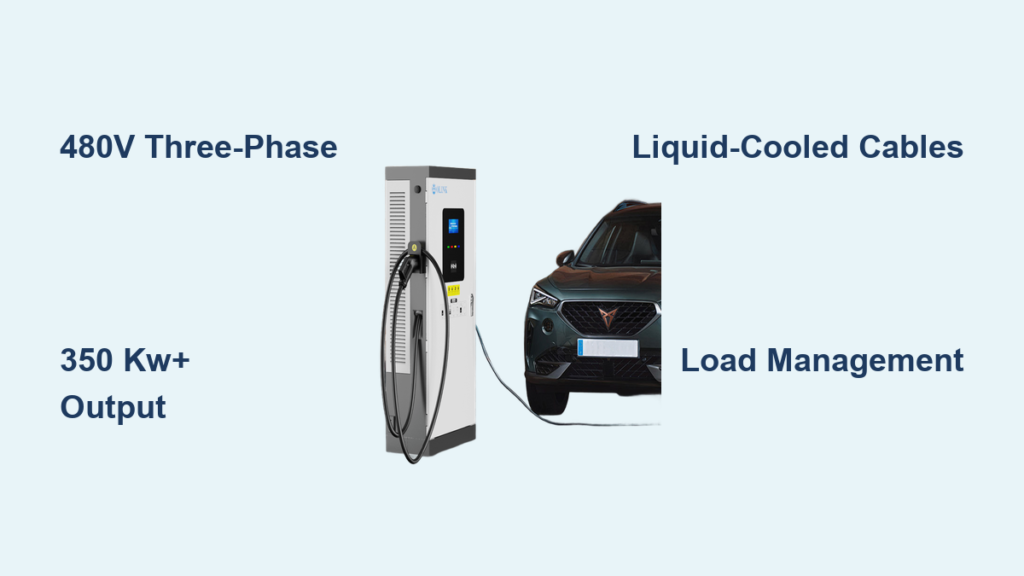
Level 3 chargers require three-phase AC input, typically 480V in North America or 400V in Europe. This is not available in homes and is usually only accessible in commercial, industrial, or utility-grade facilities. Single-phase 120V or 240V residential services cannot support Level 3 charging, and attempting to run a DCFC station off such a system would overload circuits and violate electrical codes.
Some sites use step-up transformers to convert 208V three-phase to 480V, but this increases cost, complexity, and energy loss.
Amperage and Circuit Breaker Sizing
Per NEC Article 625, all EV charging equipment must be rated at 125% of continuous load, meaning breakers and wiring must exceed nominal current draw.
| Charger Power | Input Voltage | Input Current | Required Breaker |
|---|---|---|---|
| 50 kW | 480V 3Ø | 60–100A | 80–100A |
| 150 kW | 480V 3Ø | ~180A | 200A |
| 175 kW | 480V 3Ø | ~210A | 250A |
| 350 kW | 480V 3Ø | ~420A | 500A |
For example, a Tritium RT-50 (50 kW) requires 63A input protected by an 80A OCPD. Two 175 kW units may need a 600A service panel, and six 150A chargers can demand a 2000A switchgear system. Utility upgrades are often necessary, especially in older commercial buildings.
Infrastructure and Site Planning Needs
Due to high demand, Level 3 charging power station installations almost always require new dedicated electrical service, service upgrades from the local utility, and engineering review and approval. While individual charging sessions are short, typically under 30 minutes, peak demand spikes affect grid stability.
Utility Coordination and Service Upgrades
Utilities may approve connections due to low duty cycles but will impose demand charges based on peak kW usage, sometimes accounting for 30 to 70% of monthly bills. Engage the utility early, as delays in approval can stall projects by months.
Transformer and Substation Capacity
Many Level 3 sites need on-site transformers to step down medium-voltage distribution lines to 480V. In high-density areas, substation upgrades may be required. Existing transformers may not support multiple fast chargers, and rural grids may lack redundancy or spare capacity. Upgrading a single substation transformer can cost $2 million or more. Sites with future expansion plans should oversize transformers or reserve space for additional units.
Load Management Systems
To reduce demand charges and avoid overloading circuits, modern Level 3 stations use load management systems. Dynamic load balancing distributes available power across active chargers. Cross-loading lets shared cabinets use excess capacity when other stalls are idle. Smart grid integration responds to time-of-use pricing, and battery buffering uses on-site storage to absorb off-peak power and discharge during peak charging. Without load management, operating multiple high-power chargers becomes economically unviable.
Physical Installation and Site Requirements
Installing Level 3 charging power stations involves extensive civil work beyond the electrical connections. Proper planning ensures compliance, safety, and user accessibility.
Trenching and Duct Banks
Installation requires trenching for underground conduits between utility feed and chargers, plus duct banks to house primary electrical cables, often multiple PVC or HDPE conduits in concrete. Conduit sizing must account for future upgrades and NEC derating rules. Poorly planned duct routing can increase costs and delay inspections.
Equipment Pads and Foundations
All major components need stable, code-compliant foundations. Concrete pads are required for switchgear, transformers, and rectifiers. Pedestal curbs for each charging unit ensure level installation, and drainage considerations prevent water pooling around electrical enclosures. Pads must meet local zoning and ADA compliance for accessibility.
Site Layout and User Flow
Design impacts safety and efficiency significantly. Minimum clearance zones around each charger allow for vehicle access and cable reach. Equipment corrals secure transformers and control systems. Cable routing paths minimize tripping hazards, and traffic flow planning avoids congestion at multi-stall sites. Well-designed sites reduce dwell time and improve user experience.
Connector Types and Vehicle Compatibility
Level 3 charging power stations use standardized DC connectors, each with distinct capabilities and regional adoption patterns that determine which vehicles can use each station.
CCS: Standard for Non-Tesla EVs
The Combined Charging System (CCS) is the dominant DCFC standard in North America and Europe, supporting up to 350 kW. It combines AC and DC pins in one connector and is used by Ford, GM, BMW, Volkswagen, and others. CCS adoption ensures broad compatibility with non-Tesla EVs.
NACS: Tesla’s Standard Goes Mainstream
The North American Charging Standard (NACS), originally Tesla proprietary, is now adopted by Ford, GM, Rivian, Volvo, Polestar, and others. It supports up to 300 kW on V3 Superchargers, with some models exceeding 350 kW. The connector is smaller and lighter than CCS. By 2025, most new EVs sold in the U.S. will use NACS.
CHAdeMO: Legacy Support Only
CHAdeMO is fading in relevance, with a maximum of 50 kW on older systems or 100 kW on CHAdeMO 2.0. It’s primarily used by Nissan Leaf and Mitsubishi Outlander PHEV vehicles. New installations rarely include CHAdeMO ports.
MCS: For Heavy-Duty Electrification
The Megawatt Charging System is designed for commercial vehicles, supporting 3.75 MW or more. It’s used by Tesla Semi, Daimler, and Volvo Trucks, requiring new cabling, cooling, and grid infrastructure. MCS is critical for decarbonizing freight and transit.
Adapter Use and Limitations
Adapters enable cross-compatibility between different connector types. Tesla to CCS adapters allow Tesla vehicles to use non-Tesla networks at up to 500 kW. CCS to NACS adapters are emerging but have limited availability. Warning: Adapters don’t guarantee full power delivery, so always verify compatibility and cooling capacity.
Cooling and Thermal Management Systems
High-power Level 3 charging generates significant heat that must be managed effectively to maintain performance and safety.
Liquid-Cooled Cables for High Power
Charging above 250 kW generates considerable heat. Most 350 kW+ stations use liquid-cooled cables to prevent overheating, maintain flexibility, reduce cable weight and diameter, and improve safety and user handling. Air-cooled cables are sufficient for 50 to 150 kW stations but inadequate for ultra-fast charging.
Internal Station Cooling
Level 3 chargers generate internal heat from rectifiers and transformers. Cooling methods include forced air with fans common in lower-power units, liquid cooling used in high-power models for efficiency, and hybrid systems combining both for reliability. Ambient temperature affects performance, and desert installations may require shaded enclosures.
Battery Preconditioning for Cold Weather
Cold batteries charge slower. Many EVs now support navigation-linked preconditioning that warms the battery before arrival at the charger, maximizing charge rate even in sub-zero temperatures and reducing effective charging time by up to 30%. Drivers should enable this feature in their vehicle settings.
Safety Protocols and Communication Systems
Level 3 charging power stations include sophisticated safety systems that protect vehicles, equipment, and users during every charging session.
BMS Handshake Before Charging
Before delivering power, the charger performs a two-way handshake with the vehicle’s Battery Management System. This confirms state of charge, checks battery temperature, and verifies maximum allowable charge rate. This ensures safe, optimized charging and prevents overloading the vehicle’s systems.
Automatic Shutoff and Protection
Level 3 stations include multiple safety systems. Overvoltage and overcurrent protection guard against electrical faults. Ground fault detection prevents shock hazards. Arc-fault circuit interrupters (AFCI) detect dangerous electrical arcs. Thermal overload shutdown prevents heat damage, and emergency stop buttons are located on site. All components must be UL-listed or equivalent for safety certification.
Grounding and Surge Protection
Proper grounding is mandatory. The entire conduit network must be bonded, equipment enclosures grounded to earth, and surge protectors installed at service entrance. Failure to ground properly risks equipment damage and safety hazards.
Cost and Financial Considerations
Level 3 charging power stations require substantial capital investment that extends well beyond the equipment purchase price.
Equipment and Installation Costs
| Component | Cost Range |
|---|---|
| 50–150 kW Charger | $10,000 – $50,000 |
| 350 kW Charger | $70,000 – $100,000+ |
| Installation (per unit) | Often exceeds equipment cost |
| Total Project (6+ chargers) | $200,000 – $1M+ |
Installation costs include trenching and duct banks, concrete pads, electrical upgrades, permitting and engineering, and networking and software. Grid upgrades can add $100,000+ to total cost.
Operational Pricing Models
Public stations use various pricing structures. Per kWh pricing ranges from $0.25 to $0.60 and is the most common model. Per minute pricing ranges from $0.30 to $0.80 and is often tiered with higher rates after 80% state of charge. Flat session fees are rare and used in loyalty programs. Subscription models are available through networks like Electrify America. A full charge typically costs $15 to $50, depending on battery size and local rates.
Incentives and Funding Programs
Federal and state programs reduce deployment costs significantly. The NEVI Program funds DCFC along the National Highway System. IRA Tax Credits provide up to 30% for commercial EV charging. Many utilities offer rebates for load management or storage integration. Fleet operators and municipalities should explore available grants before installation.
Use Cases and Deployment Scenarios
Level 3 charging power stations serve specific applications where rapid charging provides meaningful value.
Highway and Long-Distance Travel
Level 3 stations are essential for reducing range anxiety, enabling cross-country EV travel, and integrating with navigation systems like Google Maps and Tesla. They’re strategically placed every 50 to 100 miles along interstates.
Fleet and Commercial Operations
Delivery vans from Amazon and UPS, ride-share drivers for Uber and Lyft, taxi services, and municipal fleets all use Level 3 charging to minimize downtime and maximize vehicle utilization.
Retail and Hospitality Sites
Malls, hotels, and restaurants install Level 3 chargers to increase customer dwell time, attract EV drivers, and enhance brand sustainability. Even 30 minutes of charging supports a full meal or shopping trip.
Limitations and Operational Challenges
Despite their benefits, Level 3 charging power stations face several challenges that operators and users must understand.
Battery Degradation from Frequent Use
While occasional Level 3 charging is safe, daily use can accelerate battery wear, especially in plug-in hybrids, EVs with smaller batteries, and vehicles in hot climates. Best practice is to use Level 2 for daily charging and reserve Level 3 for trips or emergencies.
Environmental and Thermal Constraints
Cold weather below 32°F slows charging without preconditioning. High ambient heat triggers thermal throttling. Direct sun on blacktop increases battery temperature. Sites in extreme climates should include shaded parking or cooling aids.
Grid Strain and Scalability Concerns
If all U.S. vehicles charged simultaneously at 140 kW, demand would exceed 1 TW, nearly the entire grid capacity. Solutions include smart charging, on-site storage, renewable integration, and time-of-use scheduling. Long-term sustainability depends on grid modernization.
Future Trends in Level 3 Charging Technology
The Level 3 charging landscape continues evolving with new technologies and capabilities emerging.
600 kW+ Ultra-Fast Charging
Targeting 10-minute full charges by 2027, ultra-fast charging is enabled by 800V vehicle architectures, silicon-anode batteries, improved thermal management, and on-site energy storage. This requires new cabling, cooling, and grid coordination.
Megawatt Charging System Expansion
MCS is critical for electric semi-trucks, buses, and construction equipment. Tesla’s Semi charging depot already uses MCS, with more deployments expected by 2025.
Plug-and-Charge and V2G
ISO 15118 enables plug-and-charge for automatic authentication and billing. Vehicle-to-Grid technology lets EVs feed power back to the grid during peak demand. Smart grid integration allows stations to respond to grid signals. These technologies enhance convenience and grid resilience.
Solar Canopies and Renewable Integration
More sites are adding solar carports to generate on-site power, battery storage to reduce demand charges, and microgrids for off-grid operation. While costly, these systems improve sustainability and long-term economics.
Frequently Asked Questions About Level 3 Charging Power Station Requirements
What voltage is required for a Level 3 charging power station?
Level 3 charging power stations require 480V three-phase AC input in North America or 400V three-phase in Europe. This high-voltage power is typically only available in commercial, industrial, or utility-grade installations and is not available in residential settings.
How much does it cost to install a Level 3 charging station?
Equipment costs range from $10,000 for 50 kW units to $100,000+ for 350 kW chargers. Installation costs often exceed the equipment cost, and total projects with multiple chargers typically range from $200,000 to over $1 million, especially when grid upgrades are required.
Can I install a Level 3 charger at my home?
Technically possible but highly impractical. Residential settings lack three-phase power, and installation costs can exceed $50,000 to $100,000. Level 2 charging at 240V remains optimal for home use, providing full overnight recharge at a fraction of the cost and complexity.
What connector types do Level 3 stations use?
Level 3 stations primarily use CCS (Combined Charging System) for most non-Tesla vehicles, supporting up to 350 kW. NACS (North American Charging Standard) is used by Tesla and adopted by Ford, GM, and others, supporting up to 300+ kW. CHAdeMO is legacy support only, and MCS (Megawatt Charging System) is for heavy-duty vehicles.
How fast can a Level 3 charger fill an EV battery?
Under optimal conditions, a 350 kW charger can take an EV from 10% to 80% state of charge in 15 to 25 minutes, adding over 200 miles of range in 30 minutes. However, actual performance depends on the vehicle’s battery architecture, temperature, and state of charge. Charging speed decreases significantly after 80% to protect battery health.
Do Level 3 chargers damage EV batteries?
Occasional use is safe and does not cause significant damage. However, frequent daily use may accelerate battery degradation, particularly in plug-in hybrids, EVs with smaller batteries, and vehicles in hot climates. For daily charging, Level 2 is recommended to maximize battery longevity.
Key Takeaways for Level 3 Charging Power Station Requirements
Level 3 charging power stations are complex, high-capacity systems that demand careful planning, significant investment, and coordination with utilities and regulators. The core requirements include 480V three-phase electrical service, transformers sized for peak demand, advanced cooling systems for high-power operation, and robust load management to control utility costs. These stations are not suitable for residential use and require dedicated commercial infrastructure.
The future of Level 3 charging points toward ultra-fast capabilities reaching 600 kW and beyond, with Megawatt Charging Systems enabling electric truck and bus adoption. As power levels climb and new technologies like plug-and-charge and vehicle-to-grid mature, successful deployment will depend on smart, scalable, and sustainable infrastructure planning that balances performance with grid stability and long-term operational viability.