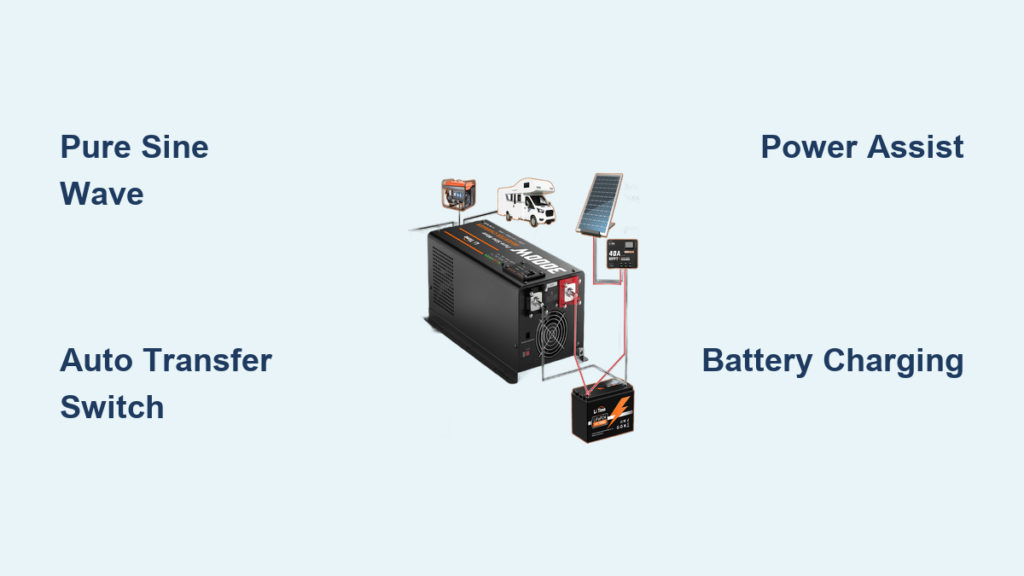
If your RV runs appliances like a microwave, coffee maker, or laptop off-grid, the device making that possible is likely an RV inverter charger. This single unit acts as the brain and muscle of your RV electrical system, seamlessly switching between shore power, generator input, and battery power to keep your lights on and devices charged, whether you are parked at a campground or deep in the woods. At its core, an inverter charger combines two critical functions: converting DC battery power into usable AC electricity in inverter mode, and recharging your batteries when external power is available in charger mode.
This guide breaks down exactly how an RV inverter charger operates, from automatic power switching and battery charging stages to advanced features like Power Assist and smart monitoring. You will learn what happens the moment you unplug from shore power, why pure sine wave output matters, and how to size and maintain your system for years of reliable service.
Dual-Function Power Management
An RV inverter charger is not two separate devices bolted together. It is an integrated system designed to manage all your AC and DC power needs from one central unit. It replaces older setups that used a basic converter for charging and a standalone inverter for AC power, eliminating inefficiencies and enabling intelligent energy flow between your battery bank and appliances.
Inverter Function: Converting Battery Power to AC
When no external power source is available, the inverter draws 12V or 24V DC power from your battery bank and converts it into 120V AC electricity, just like a wall outlet at home. This allows you to run standard household appliances during boondocking or off-grid camping.
The inverter performs these critical tasks:
It converts stored battery energy into usable AC power for devices like TVs, blenders, and CPAP machines. It activates near-instantaneously, typically within 20 milliseconds, via the internal transfer switch when external power is lost. This speed is fast enough to prevent clocks from resetting or electronics from rebooting during the switch.
Choosing Between Modified and Pure Sine Wave
Not all inverters deliver the same quality of power. The waveform type determines compatibility with modern electronics and can significantly impact performance.
Pure sine wave is essential for most modern RVs. Devices with digital circuitry can overheat, buzz, or fail when powered by modified wave output. Here is the breakdown:
Pure sine wave output is strongly recommended for modern RVs due to widespread reliance on digital electronics. Modified sine wave inverters work adequately for basic tools, incandescent bulbs, and simple heaters, but they can cause harmonic distortion and overheating in sensitive electronics.
Charger Function: Recharging Your Batteries
When connected to shore power or a generator, the charger component reverses the process. It takes 120V AC input and converts it into regulated DC current to safely recharge your battery bank.
The charger operates only when external AC power is detected and uses multi-stage charging to protect battery health. Charging rate depends on the model, with common outputs ranging from 50A to 120A. A 100A charger can replenish a 100Ah lithium battery in about one hour under ideal conditions.
Automatic Power Source Switching
One of the biggest advantages of an RV inverter charger is its ability to switch between power sources automatically, without manual intervention. This ensures uninterrupted power to your appliances regardless of what happens to your external power connection.
How the Transfer Switch Works
Inside every inverter charger is an automatic transfer switch that monitors incoming AC power continuously. This component detects whether shore power or generator input is available and routes electricity accordingly.
When shore power is connected, the transfer switch detects incoming 120V AC from the campground pedestal or generator. It instantly routes utility power directly to your AC panel while simultaneously activating the charger function. Batteries begin recharging while appliances run on shore power. This is called pass-through mode, where AC power flows through the inverter charger without conversion loss.
When shore power disconnects, the transfer switch detects loss of external power within milliseconds. It switches the load to inverter mode, converting battery DC power to 120V AC. Appliances continue running without interruption, provided the total load is within inverter capacity.
When reconnecting to shore power, the transfer switch senses the return of AC input, automatically switches back to utility power, shuts down the inverter, and charging resumes immediately. No user action is needed.
Power Assist: Boosting Limited Shore Circuits

One of the most valuable advanced features available in models like the Victron MultiPlus is Power Assist. This feature solves a common problem that RVers face: exceeding the capacity of a 15A or 30A shore power connection.
Preventing Breaker Trips
Imagine running an air conditioner requiring 1500W and a microwave requiring 1200W on a 15A circuit with a maximum of 1800W. That creates a 2700W demand, which is 900W over the limit. Without Power Assist, your breaker would trip immediately.
With Power Assist enabled, the inverter detects the excess load and draws supplemental power from your batteries to supply the missing watts. This prevents the breaker from tripping while keeping your appliances running. The feature only kicks in when needed, conserving battery power during normal operation.
Avoiding Battery Drain from Misconfiguration
Power Assist must be configured correctly to work as intended. You must set the shore power current limit in the inverter software using an app like Victron Connect. If you set the limit to 15A but plug into a 30A source, the system assumes limited power and may constantly pull from batteries, even when ample power is available. This leads to unnecessary battery drain.
Always update your current limit setting when changing campground pedestals or switching between 15A, 30A, and 50A power sources.
Battery Charging Stages Explained

The charger does not simply pump electricity into your batteries. It follows a precise, multi-stage process tailored to battery chemistry for safety and longevity. Understanding these stages helps you optimize battery care.
Stage 1: Bulk Charge
During bulk charge, the charger applies maximum current to the battery. Voltage rises steadily while the battery accepts as much power as possible. This stage charges the battery from approximately 0% to 80% quickly. Most efficient phase for both lithium and AGM batteries, similar to filling a gas tank rapidly at first.
Stage 2: Absorption Charge
During absorption charge, the charger holds voltage at the peak level while current gradually tapers as the battery accepts less energy. For AGM batteries, this is typically 14.4V, while lithium uses 14.2V. This stage completes the charge from 80% to 100% and prevents overheating by reducing current as the battery fills.
Stage 3: Float Maintenance
During float maintenance, the charger applies a low, steady voltage to keep the battery fully charged without overcharging. This is ideal for long-term storage when connected to shore power. Float voltage is typically around 13.6V.
Note that float stage is not used with lithium batteries. Many modern systems automatically disable float mode when lithium chemistry is detected.
Lithium-Specific Charging Considerations
Lithium iron phosphate batteries require different handling compared to lead-acid chemistries. They do not need a float stage, as charging stops naturally at 100%. Some models support BMS communication for charge enable and disable control. Lithium batteries can accept up to 1C charge rate, meaning a 100Ah battery can accept 100A, making high-output chargers more effective.
Battery Bank Requirements and Chemistry
Your inverter charger is only as good as the battery bank it relies on. It needs a deep-cycle battery designed for repeated discharge and recharge cycles, not a starting battery meant for brief high-current bursts.
Compatible Battery Types
Choosing the right battery chemistry impacts your off-grid capability significantly.
Flooded lead-acid batteries are the most affordable option but require regular watering and ventilation. They should only be discharged to 50% capacity and last 300 to 500 cycles.
AGM batteries are maintenance-free and handle 50 to 70% depth of discharge. They last 500 to 800 cycles and offer a good middle ground for many RVers.
Lithium batteries are ideal for off-grid use. They are lighter, last longer, and can be discharged to 80 to 100% capacity. They provide 2000 to 5000 cycles and require zero maintenance.
Minimum Bank Size Recommendations
For a 2000W inverter, you need at least 200Ah at 12V, which provides 2400Wh of usable power. For heavy loads like air conditioning and electric water heaters, 400Ah or more lithium combined with solar is recommended. Small systems powering only lights and a refrigerator may work with 100Ah AGM.
Undersized banks lead to rapid depletion and shortened battery life. Always size your bank to match your expected power needs and inverter capacity.
Standby Power and Search Mode
Even when idle, inverter chargers consume a small amount of power known as parasitic draw or standby consumption. Understanding this helps you plan for storage periods.
Typical Power Draw
Most inverter chargers draw 0.2 to 1.0A at 12V when in standby mode, which equals 2.4 to 12W continuously. Over 24 hours, this can consume 24 to 288Wh from your battery. A 200Ah lithium bank with 2400Wh usable could be drained in 8 to 10 days if left unattended with no charging source.
Search Mode: Energy-Saving Feature
To reduce standby loss, many models offer search mode. In this mode, the inverter shuts down to a low-power state and wakes up only when a load exceeding a threshold is detected, typically 5 to 15W.
This creates a common problem: chargers may not turn on if you plug in a phone charger drawing only 1 to 3W. The device appears dead until a larger load like a lamp is turned on. The fix is simple: plug in a small always-on device like a clock radio or LED strip to maintain the minimum load required to keep the inverter active.
Sizing Your Inverter Charger
Choosing the right size ensures reliability and prevents frustrating overloads during use.
Calculate Total Appliance Load
Add up the running watts of all devices you might use simultaneously. Remember that motor-driven appliances like air conditioners and refrigerators require surge watts two to three times higher than running watts when their compressors start.
For example, if you plan to run a microwave at 1500W and a coffee maker at 1200W at the same time, your total is 2700W running watts. Factor in surge requirements, and you need an inverter capable of handling 3500W or more.
Required Inverter Size
Choose an inverter rated 20 to 30% above your maximum expected load. For a 2700W total load, look for a 3000W or larger pure sine wave inverter. Ensure the inverter can handle surge watts, especially if you plan to run air conditioning or other motor-driven appliances. A soft-start kit is recommended for air conditioner units to reduce startup surge.
Charger Output Considerations
Higher amperage means faster recharge times. A 50A charger takes approximately two hours to recharge a 100Ah lithium battery. A 100A charger reduces this to about one hour, while 120A gets it done in roughly 50 minutes. Match charger output to your battery bank size and how long you typically stay at campgrounds without shore power.
Safety Features Built Into Modern Units
RV inverter chargers include multiple protections to prevent damage and ensure safe operation.
Overload and Short Circuit Protection
The inverter shuts down if AC load exceeds its capacity. This prevents fire risk and component burnout. Immediate cutoff also occurs during wiring faults or appliance shorts.
Low Battery Cutoff
The system monitors battery voltage in real time and disconnects the inverter when voltage drops to a safe threshold. For lead-acid batteries, this is typically 10.5V. For lithium batteries, it is around 11.0V, which is configurable on many models. This prevents deep discharge that can permanently damage batteries.
Over-Temperature and Surge Protection
Internal sensors reduce output or shut down completely if the unit overheats. Surge suppressors guard against voltage spikes from faulty campground pedestals or generators.
Reverse Polarity Protection
This feature prevents damage if battery cables are connected backward. The fuse blows or circuit locks out until the connections are corrected. Always double-check polarity during installation.
Installation Best Practices
Proper setup ensures efficiency, safety, and long-term performance from your investment.
Wiring and Fusing Requirements
Use thick enough cables from battery to inverter. For a 3000W unit at 12V, 4/0 AWG cable is appropriate. Install a DC fuse or breaker within 18 inches of the battery positive terminal. Follow manufacturer wire gauge and distance charts to prevent voltage drop, which reduces efficiency and can cause shutdowns.
Grounding and Ventilation
Ground the inverter chassis to the same point as the battery negative terminal to prevent ground loops and electrical noise. Mount the unit in a cool, dry, ventilated space with at least six inches of clearance around it for airflow. Heat is the enemy of electronic components. Overheating reduces lifespan and triggers automatic shutdowns.
Smart Features and Remote Monitoring
Modern inverter chargers offer app-based control and real-time insights that make managing your electrical system much easier.
Bluetooth and Mobile App Integration
Models like Victron MultiPlus support wireless monitoring via smartphone apps. Real-time data includes battery voltage and state of charge, inverter load showing how many watts are currently being used, charging status and input current, and error codes and system warnings.
Remote configuration options allow you to enable or disable Power Assist, set shore power current limits, adjust charging parameters, and schedule inverter on/off times. No more guessing about what your system is doing. You can see exactly what is happening from your phone.
Off-Grid Appliance Power Use
Your battery runtime depends heavily on what you run and for how long. Understanding power draw helps you plan effectively.
Estimated Runtime on a 2400Wh Lithium Bank
A 500W refrigerator running in electric mode gives you approximately 4.8 hours of runtime. An electric water heater at 1500W provides only 1.6 hours. An air conditioner at 1600W runs for about 1.5 hours, though this requires a 3000W or larger inverter plus solar support. A microwave at 1400W runs for roughly 1.7 hours. LED lights at 30W total can run for 80 hours. A laptop at 60W provides about 40 hours of use.
The key rule is to avoid electric water heaters and air conditioning off-grid unless you have a large solar array and substantial battery bank to support them. Switch to propane mode for refrigerators and water heaters to save battery power.
Maintenance and Longevity Tips
With proper care, an inverter charger can last 10 to 15 years, but batteries require more frequent attention.
Routine Maintenance Tasks
Inspect terminals monthly for corrosion or looseness. Clean cooling fans and vents every six months to prevent overheating. Update firmware annually for smart models. Test the transfer function by unplugging and replugging shore power periodically.
Expected Component Lifespan
The inverter charger unit itself typically lasts 10 to 15 years with proper care. Flooded lead-acid batteries last 3 to 5 years. AGM batteries last 5 to 7 years. Lithium batteries last 8 to 10 years or longer, provided they receive 2000 or more cycles.
Proper ventilation, correct charging profiles, and avoiding deep discharges all extend the life of your system.
When an RV Inverter Charger Makes Sense
An inverter charger is ideal for full-time RVers who need reliable off-grid power. It benefits boondockers who stay away from campgrounds for days at a time. Solar integrators will appreciate having a central power hub. Medical device users requiring clean, uninterrupted power like CPAP machines benefit greatly.
Weekend campers with constant shore power need an inverter charger less critically. RVs using only 12V appliances like lights and water pumps may not require full inverter charger functionality.
If you value energy independence and want to run modern AC appliances anywhere, an inverter charger is a game-changer.
Frequently Asked Questions About RV Inverter Chargers
Can I use my RV inverter charger while driving?
Yes, you can use the inverter portion while driving to power appliances from your house batteries. However, the charger function only works when connected to external AC power like shore power or a generator.
Does an inverter charger charge house batteries while driving?
No, the charger function requires AC input. Some RVers install a DC-to-DC charger connected to the vehicle alternator to charge house batteries while driving, but this is a separate system from the inverter charger.
Why does my inverter charger shut down when I plug in a phone charger?
This is likely caused by search mode. Phone chargers draw too little power to trigger the inverter out of standby. Plug in a small device like a clock radio or LED light to maintain a minimum load, or disable search mode in your settings.
Do I need a pure sine wave inverter charger?
For most modern RVs, pure sine wave is strongly recommended. Modified sine wave inverters can cause sensitive electronics like laptops, medical devices, and variable-speed motors to overheat, malfunction, or produce unusual noises.
How long does it take to recharge batteries with an inverter charger?
Recharge time depends on charger output and battery capacity. A 100A charger can recharge a 100Ah lithium battery in about one hour. The same charger would take roughly two hours for a 100Ah AGM battery due to lower acceptance rates.
Can an inverter charger work with solar panels?
Yes, but the solar panels must charge the batteries through a solar charge controller. The inverter charger manages AC power and battery charging from shore power or generator. Many modern systems integrate all three sources through a solar inverter or hybrid inverter charger.
Key Takeaways for Understanding Your RV Inverter Charger
The RV inverter charger is the central nervous system of your electrical setup. It blends inverter and charger functions into one intelligent unit, enabling seamless power transitions between shore power, generator input, and battery-based off-grid operation. The automatic transfer switch ensures your appliances keep running without interruption when external power is lost, switching to inverter mode in under 20 milliseconds.
Pure sine wave output is essential for modern electronics. Devices like microwaves, medical equipment, and laptops require clean power to function properly. Modified sine wave inverters may work for basic loads but can cause problems with sensitive equipment.
Proper sizing and configuration prevent common issues. Choose an inverter rated 20 to 30% above your maximum expected load, set correct shore power limits for Power Assist, and match charger output to your battery capacity. Lithium batteries maximize off-grid capability with deeper discharge tolerance and faster charging.
Advanced features like Power Assist and Bluetooth monitoring add significant value. Power Assist prevents breaker trips when using limited shore power, while app-based monitoring lets you track battery status and configure settings from anywhere.
By choosing the right size, configuring it properly, and managing your loads wisely, you can enjoy modern AC-powered comfort anywhere, from city campgrounds to remote wilderness, without sacrificing reliability or safety.