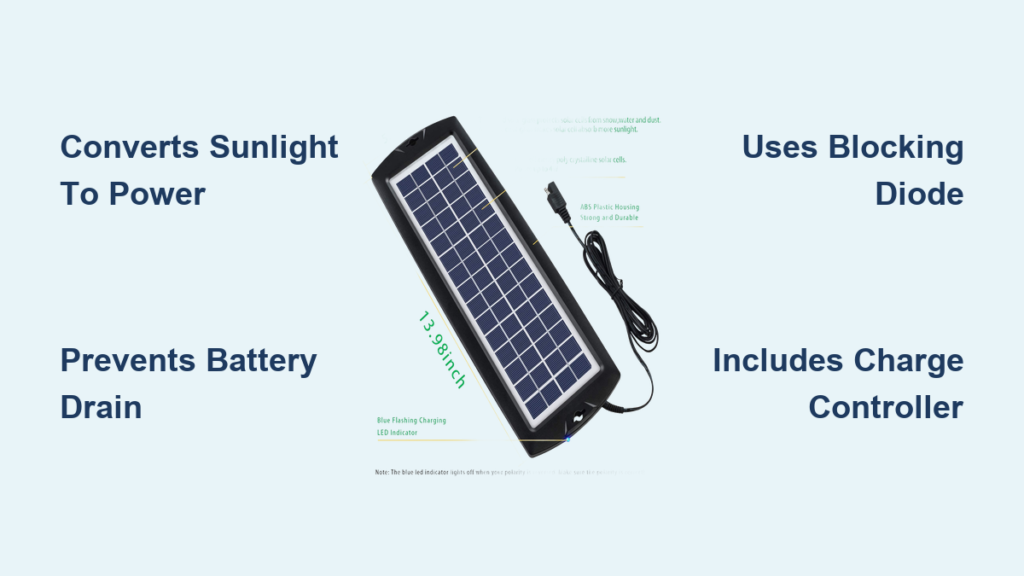
If your car, boat, or RV sits unused for weeks, you have probably returned to a dead battery. A solar trickle charger solves this problem by silently keeping your 12-volt battery topped off using only sunlight. These compact, low-power devices work by converting solar energy into a steady, safe trickle of electricity that offsets battery drain from onboard electronics like alarm systems, clocks, and engine control units.
So how does a solar trickle charger work? At its core, it uses photovoltaic cells to generate direct current power from sunlight, then delivers that power at a controlled rate to prevent battery sulfation and deep discharge. Unlike fast chargers, it does not recharge dead batteries quickly. It maintains healthy ones over time with built-in safeguards like blocking diodes and charge controllers. Whether you are storing a vehicle seasonally or want peace of mind during long vacations, understanding how these systems function helps you choose and use one effectively.
How Photovoltaic Cells Convert Sunlight to Electricity

Solar trickle chargers begin with sunlight. The key component responsible for turning light into usable electricity is the solar panel, typically made from monocrystalline silicon due to its high efficiency. This material absorbs photons from sunlight and releases electrons, generating a flow of direct current.
Monocrystalline panels are the preferred choice for quality trickle chargers because they perform better in low-light conditions, offer higher efficiency in smaller sizes, and last longer under UV exposure. Polycrystalline panels are less efficient and bulkier but may appear in budget models.
These chargers are designed for low-wattage output, typically between 1.5 watts and 8 watts, producing only 0.1 to 0.5 amps of current at 12 volts. This low current ensures gentle charging that matches or slightly exceeds a battery natural self-discharge rate, making it ideal for maintenance rather than rapid recharging.
Real-world sunlight conditions differ significantly from laboratory ratings. Cloud cover reduces output by 50 to 90 percent. Shading from trees or garage roofs cuts efficiency. Winter sun angles and shorter days limit daily exposure. Plan for 4 usable hours per day in winter and 6 in summer.
Connecting Your Solar Trickle Charger to the Battery
To deliver power, solar trickle chargers must connect directly to the battery. Two common methods exist: alligator clips and cigarette lighter plugs.
Alligator clips attach directly to the positive and negative battery terminals. This method works on all vehicles, bypasses any vehicle-specific electrical restrictions, and ensures consistent charging regardless of ignition status. Always connect red to positive and black to negative. Reversing polarity can damage the charger or battery.
Some models plug into the 12-volt accessory socket. While easy to use, this approach has drawbacks. The socket only works if it stays powered when the engine is off. Many modern vehicles disable the port to prevent battery drain. This method may not function during long-term storage. If your socket turns off with the key, this method will not maintain the battery.
Higher-end units include dual connectors, giving you flexibility. You can switch between clips and a lighter plug based on vehicle compatibility or store one for backup.
Safety Features That Protect Your Battery

Even small solar panels need protection systems. Without them, your battery could drain at night or overcharge in bright sun.
A blocking diode is a one-way valve for electricity. It allows current to flow from the panel to the battery but stops reverse flow when the panel is not generating power. This prevents the battery from discharging back through the panel at night. Not all cheap chargers include blocking diodes. If yours lacks one, it could cause battery drain instead of preventing it.
Higher-wattage or advanced models include a charge controller. This intelligent circuit monitors battery voltage, stops charging when the battery reaches approximately 14.4 volts, and resumes when voltage drops to approximately 12.6 volts. This prevents overcharging, which is especially important for small batteries under 5 amp-hours, year-round unattended use, and lithium-based chemistries. Without a controller, even a 5-watt panel can degrade battery life over time.
Better units also protect against user error and faults. Reverse polarity detection shuts down if clips are connected backward. Short-circuit protection cuts power if wires touch or short. Overheat protection prevents damage in extreme temperatures.
Battery Types and Charging Limitations

Solar trickle chargers support most 12-volt battery types, but performance varies by chemistry and capacity.
These chargers safely maintain lead-acid flooded batteries, AGM batteries, gel batteries, sealed lead-acid batteries, LiFePO4 lithium batteries, and standard lithium-ion batteries with a compatible controller. Advanced models have lithium-specific modes that adjust voltage profiles for safe charging.
A 1.5 to 5-watt panel lacks the current to overcharge a standard 40 to 100 amp-hour automotive battery. However, on small batteries under 5 amp-hours, even 0.5 amps can cause overvoltage. Without a charge controller, prolonged exposure may dry out gel or AGM batteries. Use a controller with small or lithium batteries.
Solar trickle chargers maintain rather than revive dead batteries. A 100 amp-hour battery discharged to 50 percent needs 50 amp-hours to recharge. A 5-watt panel produces roughly 0.42 amps in full sun. At 4 hours per day sunlight, that equals 1.68 amp-hours per day. Full recharge would take about 30 days.
Real-World Performance You Can Expect
When used correctly, solar trickle chargers deliver measurable benefits in battery health and reliability.
Users report success keeping car batteries fully charged for up to six months of continuous parking. One verified case showed a vehicle stored outdoors from November to April with a 1.5-watt charger mounted on the windshield. The battery started instantly after 180 days. The charger offset parasitic drain from ECU, alarm, and radio memory.
Panel size determines daily charge versus daily drain. A 1.5-watt panel generates about 0.5 amp-hours per day in winter, which may fall short of typical parasitic drain of 1 to 2 amp-hours. A 5-watt panel delivers roughly 1.7 amp-hours per day, matching or exceeding typical drain. An 8-watt panel produces about 2.5 amp-hours per day, exceeding needs. For long-term storage, 5 watts or higher is recommended.
Cold weather increases battery resistance and parasitic drain. To compensate, oversize the panel by 20 to 50 percent. Place the panel where it gets midday sun and angle it toward the south in the Northern Hemisphere. Clear snow and ice regularly. Even in winter, a well-placed 5-watt unit can prevent freezing by keeping the battery above 75 percent charge.
Installing Your Charger for Maximum Efficiency
Proper setup ensures maximum efficiency and safety.
Sun exposure is everything. Best locations include the windshield interior at dashboard level, side windows especially south-facing, and roof rack or hood if secured. Use suction cups or elastic straps to hold the panel in place. Avoid shadows from roof edges or mirrors.
For best results, tilt the panel toward the sun. Summer angle should be approximately 20 to 30 degrees from horizontal. Winter angle should be approximately 60 degrees from horizontal. Flat placement works but reduces output by up to 30 percent.
Route wires away from moving parts. Keep clips firmly attached. Insulate exposed metal. Avoid pinching wires in doors or hoods. Loose connections cause voltage drops and unreliable charging.
What a Solar Trickle Charger Cannot Do
Despite their usefulness, solar trickle chargers have clear limits.
You cannot start a car with a trickle charger if the battery is dead. It lacks the surge current needed to crank an engine. Its job is to prevent that situation from happening.
For RVs, boats, or off-grid cabins with high power demands, a 100-watt plus solar array with an MPPT controller is required. Trickle chargers are for battery preservation, not powering loads.
You can connect multiple chargers together. One can connect via cigarette lighter while another uses alligator clips. Total current adds up. Two 5-watt panels equal approximately 0.84 amps, improving winter performance. However, avoid connecting multiple chargers with controllers unless designed to work together, as conflicting logic can cause shutdowns.
Selecting the Best Model for Your Needs
Selecting the best model depends on your specific needs.
For short-term parking of 1 to 2 weeks, a 1.5 to 2-watt panel suffices. For long-term storage of months, 5 watts is recommended. Large vehicles or high-drain situations call for 8 watts or dual panels. Lithium or small batteries require 5 watts plus a charge controller.
Prioritize key features when shopping. Look for a monocrystalline panel for efficiency. Ensure a blocking diode or controller for safety. Choose alligator clips for universal compatibility. Select weather resistance of IP65 or higher for durability. An LCD or LED indicator provides status feedback. Avoid no-name brands with vague specs.
Investing 35 to 40 dollars buys reliability and longer lifespan. The ECO-WORTHY 5-watt model at 35 dollars offers dual connection and an LCD display. The POWERWIN PWS11 at approximately 40 dollars provides an intelligent controller, ETFE coating, and lithium support.
Tips for Getting the Most From Your Charger
Get the most from your solar trickle charger with these expert-backed habits.
Dust, pollen, and grime reduce output by up to 40 percent. Wipe the surface with a damp cloth monthly or more often in dirty environments.
Indicator lights show power flow but do not confirm voltage or current. Use a multimeter to measure open-circuit voltage, which should be 17 to 22 volts in sun. Check charging voltage at the battery, which should be 13.2 to 14.4 volts. This verifies the system works and detects early failures.
While designed for outdoor use, prolonged exposure to hail, ice storms, or extreme heat degrades performance. Remove and store indoors during severe conditions.
Pair your charger with a battery monitor or voltage gauge to track state of charge. This gives early warning if parasitic drain exceeds charging input.
Frequently Asked Questions About Solar Trickle Chargers
Can a solar trickle charger charge a dead car battery?
No, solar trickle chargers are designed for maintenance, not recovery. They produce too little current to recharge a dead battery in a reasonable time. A 5-watt panel would need about 30 days of full sun to recharge a half-dead 100 amp-hour battery. Use a grid-powered charger or jump starter for dead batteries.
Do solar trickle chargers work on cloudy days?
Yes, but with reduced output. Cloud cover can cut production by 50 to 90 percent. The panel still generates some power from ambient light, which helps slow battery discharge even if it cannot fully offset parasitic drain.
How long does a solar trickle charger last?
Quality panels last 3 to 25 years with 80 percent output retention. The electronics and wiring may need replacement sooner depending on weather exposure and physical handling. Monocrystalline panels typically outlive polycrystalline models.
Can I leave a solar trickle charger on all winter?
Yes, you can leave it on all winter if the panel is properly sized and positioned. Use a 5-watt or higher panel to account for shorter days and lower sun angle. Ensure the panel is clear of snow and ice. A charge controller is recommended for unattended winter use.
Will a solar trickle charger overcharge my battery?
Generally no, because the low current cannot overcharge a standard car battery. However, small batteries under 5 amp-hours or lithium batteries risk overcharging without a charge controller. Using a controller provides peace of mind for all battery types.
Do I need to disconnect the charger before starting my engine?
No, you do not need to disconnect the charger before starting the engine. Built-in circuitry protects against voltage spikes and reverse current. However, removing clips before starting is optional for added safety, especially with older models.
Key Takeaways for Using Solar Trickle Chargers Effectively
A solar trickle charger works by converting sunlight into a safe, continuous low-current charge that offsets battery self-discharge and parasitic drain. Using photovoltaic panels, blocking diodes, and sometimes smart controllers, it keeps 12-volt batteries in peak condition without grid power.
Choose a panel size based on your storage duration. A 1.5-watt unit works for short-term parking, but 5 watts or higher is essential for months-long storage. Always use alligator clips for reliable connection rather than depending on a cigarette lighter that may be disabled.
While solar trickle chargers cannot revive dead batteries or power high-demand systems, they excel at long-term maintenance. They prevent sulfation, extend battery life, and eliminate surprise jump-starts. With proper selection and placement, a solar trickle charger offers a reliable, eco-friendly solution for cars, boats, motorcycles, and RVs that sit idle.