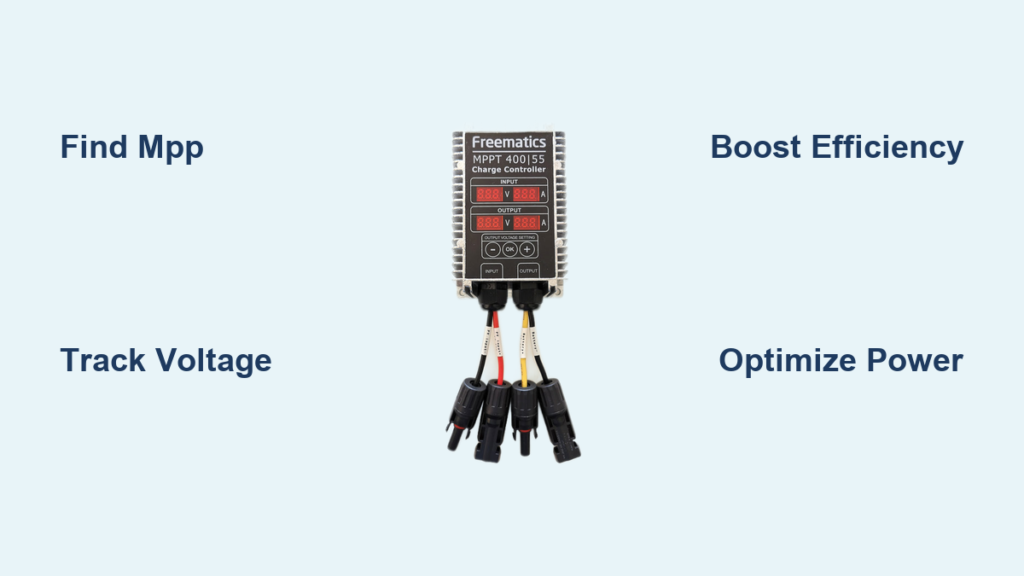
Imagine your solar panels producing power all day, but your system only capturing half of it. That’s what happens without an MPPT charger—a smart device that ensures you get every usable watt from your solar array. Unlike basic solar controllers, an MPPT (Maximum Power Point Tracking) charger doesn’t just connect panels to batteries. It actively maximizes energy transfer by dynamically adjusting how power flows between them.
Solar panels don’t deliver a fixed amount of power. Their output changes with sunlight intensity, temperature, shading, and battery charge level. At any given moment, each panel has one optimal operating point—the Maximum Power Point (MPP)—where voltage and current combine to produce peak power. An MPPT charger continuously finds this point and locks onto it, even as conditions shift.
Core Principle: Finding the Maximum Power Point
What Is the MPP?
Every solar panel has a unique sweet spot known as the Maximum Power Point. This is the exact combination of voltage and current where it generates the most power. This point shifts constantly due to environmental factors like sunlight brightness, cloud cover, and temperature. An MPPT charger’s job is to track this moving target and keep the panel operating at peak efficiency.
The MPP is defined by two key values:
* Vmp (Voltage at Maximum Power)
* Imp (Current at Maximum Power)
For example, a 300W panel might have Vmp = 30V and Imp = 10A, giving Pmax = 300W. If the system forces the panel to run at 25V instead of 30V, even at full sun, power drops to 250W—losing 50W instantly. MPPT prevents this waste by ensuring the panel always operates near its Vmp and Imp.
Why Panels Don’t Self-Regulate
Solar panels are not voltage sources. They behave more like current sources whose output depends on the connected load. Without an intelligent controller, the panel will simply follow the voltage of whatever it’s tied to, such as a battery. If the battery is at 12V but the panel’s MPP is at 17V, the panel gets dragged down to 12V and operates far below capacity.
An MPPT charger solves this by acting as an adaptive impedance matcher. It presents the optimal electrical load to the panel regardless of battery voltage. The charger manipulates the system so the panel thinks it’s connected to a load that allows it to run at its most efficient point.
Real-Time Power Optimization Process
Continuous Voltage and Current Monitoring
To find the MPP, the MPPT charger constantly measures solar input voltage, solar input current, and battery voltage. Using these readings, it calculates instantaneous input power by multiplying voltage by current. This calculation runs hundreds of times per second, enabling rapid response to changing conditions like passing clouds or shifting sun angles.
Feedback Loop for Peak Detection
Once power is measured, the controller uses a feedback loop to determine whether it’s at the peak. It slightly adjusts the operating point, usually by changing the duty cycle of its internal switching circuit, and observes the effect on power output. If power increases, it continues adjusting in the same direction. If power decreases, it reverses course. This trial-and-error method allows the system to climb the power curve toward the top.
This process is entirely passive and one-way. The solar panel has no awareness of the tracking. It simply responds to the electrical environment created by the MPPT.
MPPT Tracking Algorithms Explained

Perturb and Observe (P&O)
The most widely used algorithm works by measuring current power output, slightly increasing or decreasing the operating voltage, measuring new power, and continuing in the direction that increases power. While simple and effective, P&O can cause small oscillations around the MPP, leading to minor efficiency losses. However, its speed and reliability make it ideal for most residential and off-grid systems.
Incremental Conductance (IncCond)
More advanced than P&O, Incremental Conductance compares instantaneous conductance to incremental conductance. When the ratio of change in current to change in voltage equals the negative of current divided by voltage, the system is at the MPP. This method is faster and more accurate, especially under rapidly changing light conditions like intermittent clouds.
Fractional Open-Circuit Voltage Method
This technique estimates the MPP using a fixed ratio of the panel’s open-circuit voltage, typically around 76% of Voc. It measures Voc briefly by disconnecting the load, then sets the operating voltage close to 0.76 times Voc, followed by fine-tuning with real-time feedback. It’s fast at startup but less accurate in variable conditions unless combined with other methods.
Global MPPT for Shaded Conditions
Under partial shading, the panel’s I-V curve develops multiple peaks—one global maximum and several local ones. Basic algorithms may get stuck on a local peak. Advanced controllers use Global MPPT, which periodically sweeps the full voltage range to locate the true highest point, avoiding energy loss in complex shading scenarios.
DC-DC Conversion: Matching Voltages Efficiently

Buck Converter Operation
Most MPPT chargers use a buck converter when the solar array voltage is higher than the battery voltage. The buck circuit steps down voltage while increasing current to maintain power. For example, 30V at 10A input equals 300W. After 93% efficiency conversion to 14V, the output becomes approximately 21.4A at 14V, delivering about 280W to the battery. Buck converters are efficient, cost-effective, and ideal for standard off-grid setups.
Boost Converter Use Case
When panel voltage is lower than battery voltage, a boost converter is used. It increases output voltage at the expense of current, allowing charging even when sunlight is weak. This enables early-morning startup and better performance in low-light conditions.
Buck-Boost and SEPIC Topologies
Some advanced MPPT units use buck-boost or SEPIC converters, which can handle input voltages both above and below the battery voltage. These offer maximum flexibility in hybrid or variable-voltage systems.
Power Conservation and Efficiency Gains
Energy Transfer, Not Creation
An MPPT charger does not generate extra power. It recovers lost energy by eliminating voltage mismatch. Total power delivered to the battery equals panel power minus conversion losses, typically 3 to 7 percent. Modern MPPT units achieve 93 to 97 percent efficiency, meaning nearly all available solar energy reaches the battery.
Voltage-to-Current Transformation
The core advantage of MPPT is its ability to convert excess voltage into usable current. For example, if a panel produces 26V at 20A, that’s 520W. If the battery needs 13V, the MPPT outputs approximately 40A. Even though voltage is halved, current doubles, delivering full power to the battery. Without MPPT, a PWM controller would force the panel to 13V, dropping output to roughly 260W.
MPPT vs. PWM: Why Efficiency Matters

PWM Forces Voltage Match
A PWM controller works like a fast switch, connecting the panel directly to the battery. It rapidly turns on and off to regulate charging, but the panel must operate at battery voltage. If a panel’s MPP is at 17V but the battery is at 12V, the panel is forced down to 12V, wasting available power.
Example:
* Panel MPP: 17V × 5A = 85W
* Forced to 12V × 5A = 60W
* 25W lost, which is 30 percent loss
MPPT avoids this by letting the panel run at 17V while converting power to 12V, delivering nearly all 85W.
Efficiency Comparison
| Condition | MPPT Gain Over PWM |
|---|---|
| Full sun, warm | 10 to 15 percent |
| Cold weather | 20 to 25 percent |
| Cloudy days | 20 to 30 percent |
| Dawn/dusk | Up to 40 percent |
| Daily average gain | 20 to 40 percent |
System Design Benefits of MPPT
Higher Voltage, Lower Current Wiring
MPPT allows panels to be wired in series, increasing string voltage. Higher voltage means lower current for the same power. Lower current reduces resistive losses, wire size requirements, and voltage drop over long distances. This means thinner, cheaper cables, longer cable runs without performance loss, and reduced installation cost.
Extended Charging Window
MPPT can start charging at as low as 30 percent sunlight intensity, capturing energy during early morning, late afternoon, and overcast conditions. This extends daily charging time by 1 to 3 hours, boosting total energy harvest by 30 to 40 percent compared to PWM.
Battery Compatibility and Charging Control
Multi-Stage Charging Profiles
MPPT controllers manage full charge cycles, adapting to battery chemistry. The bulk stage delivers maximum available current until absorption voltage is reached. The absorption stage holds constant voltage while current tapers. The float stage applies lower maintenance voltage. Equalization is for lead-acid only, a periodic overcharge to prevent sulfation.
Lithium Battery Support
For lithium batteries, tight voltage control is essential, with accuracy of plus or minus 0.2V. No float stage is required in many cases, and precise cutoff prevents overcharging. Some models support low-voltage startup for deeply discharged batteries. MPPT ensures full power delivery even when battery voltage approaches panel voltage, which is a common limitation with PWM.
Key Components Inside an MPPT Charger
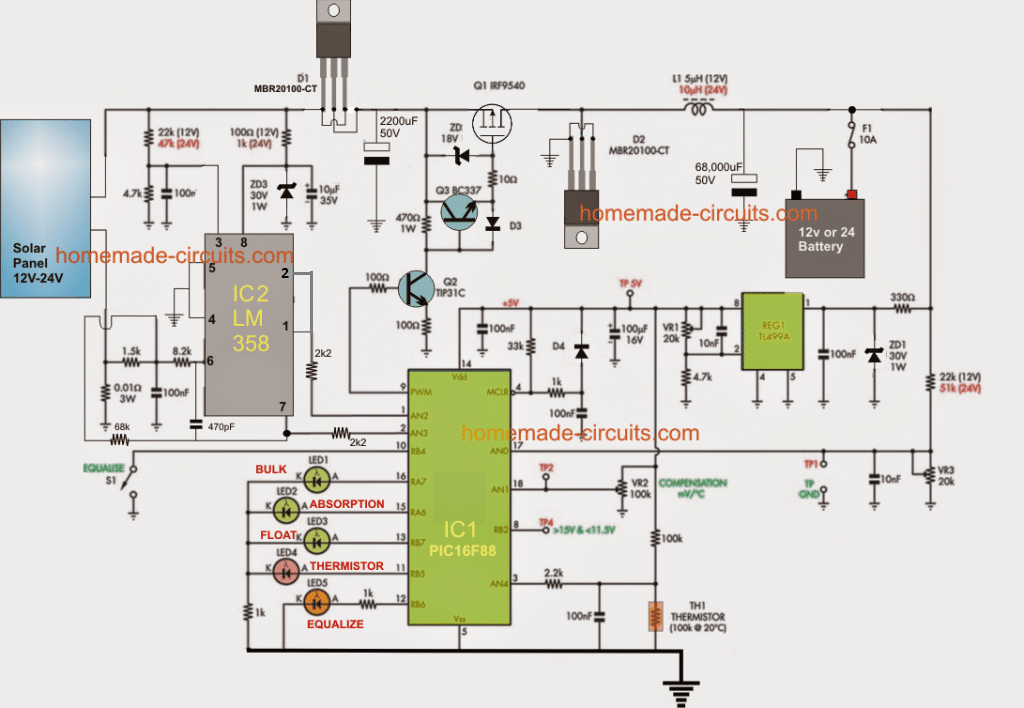
The microcontroller runs MPPT algorithms, monitors sensors, and controls switching elements. The DC-DC converter circuit includes MOSFETs, inductors, capacitors, and diodes. Precision sensors enable real-time power calculations. Gate drivers control MOSFET switching timing precisely. Protection circuits guard against overvoltage, overcurrent, short circuits, reverse polarity, and overheating.
Environmental Impact on MPP Tracking
Temperature Effects
As panel temperature rises, voltage drops by 0.3 to 0.5 percent per degree Celsius. This shifts the MPP downward. MPPT compensates automatically, adjusting the operating point to maintain peak output, even on hot days when panel voltage sags.
Shading and Multiple Peaks
Partial shading creates multiple local maxima on the I-V curve. Basic tracking can lock onto a suboptimal point. Global MPPT algorithms periodically scan the full voltage range to find the global maximum, avoiding energy loss.
Soiling and Aging
Dust, dirt, and panel degradation reduce overall performance and shift MPP. MPPT continues to track the new maximum, maintaining optimal harvest despite reduced output.
Installation Best Practices
Wiring Order: Battery First
Always connect the battery first, which provides reference voltage. Verify polarity with a multimeter. Then connect the solar panels. Finally, connect loads if supported. Never power the controller with panels alone, as many units require battery voltage to initialize.
Proper Sizing
Calculate required charge current by dividing panel wattage by battery voltage, then multiplying by 1.2 for safety margin. For a 600W array with a 24V battery, that’s 600 divided by 24 equals 25A, times 1.2 equals 30A. Choose a 30A or larger MPPT controller.
Mounting and Cooling
Install in a cool, dry, shaded location with good ventilation. Keep the unit away from direct sunlight and ensure airflow around heatsinks to prevent thermal shutdown.
Common Mistakes to Avoid
Undersized controllers lead to power clipping, where excess solar energy gets discarded. Always size above calculated needs. Wrong battery type setting risks overcharging, which is dangerous for lithium, or undercharging. Always select correct chemistry in settings. Poor ventilation causes overheating, reduced efficiency, or shutdown. Keep the unit cool and unobstructed.
Most MPPT controllers won’t function without a battery connected. They rely on battery voltage for stable operation. Mixing old and new batteries creates imbalance, reduces capacity, and strains the charging system. Replace all batteries together.
Troubleshooting and Maintenance
Monthly Checks
Inspect terminals for loose or corroded connections. Clean vents and heatsinks from dust buildup. Check cables for rodent damage or weathering.
Performance Monitoring
Track daily energy generation, input versus output power ratio, and battery voltage trends. A sudden drop in efficiency may indicate shading, soiling, or component failure.
Common Error Codes
Overvoltage means panel Voc is too high. Recheck configuration or shading. Low battery indicates deep discharge. Test battery health. Overheating means poor airflow. Improve ventilation. Reverse polarity means incorrect wiring. Verify connections before re-powering.
Debunking MPPT Myths
MPPT does not create extra power. It recovers power lost due to voltage mismatch. It maximizes utilization of existing panel output. Panels do not communicate with MPPT. The interaction is one-way and passive. The panel responds to electrical conditions set by the controller. Bypass diodes are inside panels and protect against shading. They are not controlled by the MPPT.
How MPPT Works: Step-by-Step Summary
- Measure panel voltage and current
- Calculate input power by multiplying voltage by current
- Adjust operating point via duty cycle change
- Re-measure power
- Decide direction based on increase or decrease
- Track toward peak using P&O or IncCond
- Convert power via buck or boost circuit
- Deliver optimized current and voltage to battery
This cycle repeats hundreds of times per second, ensuring peak efficiency at all times.
Final Verdict: Is MPPT Worth It?
| Scenario | Recommendation |
|---|---|
| Small camping setup under 100W | PWM acceptable |
| Off-grid home, RV, or marine | MPPT strongly recommended |
| Cold or cloudy climates | MPPT essential |
| Long cable runs | MPPT required |
| Lithium battery systems | Highly recommended |
While MPPT costs more upfront, the 20 to 40 percent energy gain, improved system flexibility, and long-term savings make it the clear choice for serious solar installations.
Frequently Asked Questions About MPPT Chargers
What does MPPT stand for?
MPPT stands for Maximum Power Point Tracking. It’s a technology used in solar charge controllers to maximize the power extracted from solar panels by continuously finding and maintaining the panel’s optimal operating point.
How much more efficient is MPPT compared to PWM?
MPPT controllers typically harvest 20 to 40 percent more energy than PWM controllers. The exact gain depends on conditions, with the biggest improvements seen in cold weather, cloudy days, and during dawn and dusk.
Can MPPT work with any solar panel?
MPPT works with most solar panels, but the controller must be properly sized for the panel’s voltage and current specifications. The panel’s maximum open-circuit voltage must not exceed the controller’s rating.
Do MPPT controllers need a battery to work?
Yes, most MPPT controllers require a battery connected to function properly. They need the battery voltage as a reference point for their conversion and charging algorithms.
Does MPPT increase the total power my panels can produce?
No, MPPT does not increase total power. It recovers power that would otherwise be lost due to voltage mismatch between the solar panel and the battery. It maximizes utilization of the panel’s existing output.
Key Takeaways for Understanding MPPT Chargers
An MPPT charger works by acting as a smart, self-adjusting DC-DC converter that constantly locates and maintains the solar panel’s maximum power point. It efficiently transforms that power to match the battery’s requirements, maximizing energy harvest and reducing waste. The technology delivers 20 to 40 percent more energy than basic PWM controllers, especially in challenging conditions like cold weather, low light, or long cable runs. For any serious solar installation, MPPT is the clear choice for optimal performance and long-term value.