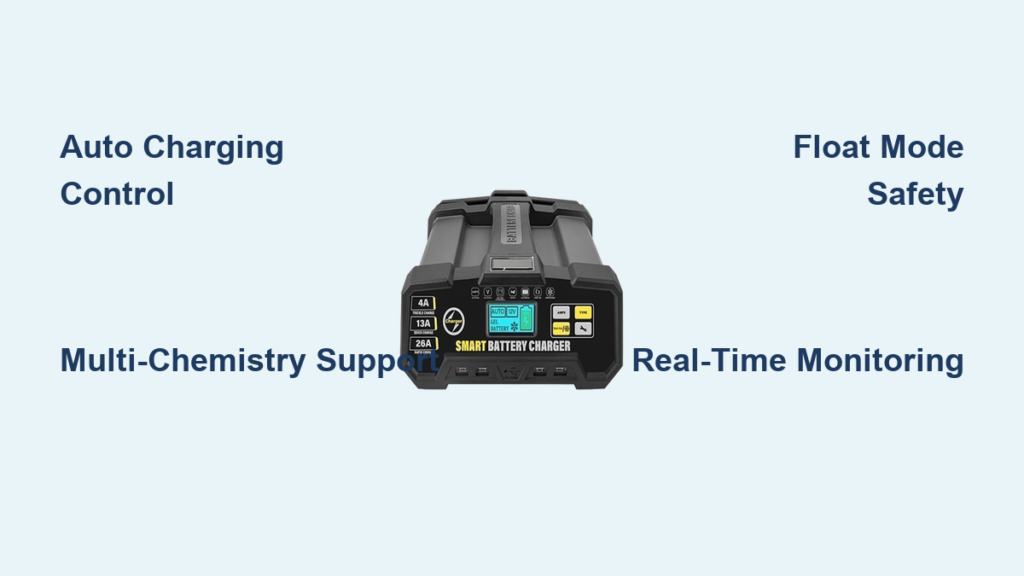
You plug in your car battery, solar setup, or motorcycle after weeks of sitting and wonder: Will it start? A smart battery charger does not simply deliver power. It thinks, adapts, and protects. Unlike old-school trickle chargers that blindly pump out current, a smart battery charger uses embedded intelligence to assess, adjust, and optimize every stage of charging. Whether you are maintaining a boat battery over winter or fast-charging an e-bike, this device ensures your battery gets exactly what it needs, no more and no less.
At its core, a smart battery charger works by continuously monitoring voltage, temperature, and charge acceptance, then dynamically adjusting output using microprocessor-controlled algorithms. It follows precise multi-stage charging profiles tailored to your battery chemistry, whether lead-acid, AGM, gel, or lithium, and safely transitions between bulk, absorption, and float modes. This guide breaks down exactly how smart chargers work, from the first voltage check to long-term maintenance, so you can choose the right one and use it with confidence.
Core Smart Charger Functions
A smart battery charger integrates several essential capabilities that distinguish it from basic chargers. These functions work together to ensure safe, efficient, and battery-friendly charging across all conditions.
Automatic Charging Control
A smart battery charger starts and stops charging without user input. Once connected, it detects battery presence, checks voltage, and determines if the battery is safe to charge. If voltage is too low, such as below 3V for a 12V system, it may refuse to start, preventing dangerous attempts on deeply discharged or damaged units. The microprocessor runs diagnostics in seconds, then selects the appropriate charging profile based on chemistry and state of charge. You do not need to monitor progress. Simply leave it connected.
Pro Tip: True automatic control means the charger will restart charging if the battery drains slightly, maintaining peak capacity over months.
Microprocessor-Based Regulation
Inside every smart charger is a microcontroller or battery management IC that acts as the brain. This chip samples battery voltage, current, and temperature dozens of times per second. Using closed-loop feedback, it adjusts output in real time, ensuring optimal charge delivery. High-end models use adaptive firmware that learns battery behavior across cycles, improving performance over time. Even budget units use the same core ICs, but differences in sensors and software affect accuracy and safety.
Example: A charger with a BQ24618 IC delivers precise CC/CV control with thermal protection, commonly used in lithium and lead-acid systems.
Multi-Chemistry Compatibility
Smart chargers support multiple battery types, including flooded lead-acid, AGM, gel, VRLA, and LiFePO4. You can either manually select the chemistry or rely on auto-detection. The charger identifies type by analyzing voltage response to a small test current. Lithium batteries show rapid voltage rise, while lead-acid responds more slowly. Once identified, the charger applies the correct voltage profile to avoid damage.
Critical: Using a lead-acid charger on a lithium battery can cause fire or explosion. Always verify compatibility.
Automatic Float Mode Transition
After full charge, the smart battery charger switches to float mode, delivering a low-maintenance voltage between 13.2V and 13.6V for 12V lead-acid that keeps the battery topped off without overcharging. This allows indefinite connection, perfect for seasonal vehicles, backup systems, or solar storage. Unlike old trickle chargers, float voltage stays below the gassing threshold, preserving electrolyte and plate integrity.
Myth Buster: Float mode does not overcharge. It is designed for continuous use and is a key reason smart chargers extend battery life.
Internal Operation and Intelligence
The true intelligence of a smart battery charger lies in its ability to continuously monitor and adjust. This real-time responsiveness is what separates smart chargers from basic automatic models.
Real-Time Feedback Loop
Smart chargers use a closed-loop system: measure, analyze, adjust, and repeat. Every few milliseconds, the microprocessor reads battery voltage and current. If absorption voltage is reached and current drops below a set threshold, such as 0.5A, it signals the battery is nearing full charge. The charger then reduces current and holds voltage steady. This real-time responsiveness prevents thermal runaway and ensures complete charging without stress.
Visual Cue: Watch the amperage display drop during absorption. It is a sign the battery is filling up.
Adaptive Firmware Logic
Advanced models use firmware that adapts to battery condition. If a battery consistently accepts charge slowly, the charger may extend absorption time or initiate a soft-start phase. Some units track charge cycles and estimate battery health. While not as detailed as a full BMS, this logic helps preserve aging batteries by reducing peak current when needed.
User Benefit: Older batteries get gentler treatment, reducing the risk of further degradation.
Multi-Stage Charging Process

Smart chargers follow a multi-stage charging process that ensures safe and complete charging. Each stage serves a specific purpose in the battery replenishment cycle.
Initialization: Safety First
Before applying power, the charger performs a diagnostic lasting 1 to 5 seconds. It detects battery presence, measures open-circuit voltage, checks for reverse polarity, and verifies no short circuits. If voltage is below 3V, or 7.3V on some models, it may refuse to charge, indicating a failed cell or deep discharge. Battery Tender pioneered this safety protocol in 1989, preventing hazardous charging attempts.
Warning: A 12V lead-acid battery reading below 10.5V likely has a shorted cell. Let it rest and cool before retrying.
Soft Start for Sensitive Batteries
Premium chargers include a soft-start phase for deeply discharged or sealed batteries. Instead of jumping to full current, they apply 0.5A to 1A to gently raise voltage. This prevents thermal shock, plate warping, and gassing, especially important for AGM and gel batteries.
Best For: Winter-start vehicles, marine batteries, and lithium units with cold-weather protection.
Bulk Charge: Fast Energy Recovery
Bulk charge restores approximately 70% to 80% of capacity quickly. The charger delivers its maximum rated current, such as 5A or 10A, while voltage rises. Current remains constant during this phase. This stage is highly efficient, with nearly all energy stored.
| Battery Type | Absorption Voltage (12V) |
|---|---|
| Flooded Lead-Acid | 14.4V to 14.8V |
| AGM | 14.4V to 14.6V |
| Gel | 14.0V to 14.2V |
| LiFePO4 | 14.2V to 14.6V |
Clarification: A 10A charger will not force 10A into a small battery. It delivers only what the battery can accept.
Absorption Charge: Top Off Safely
Once voltage hits the absorption setpoint, the charger switches to constant voltage mode. Current gradually tapers as internal resistance rises. This phase takes 1 to 6 hours, completing the final 20% to 30%. It is critical for preventing sulfation, the number one killer of lead-acid batteries.
Pro Tip: Do not interrupt absorption. Let the charger finish to ensure full capacity and long life.
Float Mode: Long-Term Maintenance
Float mode maintains 100% charge at 13.2V to 13.6V. Current drops to below 0.5A, just enough to offset self-discharge. This is safe for months or years. Ideal applications include boats in storage, backup generators, and RVs between trips.
Reality Check: Float voltage is too low to cause overcharging. Reputable brands like Battery Tender design this mode specifically for continuous use.
Pulse Maintenance: Advanced Desulfation
Some chargers use pulsed charging instead of continuous float. They send short current bursts, monitor voltage decay, help break soft sulfation, and balance cells in AGM and gel batteries. This is useful in systems with small parasitic loads, such as RV clocks or marine sensors.
Recondition Mode: Restore Lost Capacity
For older flooded lead-acid batteries, equalization applies 15.5V for 1 to 2 hours to break sulfate crystals, rebalance cell voltages, and mix stratified electrolyte.
Warning: Never use this mode on gel or most AGM batteries. Risk of dry-out and permanent damage exists.
Chemistry-Specific Charging Logic

Smart chargers adjust their algorithms based on battery chemistry. Incorrect voltage or timing can permanently damage certain types.
Lead-Acid Charging Optimization
Flooded, AGM, and gel batteries all use similar multi-stage profiles but with key differences. Flooded batteries tolerate equalization and need ventilation. AGM batteries are sealed and maintenance-free but sensitive to overvoltage. Gel batteries are most sensitive and require lower voltage. Smart chargers adjust setpoints accordingly, with AGM units often receiving 14.4V to 14.6V while gel is capped at 14.2V.
Lithium-Ion (LiFePO4) Charging Rules
Lithium batteries charge differently than lead-acid. They require no float mode because the charger shuts off after full charge. They rely on internal BMS for final cutoff and need thermal monitoring during charging. Charging pauses if the battery becomes too hot.
Critical: Never apply float voltage to LiFePO4. It degrades cells and creates safety risks.
Advanced Safety and Diagnostics
Smart chargers include comprehensive safety systems that protect both the battery and the user.
Reverse Polarity Protection
If clamps are reversed, the charger detects it and blocks power. An LED or beep alerts you. This prevents damage to the battery, charger, and vehicle electronics.
Action Step: Always connect red to positive, black to negative before plugging in.
Short Circuit and Overheat Protection
Smart chargers shut down if clamps touch, if internal temperature exceeds safe limits, or if output current spikes abnormally. Many are UL or CSA certified, meeting North American safety standards.
Battery Health Assessment
Top-tier chargers evaluate battery condition by measuring open-circuit voltage to estimate state of charge. They apply test current to check rechargeability, detect failed cells when voltage drops below 10.5V, and alert if the battery is too hot or damaged.
User Benefit: Know if your battery can be saved or needs replacing.
Fast Charging and Protocol Negotiation
In consumer electronics, smart charging refers to voltage negotiation between charger and device.
USB Smart Charging Explained
Standard USB delivers 5V at 2A, providing 10W. Fast charging protocols like Qualcomm Quick Charge and USB-PD increase voltage to 9V, 12V, or higher. Both charger and device must support the same protocol for fast charging to engage.
Example: A phone negotiates from 5V 0.3A to 9V 1.8A, delivering approximately 16.2W for faster charging.
Cable and Device Compatibility
Fast charging fails if the cable lacks data wires, if the device does not support the protocol, or if the charger port has red internal wiring indicating a dedicated circuit.
Test Tip: Use a known-good cable. If current stabilizes at 1.2A, the issue was likely the cable.
Temperature and Environmental Adaptation
Smart chargers with temperature sensors adjust their output based on ambient conditions.
Temperature Compensation
Cold batteries need higher voltage, while hot ones need less. Smart chargers adjust by approximately 0.03V per degree Fahrenheit from 77F. Below 77F, voltage increases. Above 77F, voltage decreases. This prevents undercharging in winter and overcharging in summer.
Best Practice: Use a charger with an external sensor for outdoor or engine-bay installations.
Long-Term Storage and Maintenance
Proper storage charging extends battery life significantly.
Optimal Charge Levels for Storage
To maximize lifespan, store lead-acid batteries at approximately 70% state of charge, around 12.3V. Store lithium batteries at 40% to 70% state of charge, or 3.7V to 3.8V per cell. Some smart chargers fully charge, then allow gradual discharge to ideal storage level before topping up.
Example: A Wi-Fi router charger limits battery to 65% after 16 hours plugged in to extend cycle life.
Continuous Connection Safety
True smart chargers are safe for indefinite use. They switch to float or pulse mode, preventing overcharge. Avoid cheap automatic chargers that do not reduce voltage. They can dry out sealed batteries.
BMS Communication and Grid Integration
Advanced smart chargers communicate with battery management systems and power grids.
Battery Management System (BMS) Interaction
Smart chargers with BMS support can read internal temperature, monitor cell balance, receive full-charge signals, and adjust charge rate in real time. This enables precision charging beyond voltage-based methods.
Grid-Aware Charging
Advanced systems with Wi-Fi or clocks can charge during off-peak hours, use solar first and grid only when needed, and support demand response programs. This is ideal for EVs, solar homes, and time-of-use billing situations.
Multi-Bank and Industrial Systems
For boats, RVs, or fleets, multi-bank chargers offer significant advantages.
Independent Multi-Bank Charging
Multi-bank chargers provide separate channels per battery with individual chemistry settings and autonomous stage control. One bank can be in bulk while another is in float, maximizing efficiency.
Example: A 3-bank 30A charger delivers 10A per bank and is IP68-rated for marine use.
User Interface and Remote Control
Many models include digital interfaces for monitoring and control.
Smart Charger Apps and Displays
Common features include LCD screens with real-time data, Bluetooth or Wi-Fi connectivity, and smartphone apps. Functions cover charge status and history, battery health reports, remote start and stop, and firmware updates. These are used in marine, industrial, and solar applications.
Debunking Common Myths
Several misconceptions persist about smart chargers.
All Smart Chargers Are the Same
Quality varies significantly. Battery Tender holds patents on core algorithms. Entry-level units may lack temperature sensing or accurate diagnostics.
Float Mode Overcharges
Float voltage is below the gassing threshold and is designed for continuous use.
Higher Amp Chargers Damage Small Batteries
Smart chargers regulate current based on battery acceptance. A 10A unit will not deliver 10A to a motorcycle battery.
Smart Chargers Can Revive Any Dead Battery
Only if voltage exceeds 3V and no physical damage exists. Below that, failure is likely permanent.
Choosing the Right Smart Charger
Selecting the appropriate charger requires matching amperage to your specific use case.
Match Amperage to Use Case
| Model | Amps | Best For | Charge Time |
|---|---|---|---|
| Battery Tender Plus | 1.25A | Motorcycles, ATVs | 10 to 30 hours |
| Power Tender 5A | 5A | Cars, trucks | 2 to 8 hours |
| Selectable 10A | 10A | Diesel trucks | 1 to 4 hours |
Same technology applies across all models. Only speed differs.
Key Features to Verify
When buying, ensure the charger offers true 3 or 4-stage charging, temperature compensation, chemistry selection for AGM and lithium, safety certifications like UL or CSA, and positive user reviews.
Pro Tip: Look for a ring terminal harness for permanent, clean installation.
Frequently Asked Questions About Smart Battery Chargers
What is the main difference between a smart charger and a regular charger?
A regular charger delivers fixed voltage or current regardless of battery condition. A smart battery charger uses a microprocessor to continuously monitor voltage, current, and temperature, adjusting output in real time to match what the battery needs at each moment. This prevents overcharging, undercharging, and damage from incorrect charging profiles.
Can I leave a smart battery charger connected indefinitely?
Yes, smart chargers are designed for indefinite connection. They automatically switch to float mode or pulse maintenance once the battery reaches full charge, delivering just enough current to offset self-discharge without causing overcharging. This makes them ideal for seasonal vehicles and long-term storage situations.
Does a smart battery charger work with all battery types?
Smart chargers support multiple battery chemistries including flooded lead-acid, AGM, gel, VRLA, and lithium-ion. Most feature automatic detection or manual selection to apply the correct voltage profile. Always verify compatibility before charging. Using a lead-acid profile on a lithium battery can cause fire or permanent damage.
How does a smart battery charger extend battery life?
Smart chargers prevent the three main causes of battery failure. They prevent sulfation by ensuring full regular charging, avoid overcharging through float mode and voltage regulation, and protect against deep discharge through low-voltage cutoff and maintenance charging. These combined effects can extend battery life 2 to 3 times longer than using traditional chargers.
What does multi-stage charging mean?
Multi-stage charging refers to the sequence of phases a smart battery charger uses. It typically includes bulk charge for rapid energy recovery, absorption charge for safe topping off, and float mode for long-term maintenance. Some advanced chargers add soft start for sensitive batteries, pulse maintenance for desulfation, and equalization for older lead-acid batteries. Each stage optimizes charging for that specific battery condition.
Key Takeaways for Understanding Smart Battery Chargers
A smart battery charger is more than a power supply. It is a battery guardian that combines microprocessor intelligence, adaptive charging stages, and real-time diagnostics to prevent the top causes of battery failure: sulfation, overcharging, and deep discharge. The multi-stage charging process moves through initialization, bulk charge, absorption, and float mode, each designed to optimize battery health at every state of charge.
Chemistry-specific charging ensures that lead-acid, AGM, gel, and lithium batteries each receive the correct voltage profile. Temperature compensation adapts to environmental conditions, while safety systems including reverse polarity protection, short circuit detection, and overheat shutdown protect both battery and user. Whether you are maintaining a classic car, powering a solar shed, or charging an e-bike, a quality smart charger can extend battery life 2 to 3 times.
Choose wisely by matching amperage to your use case, verifying true multi-stage charging capabilities, and ensuring chemistry compatibility. Connect safely, let the smart charger do the thinking, and you will spend less on replacements while avoiding unexpected failures.