You place your phone on a sleek charging pad, and instantly, it starts charging. No cables, no plugs, just pure convenience. This seamless experience relies on a 19th-century discovery: electromagnetic induction. Today, wireless phone charging uses this principle to transfer power from a charging pad to your smartphone through an invisible magnetic field. Known officially as inductive charging, this technology powers iPhones, Samsung Galaxy devices, and many other smartphones without a single wire touching the port.
At the heart of the system is the Qi standard, maintained by the Wireless Power Consortium, which ensures your phone can charge on almost any compatible pad. But how exactly does energy jump from a plastic pad into your battery? The process involves precisely tuned coils, high-frequency signals, real-time communication, and smart safety systems.
Core Principle: Electromagnetic Induction
The magic of wireless charging starts with a physics breakthrough from the 1830s. Michael Faraday discovered that a changing magnetic field can generate an electric current in a nearby conductor. Modern wireless chargers use this effect to transmit energy without physical contact.
How Induction Powers Your Phone
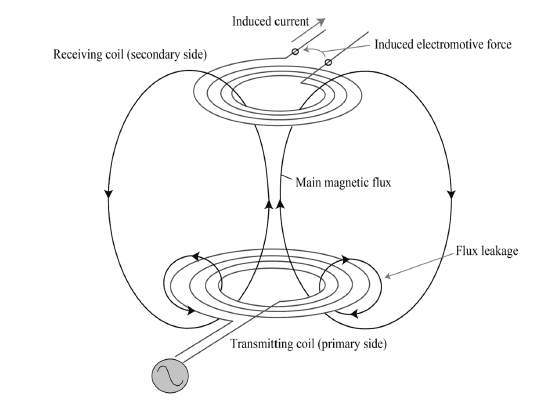
Inside every wireless charging pad is a copper-wound transmitter coil. When plugged in, alternating current flows through this coil at high frequency, typically between 110 and 205 kHz, creating an oscillating magnetic field above the surface. When you place a compatible phone on the pad, its internal receiver coil enters this field. The fluctuating magnetic energy induces an alternating current in the phone coil, which is then converted into usable DC power to charge the battery.
This process mirrors a relay race. Energy is passed from the charger to the phone through an invisible field. While Nikola Tesla once dreamed of global wireless power, today’s systems work best at close range, usually within 5 mm of the charging surface.
Why Alignment Matters
Efficiency drops quickly with distance or misalignment. If the phone is too far or off-center, less magnetic flux reaches the receiver coil, reducing power transfer. That is why newer systems like MagSafe and Qi2 use ring-shaped magnets to snap the phone into perfect position, boosting efficiency from approximately 70% to over 80%.
Step-by-Step: Energy Transfer Process
Understanding how power moves from wall outlet to phone battery reveals the sophistication behind this seemingly simple act.
1. Power Source Connection
Despite being wireless, the charging pad must be connected to a power source, usually via USB-C or wall plug. The pad draws standard 5V DC power, which it converts into high-frequency AC for the transmitter coil.
2. Transmitter Coil Activation
Once powered, the transmitter coil generates an oscillating electromagnetic field. This field extends just a few millimeters above the pad and remains inactive until a compatible device is detected.
3. Device Placement and Detection
When you place your phone on the pad, the system checks for compatibility. The charger sends a low-power signal to detect if a Qi-enabled device is present. If confirmed, full power delivery begins.
4. Energy Induction in Receiver Coil
The changing magnetic field induces an alternating current in the receiver coil inside the phone. The strength of this current depends on several factors.
- Distance between coils (less than 5 mm ideal)
- Alignment (centered equals maximum efficiency)
- Obstructions (metal cases or foreign objects reduce performance)
5. AC to DC Conversion
The induced AC current is not usable by the battery. A rectifier circuit inside the phone converts it into direct current. This step is crucial. Without it, the battery could not store the energy.
6. Power Regulation and Battery Charging
A power management IC regulates voltage and current to match the lithium-ion battery needs. It adjusts charging speed based on temperature, charge level, and communication with the charger. The system follows standard charging stages: trickle, constant current, and constant voltage.
7. Two-Way Communication
Unlike basic chargers, wireless systems use bidirectional communication. The phone modulates the magnetic field to send data back to the charger, signaling its power needs, temperature status, or when charging is complete. This ensures safe, efficient power delivery.
8. Auto-Shutoff and Safety
Charging stops automatically when the battery is full or if the phone is removed. The system also halts power if overheating or foreign objects like keys are detected, preventing hazards.
Wireless Charging Standards Explained

Not all wireless chargers work the same. Standards ensure safety, speed, and cross-brand compatibility.
Qi Standard: Universal Compatibility
The Qi standard dominates the market. It was developed by the Wireless Power Consortium and is adopted by Apple, Samsung, Google, Huawei, and most major brands. The frequency range is 110 to 205 kHz, with maximum power up to 15 W for standard charging and proprietary extensions reaching 50 W. The key feature is backward compatibility. Any Qi phone works on any Qi pad.
Qi2 Standard: Magnetic Future
Launched in 2023, Qi2 upgrades the original standard with magnetic alignment inspired by Apple MagSafe. The Magnetic Power Profile uses ring magnets to ensure perfect coil alignment. It standardizes 15 W fast charging across all Qi2 devices and improves efficiency to up to 85% due to better alignment. Enhanced FOD and thermal management are also included, along with accessory support for magnetic wallets, stands, and car mounts.
PMA and AirFuel: Legacy Systems
The PMA standard was once used in Starbucks and McDonald charging stations but is now obsolete. AirFuel Alliance merged PMA and A4WP and focuses on resonant and RF charging for industrial and IoT use, not smartphones. For consumers, Qi and Qi2 are the only relevant standards today.
Types of Wireless Charging Technologies
Different methods enable varying degrees of convenience and speed.
Electromagnetic Induction
This is the foundation of all mainstream wireless charging. Direct coil-to-coil energy transfer happens via magnetic field. The pros include high efficiency at close range and wide adoption. The cons are that it requires precise alignment and has short range of less than 5 mm. Common use cases include smartphones, earbuds, and smartwatches.
Resonant Charging
Resonant charging uses coils tuned to the same frequency to transfer energy over slightly longer distances. The pros are that it tolerates misalignment and supports multi-device charging. The cons are lower efficiency and higher cost. Use cases include charging furniture and automotive trays.
Magnetic Alignment (MagSafe/Qi2)
This approach uses magnets to snap the phone into optimal charging position. The pros are maximized efficiency, fast charging up to 15 to 25 W, and prevention of slippage. The cons are that it requires a magnet-compatible phone or case. Use cases include iPhones, Qi2 smartphones, and car mounts.
Key Components Inside the System
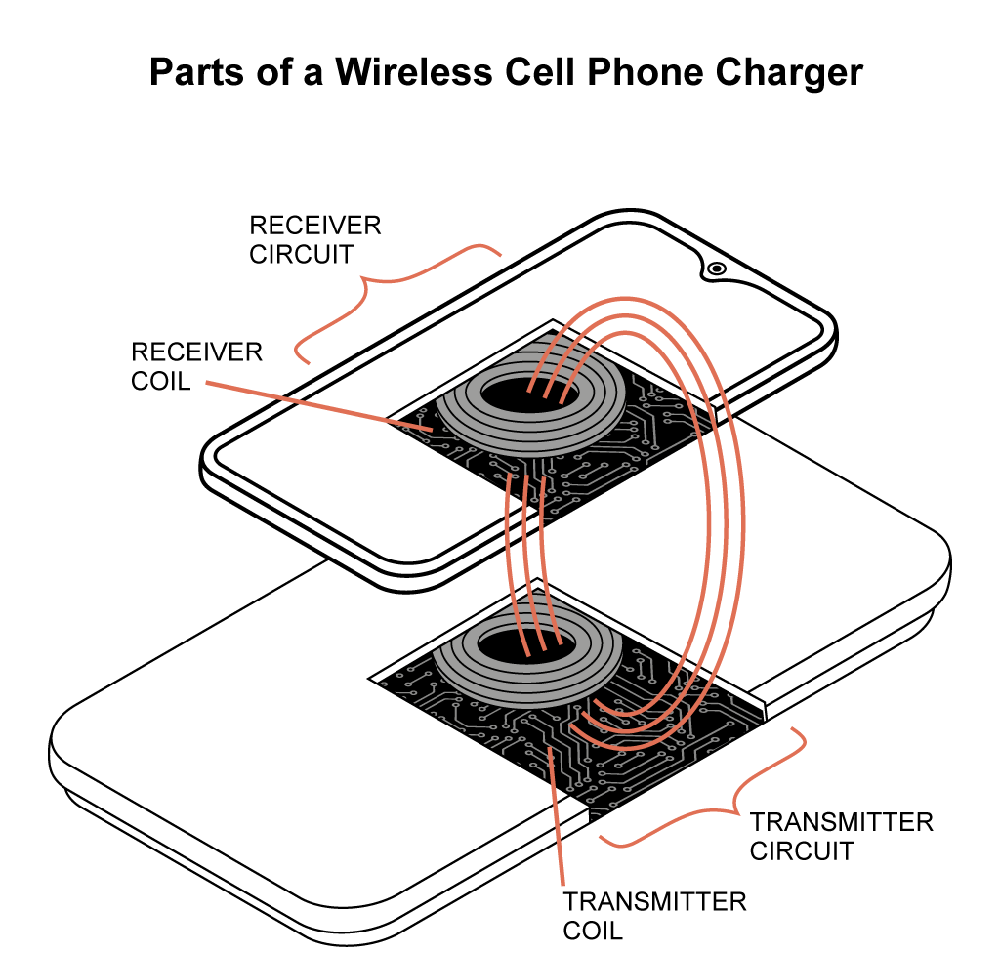
Every wireless charging setup relies on specific hardware working in harmony.
Transmitting Coil (Charger)
The transmitting coil is made of tightly wound copper wire. It converts electricity into an oscillating magnetic field and often includes ferrite shielding to focus the field and reduce interference.
Receiving Coil (Phone)
The receiving coil is embedded in the back of compatible phones. Its diameter is typically 30 to 50 mm, and it is positioned near the rear glass for minimal distance from the charger.
Rectifier Circuit (Phone)
This component converts induced AC into DC. It is integrated into the phone power management module.
Power Management IC
This IC regulates voltage and current while implementing adaptive charging. It communicates with the charger to adjust power dynamically.
Magnets (Qi2/MagSafe)
There are 16 to 24 magnets arranged in a ring. They ensure automatic alignment and enable magnetic accessories like wallets and stands.
Foreign Object Detection (FOD)
This system monitors changes in coil impedance. It detects metal objects like coins or keys on the pad and shuts off power to prevent overheating.
Thermal Sensors
Located in both charger and phone, these sensors trigger thermal throttling if temperature rises too high, helping protect battery health during prolonged charging.
Charging Speed and Efficiency Compared
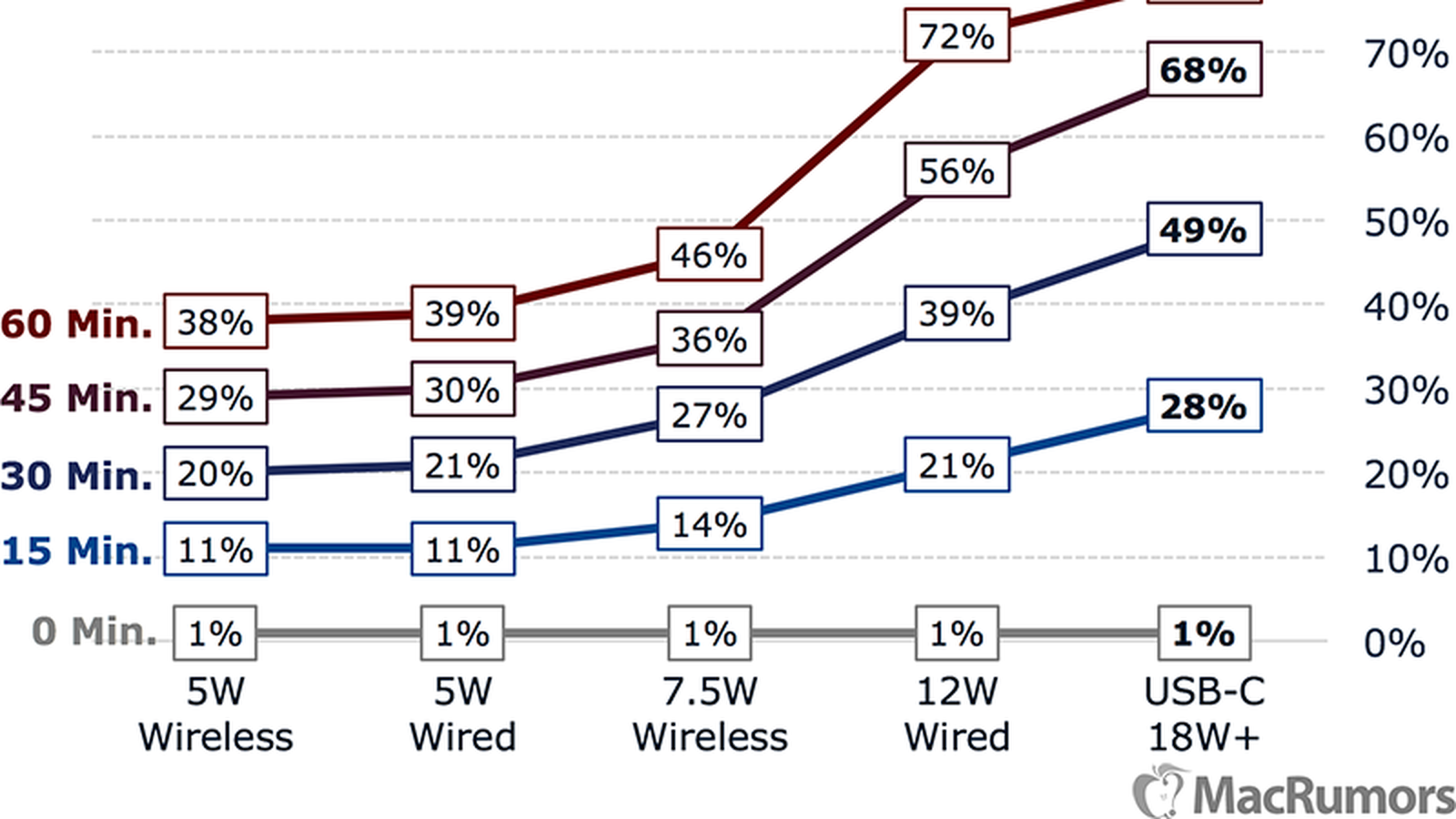
Power output varies significantly between charging methods.
| Charging Type | Max Power | Full Charge Time |
|---|---|---|
| Standard Qi | 5 W | 3 to 4 hours |
| Fast Qi | 10 to 15 W | 2 to 3 hours |
| MagSafe (Apple) | Up to 25 W | About 2 hours (iPhone 15) |
| Wired Charging | 30 to 65+ W | 30 to 50 minutes |
Even the fastest wireless charging lags behind high-wattage wired solutions.
Efficiency: Wireless vs Wired
Wireless charging is 70 to 85% efficient, while wired charging is 90 to 95% efficient. Energy loss of 15 to 30% is lost as heat due to coil resistance, electromagnetic leakage, misalignment, and impedance mismatch. Qi2 improves efficiency by ensuring optimal coil positioning, achieving approximately 82% efficiency versus 73% for standard Qi pads.
Device Compatibility List
Most flagship smartphones support wireless charging.
| Brand | Compatible Models |
|---|---|
| Apple | iPhone 8 and later, all SE (2nd/3rd Gen), 12 to 15 series |
| Samsung | Galaxy S8+, Note 8+, S20 to S24, Z Fold/Flip series |
| Pixel 3 and later (Pixel 3 to 8) | |
| Huawei | Mate 20 Pro+, P30 Pro+, P40 Pro |
| Sony | Xperia XZ, 1 to 10 series |
| Motorola | Edge+ (2023), Razr+ (2023) |
Older or budget phones can use wireless charging adapters that plug into the USB port.
Advantages of Wireless Charging
Wireless charging offers several benefits that make it appealing for everyday use.
- No more cable hassles. Just drop your phone on the pad without fumbling with frayed cables or worn-out ports.
- Reduced port wear. Fewer insertions mean longer-lasting charging ports and better dust and water resistance.
- Universal Qi compatibility. One charger powers iPhones, Androids, and earbuds without needing multiple cables.
- Seamless integration. Built into furniture, cars, and public spaces, charging becomes invisible.
- Magnetic security. Phones stay attached even in motion, ideal for car navigation.
- Cleaner workspaces. Eliminates cable clutter on desks and nightstands.
- Fast charging now possible. Qi2 and MagSafe deliver up to 15 to 25 W, closing the gap with wired.
Limitations and How to Avoid Them
Despite its convenience, wireless charging has some drawbacks.
Slower Than Wired
Even fast wireless charging cannot match 65W USB-PD. It is not ideal for quick top-ups when you need power fast.
Heat Generation
Energy loss creates heat, which may accelerate battery degradation over time. Use adaptive charging features or avoid overnight charging to reduce thermal stress.
Alignment Sensitivity
Standard pads require centering. Misalignment cuts efficiency by 20 to 40%. Use Qi2 or MagSafe chargers with magnets for foolproof alignment.
Case Compatibility Issues
Thick or metal cases block charging. Use thin, non-metallic cases less than 3 mm thick.
No Use While Charging
Flat pads make it hard to use the phone. Use a charging stand or car mount instead.
Higher Accessory Cost
Quality Qi2 and MagSafe chargers cost more than basic cables.
Safety Features Built In
Wireless chargers are designed with multiple safeguards.
- Overvoltage protection prevents voltage spikes
- Overcurrent protection limits current flow
- Overtemperature protection reduces or stops charging if too hot
- Short-circuit protection halts power during faults
- Foreign object detection shuts off if metal is detected
- Auto-shutoff stops when battery is full
- Ferrite shielding contains the magnetic field
- Non-ionizing radiation levels are safe at regulated intensities
Always use Qi or Qi2-certified chargers to ensure safety compliance.
Real-World Use Cases
Wireless charging fits naturally into daily life.
Bedside Charging
Place phone on pad before sleep and wake up to a full battery.
Office Desks
Built-in or standalone pads reduce cable clutter in shared workspaces.
Car Charging
Qi or MagSafe car mounts charge while navigating, staying secure and convenient.
Public Charging Stations
Airports, cafes, and hotels offer multi-device charging pads.
Multi-Device Charging
Two-in-one pads charge phone and earbuds simultaneously.
On-the-Go Power
Wireless power banks let you charge without cables, perfect for travel.
Future of Wireless Charging
The technology continues to evolve.
Long-Range Charging
Research into RF, laser, and ultrasound aims to charge across rooms, but this remains in early stages.
Smart Furniture
Desks, tables, and countertops with embedded charging zones are becoming more common.
30 to 50 W Wireless Charging
Gallium Nitride technology could enable laptop-level wireless charging.
Battery Longevity Tech
AI-driven charging learns your habits to delay full charge until morning.
Sustainable Design
Efforts to reduce e-waste by minimizing cables and improving charger recyclability are ongoing.
Multi-Device Resonant Surfaces
Tables that charge multiple devices at once, regardless of position, are under development.
Recommended Wireless Chargers (2024)
| Product | Type | Max Power | Key Features |
|---|---|---|---|
| Belkin Qi2 15W Stand | Stand | 15 W | Foldable, Qi2-certified, desk-friendly |
| iOttie Qi2 Car Mount | Car Mount | 15 W | Secure grip, navigation-ready |
| Mophie 15W Pad | Pad | 15 W | Includes 30W GaN adapter |
| Apple MagSafe Charger | Pad | 25 W | Magnetic snap, sleek design |
| Belkin Qi2 2-in-1 Pad | 2-in-1 | 15 W + 5 W | Charges phone + earbuds |
| Mophie PowerStation Mini | Power Bank | 15 W | Pocket-sized, magnetic stand |
Frequently Asked Questions About Wireless Charging
Can I use any wireless charger with my phone?
Yes, if both support Qi or Qi2. Cross-brand compatibility is guaranteed by the standard.
Does wireless charging damage the battery?
Not if using certified chargers. Heat is the real concern. Avoid poor-quality pads to protect battery health.
Can I charge in the car?
Yes, via Qi or MagSafe car mounts that secure your phone while driving.
Can I charge two devices at once?
Yes, with 2-in-1 pads or charging stands designed for multiple devices.
Why does my phone get warm?
Heat comes from energy loss during induction. Better alignment with Qi2 or MagSafe reduces warmth.
Do I need a special case?
Avoid thick or metal cases. Use thin, non-metallic or MagSafe-compatible cases for best results.
Is wireless charging safe?
Yes. FOD, thermal protection, and auto-shutoff make it safe. Always use certified gear.
Key Takeaways for Understanding Wireless Charging
Wireless phone charging works through electromagnetic induction, using a magnetic field to transfer energy from a pad to your phone. Governed by the Qi and Qi2 standards, it offers unmatched convenience, reduced cable clutter, and growing speed, especially with magnetic alignment. While still less efficient and slower than wired charging, innovations like Qi2, GaN tech, and adaptive charging are closing the gap. With integration into cars, furniture, and public spaces, wireless charging is moving toward a truly cord-free future.
For best results, use Qi2 or MagSafe-certified chargers, keep your phone centered, avoid thick cases, and monitor heat during long charges. The simplicity and elegance of dropping your phone on a pad and walking away make wireless charging a smart choice in today’s mobile world.