You’re counting on your power bank to keep your phone alive during an important meeting or while traveling, but instead of steady power, it abruptly shuts down every few minutes. This frustrating issue—when your power bank keeps switching off mid-charge—isn’t just inconvenient; it can leave you stranded with a dead device when you need power most. The good news is that this common problem usually has straightforward solutions, not requiring replacement. Most auto-shutdown issues stem from safety features working too aggressively or simple compatibility problems between your power bank and devices.
Unlike wall chargers that provide continuous power, power banks incorporate sophisticated circuitry to conserve their limited battery capacity. When your power bank keeps switching off, it’s typically responding to specific conditions that trigger its built-in protection systems. Understanding these triggers is the first step to solving the problem. Whether you’re trying to charge low-power electronics like Arduino projects or simply keeping your smartphone powered during a long flight, this guide delivers actionable fixes that work.
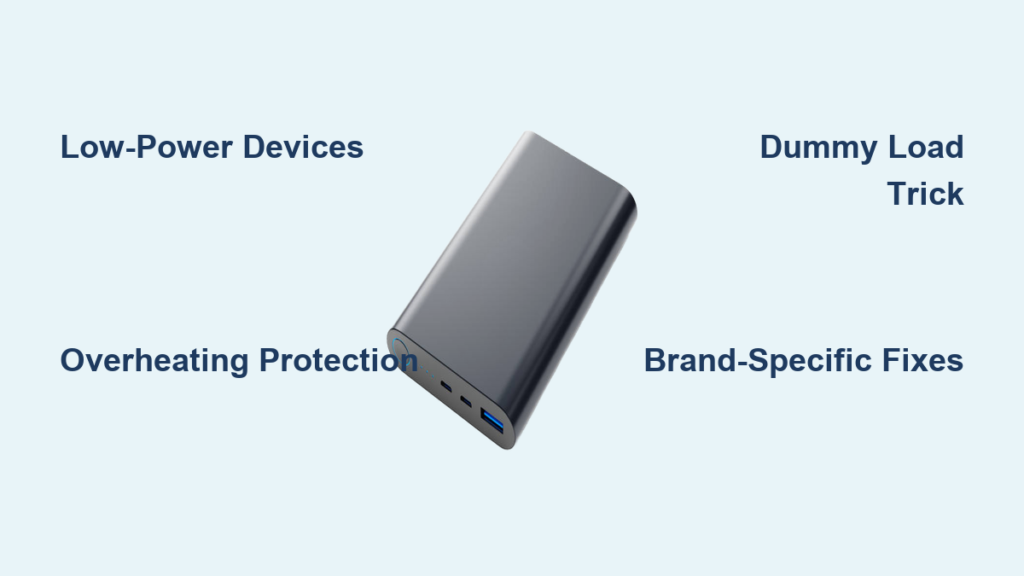
Why Low-Power Devices Trigger Your Power Bank’s Auto-Shutoff
Most power banks automatically shut down when they detect current draw below 50-100mA for 15-60 seconds—a feature designed to conserve battery when your phone finishes charging. Unfortunately, this becomes problematic when powering devices that naturally draw minimal current like Bluetooth earbuds, fitness trackers, or microcontrollers. Your power bank mistakes these normal low-power states for “charging complete” and cuts off.
Arduino and Raspberry Pi Projects That Keep Power Banks Cutting Out
If you’re working with microcontrollers like Arduino Uno, ESP8266, or Raspberry Pi Pico, you’ve likely encountered this issue. These devices often operate at 30-80mA—right in the danger zone where most power banks initiate shutdown sequences. The power bank senses what it thinks is an idle connection and powers down, disrupting your project unexpectedly.
How to Add a “Dummy Load” to Trick Your Power Bank
The simplest hardware solution involves adding a small constant load to keep current above the shutdown threshold:
– Resistor Method: Connect a 1MΩ resistor between 5V and GND on your USB cable (draws ~5mA)
– LED Indicator Trick: Add a small LED with 1KΩ resistor (draws 5-10mA)
– USB Hub Workaround: Plug in an inexpensive USB hub between your power bank and device
Pro Tip: For Arduino projects, program a brief LED pulse every 20-30 seconds using this code snippet to create intermittent higher current that prevents shutdown detection:
arduino

void loop() {

  digitalWrite(LED_BUILTIN, HIGH);

  delay(200);

  digitalWrite(LED_BUILTIN, LOW);

  delay(30000); // 30-second interval

}
Overheating Protection: When Your Power Bank Shuts Down from Heat
Power banks contain lithium-ion batteries that automatically cut off when internal temperatures exceed safe limits—typically around 60°C (140°F). If your power bank keeps switching off only when charging multiple devices or in warm environments, overheating is likely the culprit. This safety feature prevents thermal runaway but creates frustrating interruptions.
Identifying Temperature-Related Shutdowns
Your power bank is overheating if:
– Shutdowns occur only when charging power-hungry devices like tablets
– The casing feels noticeably warm to the touch before shutting down
– The problem disappears after 5-10 minutes of cooling
– Shutdowns happen more frequently in hot cars or direct sunlight
Cooling Techniques to Prevent Thermal Auto-Shutoff
Immediately address overheating with these field-tested methods:
1. Pause Charging: Unplug all devices for 5 minutes to allow cooling
2. Improve Airflow: Place power bank on a cool surface, not in your pocket
3. Reduce Load: Charge one device at a time instead of using multiple ports
4. Avoid Enclosures: Never use inside insulated cases or under blankets
5. Shade Protection: Keep out of direct sunlight during outdoor use
Anker and RAVPower Auto-Shutoff Workarounds
Brand-specific solutions can bypass auto-shutoff without hardware modifications. Many premium power banks include hidden modes that manufacturers don’t prominently advertise.
Anker PowerCore’s Secret Double-Tap Activation Method

Newer Anker PowerCore models (like the 10000mAh A1271) feature a “trickle charge” mode activated by double-pressing the power button. This disables the auto-shutdown circuit for low-power devices, allowing continuous operation with draws as low as 20mA. Verify it’s working when the indicator light pulses slowly instead of staying solid.
RAVPower’s 10-Second Button Hold Trick
For RAVPower 20000mAh models (RP-PB058), hold the power button continuously for 10 seconds until all indicator lights flash simultaneously. This disables the auto-shutoff feature, confirming with a steady green light. Some models require holding all buttons simultaneously—check your specific model’s pattern in the manual.
Faulty Cable or Port Issues Causing Intermittent Power Cuts
Damaged cables create inconsistent connections that mimic “charging complete” states. A frayed cable might deliver power intermittently, causing the power bank to detect fluctuating current and shut down.
How to Test if Your USB Cable Is the Culprit
Perform this quick cable diagnostic:
1. Try three different high-quality cables (avoid cheap, thin ones)
2. Inspect for visible damage, especially near connectors
3. Gently bend the cable while monitoring charging—interruptions indicate internal break
4. Test with a USB power meter to check for inconsistent current flow
Critical Warning: Never attempt to repair damaged cables by taping—they can create short circuits that damage your devices.
Cleaning Clogged Power Bank Ports Without Damage
Lint buildup in ports causes poor connections. Safely clean ports using:
– Compressed air (hold upright to avoid moisture)
– Soft-bristled toothbrush (dry, unused)
– Non-conductive plastic pick (never metal!)
– Isopropyl alcohol on cotton swab for stubborn grime
Battery Degradation: When Your Power Bank Is Simply Worn Out

After 300-500 charge cycles, lithium-ion cells degrade and can’t maintain stable voltage under load. If your power bank keeps switching off even when fully charged and powering basic devices, internal battery failure may be the cause.
Testing Battery Health with a USB Power Meter
Accurately assess your power bank’s condition:
1. Fully charge the power bank
2. Connect a USB power meter (like RuiDeng UM25C)
3. Power a consistent load (500mA LED light)
4. Monitor voltage—healthy units maintain >4.8V; failing units drop below 4.5V
Lifespan Expectations: When to Replace vs. Repair
Replace your power bank if:
– It’s more than 2 years old with frequent use
– Voltage drops below 4.5V under minimal load
– It swells or gets unusually hot during charging
– Multiple troubleshooting steps fail
Safety Note: Never attempt to replace internal 18650 cells unless you’re a qualified technician—lithium batteries can ignite if mishandled.
Step-by-Step Troubleshooting Guide for Persistent Auto-Shutoff
Follow this precise diagnostic sequence to identify your specific issue:
- The Device Swap Test: Charge a basic LED flashlight—if it works, your original device draws too little power
- Cable Verification: Test with three known-good cables
- Temperature Check: Feel for excessive heat before shutdown
- Button Sequence Test: Try brand-specific activation methods
- Load Addition: Attach a small dummy load to verify shutdown pattern
Preventing Future Shutdowns: Power Bank Maintenance Secrets
The 50% Storage Rule for Long-Term Battery Health
Store your power bank at approximately 50% charge in a cool, dry place—not fully charged or depleted. Lithium batteries degrade fastest at extreme charge levels. Check and recharge every 3 months to maintain optimal health.
Monthly Maintenance Routine That Extends Power Bank Life
- Full Cycle Refresh: Every 30 days, discharge to 5% then recharge to 100%
- Port Inspection: Check for debris and clean as needed
- Firmware Check: Verify manufacturer updates (for smart power banks)
- Performance Test: Time how long it powers a standard device
When your power bank keeps switching off, systematic troubleshooting almost always reveals a fixable issue rather than requiring replacement. By understanding the specific shutdown triggers—whether low-power detection, overheating, or battery degradation—you can apply targeted solutions that restore reliable portable power. Implement the maintenance practices outlined here to significantly extend your power bank’s functional life and prevent future shutdown frustrations.