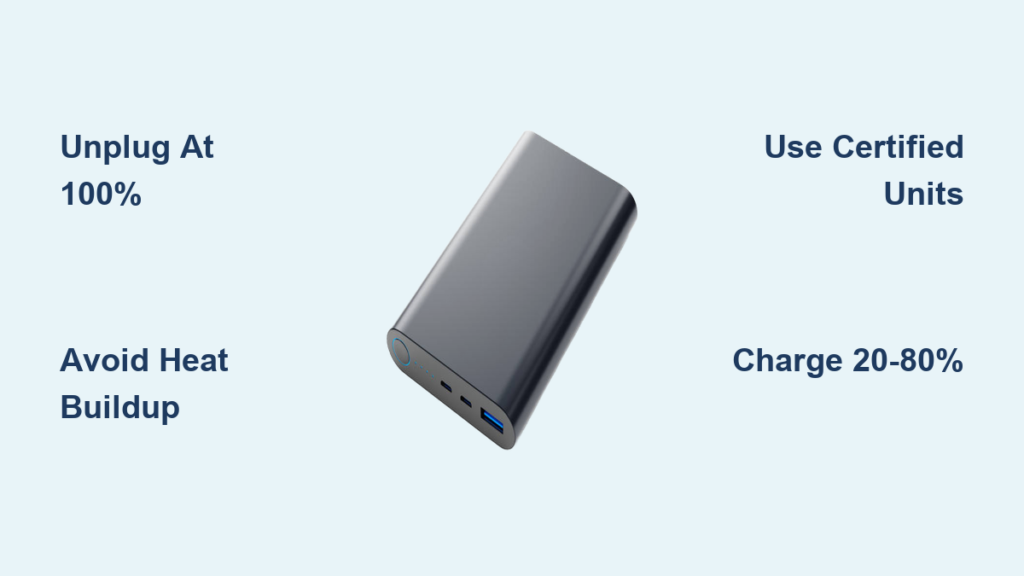
Plugging in your power bank before bed and waking up to a fully charged device seems perfectly logical. But is it safe to leave your power bank charging overnight? While modern power banks have safety features, this common habit carries hidden dangers many users ignore. The convenience of overnight charging comes at a cost: accelerated battery wear and, in worst-case scenarios, fire hazards from heat buildup or faulty components.
The reality is nuanced—high-quality certified power banks usually won’t catch fire overnight, but they pay a long-term price. That 10,000mAh backup battery you rely on might lose capacity within months due to constant micro-charging cycles. Worse, uncertified or damaged units turn this routine into a gamble with your safety. Understanding the actual risks—not myths—is essential for protecting your devices and home.
In this guide, you’ll discover the four silent threats of overnight charging, proven strategies to charge safely without disrupting your routine, and the exact habits that double your power bank’s lifespan. No speculation—just actionable steps based on how lithium-ion batteries actually behave.
How Power Bank Circuitry Fails to Stop Heat Buildup Overnight
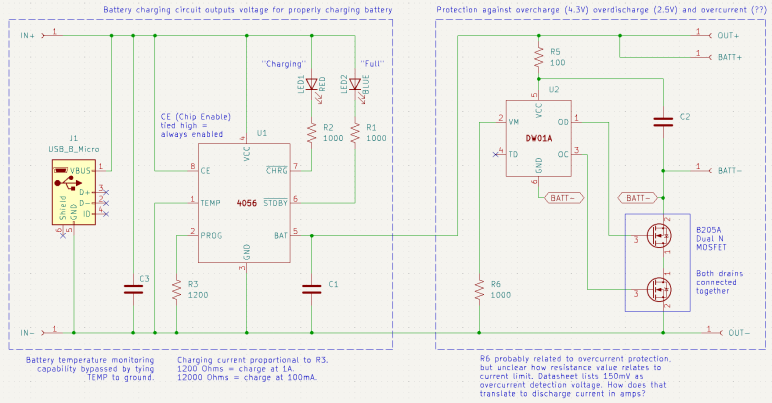
Modern power banks use Power Management Systems (PMS) that halt charging at 100%, debunking the “overcharging” myth. But here’s the critical flaw: once full, the PMS allows micro-charging cycles as the battery self-discharges slightly. This creates continuous low-level current flow, generating persistent heat even when not actively charging.
Why Your Power Bank Stays Warm After Reaching 100%
Unlike older nickel-based batteries, lithium-ion cells hate sitting at maximum voltage. The PMS prevents dangerous overcharging but can’t eliminate the chemical stress of maintaining 100% charge. This constant high-voltage state accelerates electrolyte decomposition inside the battery, directly causing:
– Heat generation from internal resistance during micro-cycles
– Capacity loss as the battery degrades 20% faster than normal
– Swelling risk from gas buildup in low-quality cells
Spotting Dangerous Heat During Charging
Place your hand on the power bank 30 minutes after it hits 100%. If it’s too hot to touch comfortably (above 40°C/104°F), unplug it immediately. Never ignore warmth under pillows or blankets—these surfaces trap heat, creating a thermal runaway trigger.
Why Heat Buildup Threatens Your Power Bank More Than Overcharging

Heat is the undisputed enemy of lithium-ion batteries, and overnight charging creates the perfect storm for dangerous temperature spikes. While PMS blocks overcharging, it can’t prevent heat accumulation from three compounding sources: the charging process itself, ambient room temperature, and poor ventilation from cluttered surfaces.
The 3-Step Heat Amplification Cycle
- Micro-charging generates baseline heat as the PMS tops off the battery
- Poor airflow (e.g., under bedding or in drawers) traps this heat
- Ambient temperature rises overnight, pushing the unit past safe limits
This cycle degrades battery chemistry 3x faster than daytime charging. Studies show lithium-ion cells kept at 100% charge in warm conditions lose 20% capacity in just 3 months—versus 12 months at 40°C storage.
Emergency Warning Signs You Must Act On
- Physical swelling (bulging casing)
- Burning smell or unusual chemical odor
- Excessive heat during normal use (not just charging)
If detected, power down immediately and move the unit outdoors to a non-flammable surface. Do not attempt further charging.
How Overnight Charging Cuts Your Power Bank’s Lifespan in Half
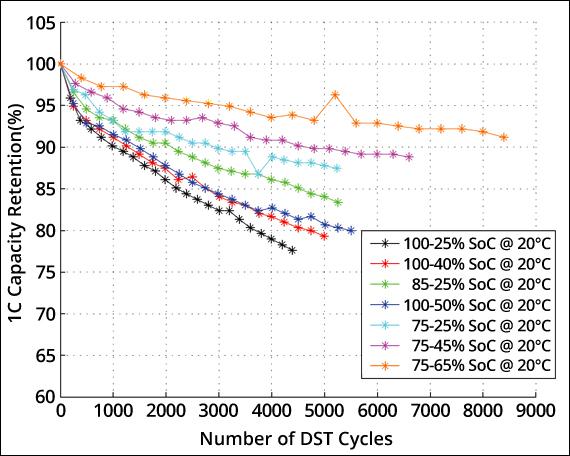
Leaving your power bank plugged in overnight inflicts invisible damage through “voltage stress.” Lithium-ion batteries degrade fastest when held at high voltage states (90-100% charge). Each 8-hour overnight session counts as 0.5 charge cycles—not one full cycle—due to micro-charging, but the constant high-voltage exposure is far more destructive.
Real-World Capacity Loss Timeline
| Charging Habit | Capacity After 6 Months | Expected Lifespan |
|---|---|---|
| Overnight charging daily | 65-70% of original | 12-18 months |
| Unplugged at 100% | 85-90% of original | 24-36 months |
| 20-80% daily range | 95%+ of original | 3+ years |
Cheap power banks with uncertified cells suffer even faster degradation. Their inferior battery management often allows voltage spikes during micro-charging, causing irreversible damage within weeks.
The Self-Discharge Trap
All batteries lose 1-5% charge monthly when idle. Overnight-charged power banks constantly “top off” this loss, creating unnecessary stress cycles. A unit left plugged in for 30 days undergoes 15-20 micro-cycles—equivalent to 3-4 full discharge cycles.
Fire Hazard Realities: Cheap vs. Certified Power Banks
While thermal runaway (fire/explosion) is statistically rare with certified power banks, it becomes a real threat with uncertified units left charging unattended overnight. Genuine UL/CE-certified power banks include critical safety layers: temperature fuses, current limiters, and flame-retardant casings. Knockoffs skip these to cut costs.
Why Counterfeit Units Fail Catastrophically
- Missing CID (Current Interrupt Device): Allows dangerous overcurrent during micro-charging
- Substandard cells: Use recycled or mismatched batteries prone to thermal runaway
- No thermal cutoffs: Continue charging even at 60°C+ temperatures
In 2022, 73% of power bank fire incidents involved uncertified brands purchased for under $15. Never charge suspiciously cheap units (e.g., “20,000mAh for $10”) overnight—they lack the circuitry to manage heat safely.
Spotting Unsafe Power Banks Before You Plug In
- Check certification marks: Genuine UL/CE/FCC logos are etched (not stickered)
- Test charger heat: If the wall adapter gets hot during normal use, discard it
- Avoid “capacity inflation”: Real 10,000mAh units weigh 200g+; lighter versions use fake cells
Unplug-When-Full: The Simplest Overnight Charging Fix
The single most effective safety upgrade? Charge your power bank while awake and unplug it at 100%. This eliminates micro-charging cycles and heat buildup. Most quality units fully charge in 4-6 hours—plug in during dinner and unplug before bed.
How to Track Full Charge Without Guessing
- LED indicators: Solid green (not blinking) = 100%
- App notifications: Brands like Anker show exact charge status via Bluetooth
- Timer method: Set a 5-hour phone alarm for 10,000mAh units
If you forget occasionally, it’s low-risk for certified units—but making this a habit adds 1+ years to your power bank’s life. Never leave it plugged in for >12 hours continuously.
Using Smart Plugs to Limit Overnight Charging Time
For unavoidable overnight charging, use a $15 smart plug to automate safety. Schedule charging to start 3-4 hours before wake-up time—enough to reach 100% without prolonged micro-charging.
Step-by-Step Smart Plug Setup
- Buy a UL-certified smart plug (TP-Link Kasa or Eve Energy)
- Set timer to activate 4 hours before your alarm
- Test once to confirm full charge at wake-up
- Place plug on non-flammable surface (never carpets/beds)
This reduces time at 100% charge by 75% versus all-night charging. Bonus: Smart plugs cut phantom drain from idle chargers, saving $5+/year on electricity.
Choosing UL-Certified Power Banks and Chargers for Safety
Your charger and cable are part of the safety system. A $30 Anker power bank with a $2 knockoff charger creates dangerous voltage fluctuations. Always pair certified power banks with OEM or MFi-certified accessories.
The 3 Non-Negotiable Safety Checks
- Power bank: Must have UL/CE mark on the casing (not just packaging)
- Wall adapter: Output matches power bank specs (e.g., 5V/3A)
- Cable: Has MFi/USB-IF certification logo near connectors
Never use frayed cables or chargers that feel warm during normal use—they indicate failing insulation. When in doubt, replace both charger and cable.
Creating a Non-Flammable Charging Zone in 60 Seconds
Where you charge matters as much as how you charge. Lithium-ion fires ignite in seconds on flammable surfaces but self-extinguish on stone or metal.
Fireproof Charging Station Checklist
- Surface: Concrete, tile, or metal tray (never wood/bedding)
- Clearance: 12+ inches from curtains, paper, or furniture
- Monitoring: Place near a smoke detector (not inside closets)
This takes 30 seconds to set up but could prevent a house fire. If space is limited, use a ceramic dish as a charging base—it won’t melt or ignite.
The 20-80% Rule: Daily Charging for Longest Battery Life
For maximum longevity, keep your power bank between 20-80% charge. Lithium-ion batteries experience minimal stress in this mid-voltage range. Top up during the day instead of nightly full charges.
Practical Implementation Tips
- Charge at 30%: Plug in when indicator shows 2 bars (for 4-LED units)
- Unplug at 80%: Stop at 3 solid LEDs (not full brightness)
- Weekly full cycle: Only do 0-100% once monthly to calibrate the PMS
This habit reduces degradation by 50% versus daily 0-100% cycles. Your power bank will retain 90%+ capacity after 2 years.
Extreme Temperature Dangers for Power Bank Health
Heat isn’t the only temperature threat—cold damages batteries too. Never leave power banks in cars (<0°C/32°F or >35°C/95°F) as extreme temps cause:
– Cold exposure: Temporary capacity loss (recovers at room temp)
– Heat exposure: Permanent capacity loss from electrolyte breakdown
Overnight charging in hot rooms (above 30°C/86°F) doubles degradation rates. Always charge in climate-controlled spaces below 25°C/77°F.
Emergency Steps for Swollen or Overheating Power Bank
If your power bank swells, smokes, or exceeds 50°C (122°F):
1. Unplug immediately using insulated gloves
2. Move outdoors to concrete/grass—away from structures
3. Submerge in sand (not water) to smother thermal runaway
4. Dispose responsibly at e-waste facilities—never in trash
Never attempt to puncture or cool a swollen unit with water—it risks explosion. Keep a small bucket of sand near your charging station as a fire suppressant.
Final Verdict: Should You Leave Your Power Bank Charging Overnight?
Only if it’s UL-certified, placed on non-flammable surfaces, and unplugged within 2 hours of full charge. For certified units, the fire risk is extremely low but never zero—and the battery wear is guaranteed. For uncertified units, overnight charging is never safe.
The smarter habit: Charge while awake using the 20-80% rule, or automate charging with smart plugs. This adds years to your power bank’s life while eliminating 99% of risks. Your portable power deserves the same care as your phone—because when it comes to lithium-ion batteries, “mostly safe” isn’t safe enough.
Final Tip: Test your power bank’s heat monthly. If it’s warmer than your phone after full charge, replace it immediately—your safety isn’t worth the risk.