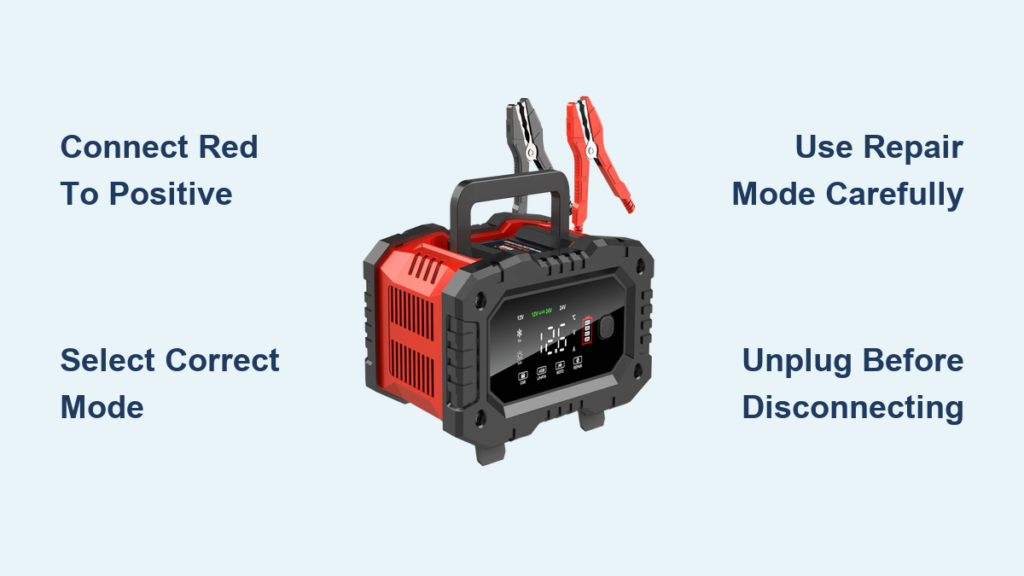
You’ve just discovered your car won’t start. The engine clicks, the lights are dim, classic signs of a drained battery. Instead of relying on jump-starts or replacements, many vehicle owners are turning to smart solutions like the Yonhan battery charger to safely restore and maintain their lead-acid batteries. Designed for simplicity and safety, this charger automates the entire process, from desulfurization to full charge, while protecting against common hazards like overcharging and reverse polarity.
But to get the most out of it, you need to know how to use the Yonhan battery charger correctly. Whether you’re reviving a dead motorcycle battery, maintaining a seasonal boat, or simply topping off your car after winter, this guide walks you through every step from connection and mode selection to troubleshooting errors and maximizing battery life.
Connect Clamps Correctly

Avoid Reverse Polarity Damage
Connecting the clamps properly is the most critical step when using the Yonhan battery charger. A single mistake, reversing the red and black clamps, can trigger an alarm, halt charging, or even damage your battery or vehicle electronics.
Start by identifying the battery terminals. The positive (+) terminal is usually marked in red and may be slightly larger than the negative. Attach the red clamp to positive first. Then connect the black clamp to the negative (–) terminal or to a clean, unpainted metal part of the chassis if the battery is still installed in a vehicle. This grounding method reduces spark risk near the battery where hydrogen gas might be present.
Warning: If you reverse the connections, the screen will flash “E-I-D-I-D” and a buzzer will sound. Immediately unplug the charger from the wall and swap the clamps before continuing.
Inspect Before Connecting
Before making any connection, visually inspect both the battery and cables.
Ensure no cracks, leaks, or bulging on the battery case. Clean corroded terminals with a wire brush or baking soda solution. Check that the charger output cables have no exposed wires or fraying. A secure, clean connection ensures efficient charging and prevents false error readings. Poor contact can mimic low voltage or open-circuit conditions, causing the charger to refuse startup.
Pro Tip: Wipe the clamp jaws with a dry cloth before attaching. Even light oxidation can reduce conductivity and affect performance.
Select the Right Charging Mode

Choose Based on Battery Type
The Yonhan charger offers five distinct modes tailored to different lead-acid battery types. Using the correct mode ensures optimal charging voltage and current, protecting your battery from undercharge or overvoltage stress.
Press the Mode button to cycle through available modes:
• Standard Mode: For regular 12V/24V lead-acid batteries (most common)
• AGM/Gel/EFB Mode: Use for sealed batteries found in modern cars, SUVs, and start-stop systems
• Water Battery Mode: Designed for flooded (wet-cell) batteries with removable caps
• Motorcycle Mode: Lower current profile ideal for small engines (50cc to 1200cc)
• Repair Mode: Activates pulse charging to recover sulfated or deeply discharged units
The charger remembers your last-used mode (except Repair Mode, which resets each time).
Activate Repair Mode Properly
If your battery fails to charge normally, it may be sulfated or deeply discharged. In such cases, use Repair Mode to attempt recovery.
To activate repair mode:
- Connect clamps correctly
- Plug the charger into the outlet
- Press the Mode button five times quickly
- The display shows “PUL” with a flashing cross symbol
This mode applies controlled pulses to break down sulfate crystals that form during long storage or repeated deep discharges. It typically takes 2 to 4 hours depending on battery size and condition.
Caution: Do not leave unattended for more than 12 hours. Stop immediately if the battery becomes hot or emits a burning smell.
Set Seasonal Charging Profile Automatically
Understand Temperature Compensation
The Yonhan charger automatically adjusts its output voltage based on ambient temperature, a crucial feature for safe and effective charging in varying climates.
Every 3 to 5 seconds, the built-in sensor checks the environment:
• Below 10°C (50°F): Winter Mode activates (snowflake icon). Charging voltage increases slightly to overcome reduced chemical activity in cold batteries.
• Above 28°C (82°F): Summer Mode engages (sun icon). Voltage decreases to prevent overcharging and electrolyte loss.
• Between 10°C and 27°C: Normal mode operates without icon.
This intelligent compensation extends battery life and improves charge efficiency year-round.
Best Practice: Place the charger near the battery but out of direct sunlight or drafts to ensure accurate temperature readings.
Why Seasonal Adjustment Matters
Cold batteries accept charge more slowly and require higher voltage to reach full capacity. Without compensation, charging may stall prematurely. Conversely, hot batteries are prone to gassing and water loss if overvolted. The Yonhan auto-adjustment eliminates guesswork, making it ideal for garages, sheds, or outdoor storage areas.
Start and Monitor Charging Process
Watch the Seven-Stage Smart Cycle
Once powered, the Yonhan charger runs a fully automatic seven-stage charging process designed to maximize battery health and longevity.
After connecting and plugging in, the screen displays “DFS” (Desulfurization) for about 5 minutes. It then progresses through constant-current charging, constant-voltage charging, battery current detection, compensation charging, floating charging, and anti-fault trigger mode (in Water Battery or Start/Stop Mode).
Normal Behavior: Charging current tapers off during constant-voltage stage. This is expected and indicates proper regulation.
Read the LCD Display
The digital screen provides real-time feedback including rising voltage toward 12.6V (12V) or 25.2V (24V), current that starts high then gradually drops, ambient temperature updated every few seconds, and time remaining or progress bar showing approximate completion estimate.
As the battery reaches full charge, the progress bar hits 100%, the screen shows “Full”, then shifts to float mode for 1 to 2 hours before shutting down automatically.
The Mode button locks after approximately 25 seconds. To change settings, disconnect power or remove one clamp.
Complete Charging and Disconnect Safely
Follow Proper Shutdown Sequence
When charging finishes, the Yonhan transitions to float/maintenance mode, holding the battery at optimal voltage without overcharging. After 1 to 2 hours, it powers down and displays “Off”.
To disconnect safely:
- Unplug the charger from the wall outlet first
- Remove the black (negative) clamp
- Remove the red (positive) clamp last
This reverse order minimizes sparking near the battery, a critical safety step since hydrogen gas may be present during and after charging.
Never disconnect clamps while the charger is still powered. Always cut AC input first.
Store for Long-Term Use
After use, wipe clamps clean and store cables loosely coiled. Keep the unit in a dry, cool place away from moisture and extreme temperatures. Test functionality every few months even if unused.
Expert Tip: For stored vehicles, reconnect every 3 to 4 weeks or use the charger in Maintenance Mode to prevent sulfation.
Troubleshoot Common Errors

Fix No Power or Display Issues
If the screen remains blank after connection, check the following:
• Check clamp polarity. Reverse connection disables startup.
• Test battery voltage with a multimeter. If below 3V, the charger won’t initiate.
• Verify AC outlet function. Try plugging in another device.
• Inspect input cable for damage or loose plug.
Reset the charger by unplugging for 60 seconds, then restarting.
Resolve Charging Stalls or False Full Readings
Sometimes the charger displays “Full” but the battery still won’t crank the engine. Possible causes include severe sulfation preventing full absorption, low electrolyte levels in flooded batteries, or internal battery damage or shorted cell.
Try Repair Mode for 2 to 4 hours. If no improvement, the battery may be beyond recovery.
Stop charging if the battery heats up excessively or emits gas or smell.
Handle Overheating and Buzzer Alarms
Excessive heat during operation could mean poor ventilation around the charger, high ambient temperature, or prolonged use without cooldown. Move to a cooler, shaded area and let the unit rest. Ensure airflow isn’t blocked.
If the buzzer sounds, “Reverse Connection” means swap clamps immediately. Continuous beeping could indicate short circuit or internal fault. Unplug and inspect all components.
Optimize Battery Life with Best Practices
Prevent Sulfation with Regular Charging
Sulfation, the buildup of lead sulfate crystals, is the leading cause of premature battery failure. It occurs when a battery sits discharged for days or weeks.
Prevent it by charging before storage, not after. Recharge every 3 to 4 weeks for seasonal vehicles. Use float/maintenance mode during long-term parking.
Users report 2 to 3 extra years of battery life with consistent Yonhan use versus occasional jump-starts.
Avoid Deep Discharges
Keep your battery above 11.9V whenever possible. Below this level, sulfation accelerates rapidly.
Never leave lights, alarms, or accessories on for extended periods. If the battery dies frequently, check for parasitic drain.
Smart Tip: Use the Yonhan charger monthly as preventive care. It is cheaper than replacement.
Maintain Flooded Batteries Properly
For wet-cell batteries, check water levels monthly. Top up with distilled water only, never acid. Charge in a well-ventilated space due to gassing.
Undercharged flooded batteries lose capacity. Overcharged ones lose water. The Yonhan precise control helps avoid both.
Know What Yonhan Charger Cannot Do
Not for Lithium or Non-Lead-Acid Batteries
The Yonhan charger is designed exclusively for 12V/24V lead-acid batteries, including AGM, gel, EFB, and flooded types.
It is not compatible with lithium-ion (Li-ion), lithium iron phosphate (LiFePO4), NiMH, alkaline, or dry-cell batteries.
Critical Warning: Attempting to charge lithium batteries can result in fire, explosion, or permanent damage. The charger lacks the communication protocols and voltage limits required for lithium chemistry.
Not a Jump Starter
While the Yonhan can revive weak batteries over time, it is not a booster. It does not provide instant high-current cranking power to start a dead engine.
If your vehicle won’t start and you need immediate help, use a jump starter pack, get a jump from another vehicle, then connect the Yonhan for a full, slow recharge.
Think of it as a doctor, not an ambulance. It is ideal for recovery and maintenance, not emergencies.
Frequently Asked Questions About Yonhan Battery Charger
Can a Yonhan charger revive a completely dead battery?
Yes, if the battery is not physically damaged and retains at least 3V. Use Repair Mode for recovery attempts. Charging may take 6 to 24 hours depending on condition.
Is it safe to leave the Yonhan charger connected overnight?
Yes, with conditions. Only for short-term unattended charging (up to 12 hours). The battery must be in good condition and properly connected. The area must be well-ventilated. Float mode prevents overcharging, but long-term continuous charging is not recommended.
Does the Yonhan charger work on AGM batteries?
Yes. Select AGM/Gel/EFB Mode for optimal charging profile. Most users report successful charging of AGM batteries in modern vehicles.
Is Yonhan a trickle charger or a smart charger?
It is a smart charger, not a basic trickle charger. It uses multi-stage charging and automatically switches to float/maintenance mode when full, preventing overcharge.
Can I leave the charger connected all the time?
Not indefinitely. While float mode safely maintains charge for weeks, continuous connection beyond 12 hours unattended is discouraged by the manufacturer. Check periodically.
How often should I charge a stored vehicle?
Every 3 to 4 weeks to prevent sulfation and capacity loss. Alternatively, use the charger in Maintenance Mode during storage periods.
Why does the charger show DFS at startup?
DFS stands for Desulfurization, a pre-charge stage that applies a low-current pulse to break down lead sulfate crystals in idle or weakened batteries. It lasts about 5 minutes.
Key Takeaways for Using Your Yonhan Battery Charger
The Yonhan battery charger is a powerful tool for extending battery life and preventing avoidable failures. When used correctly, with proper connections, mode selection, and safety awareness, it delivers reliable, hands-off charging for cars, motorcycles, boats, and more.
Remember these essential points: always connect red to positive and black to negative first, then unplug before disconnecting. Select the appropriate mode for your battery type, using Repair Mode only when necessary and never exceeding 12 hours unattended. The automatic temperature compensation feature works in the background, so place the charger in a moderate environment for best results.
By following these steps, you will keep your batteries in peak condition, reduce the need for replacements, and avoid the stress of unexpected breakdowns. Regular monthly charging is the simplest way to ensure your vehicle starts when you need it.