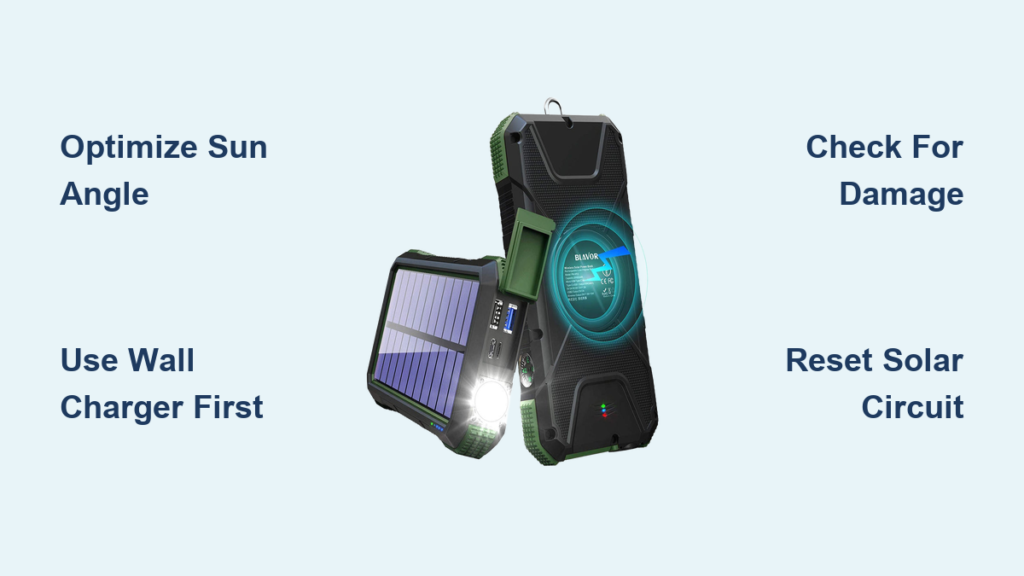
Your Blavor solar power bank sits useless on your camping trip because it won’t charge, leaving you stranded without power for critical devices. You’re not alone—many users mistakenly expect these compact units to fully recharge like wall-powered alternatives, only to discover their solar panels deliver frustratingly slow results. The harsh reality? Blavor solar power banks are designed for trickle-charging in emergencies, not rapid full recharges. This guide cuts through the confusion with actionable steps verified by user experiences and technical specifications. You’ll learn why your unit seems broken when it’s actually functioning as intended—and discover when a true malfunction requires intervention. By the end, you’ll know exactly how to maximize solar input and when to switch to conventional charging.
Why Your Blavor Solar Power Bank Appears Broken (But Isn’t)
Most “not charging” complaints stem from unrealistic expectations about solar panel capabilities. Blavor’s integrated solar panels operate at extremely low output—typically 5V/600mA—due to their tiny surface area. This generates only 1-3% charge per hour in perfect conditions, not the 50-100% users anticipate. Unlike wall chargers delivering 15-30W, these panels produce less than 3W, making them fundamentally incapable of rapid charging. If your power bank shows no progress after 2 hours in sunlight, it’s likely working correctly within its design limits. The critical distinction: your unit isn’t malfunctioning; it’s revealing solar power’s physical constraints for portable devices. Recognizing this prevents wasted time troubleshooting non-issues and directs your efforts where they matter.
Solar Charging vs. Wall Charging: The Critical Performance Gap
- Wall charging: Delivers 15-30W (e.g., 5V/3A), fully charging a 20,000mAh unit in 6-8 hours
- Solar charging: Provides 1.5-3W (5V/0.3-0.6A), requiring 5-7 days of direct sun for a full charge
- Real-world impact: A cloudy afternoon might yield just 0.5% charge—enough to power emergency calls but not device reboots
When “Not Charging” Is Actually Normal Operation
Your Blavor unit is functioning correctly if:
– Indicator lights flicker faintly during solar charging (confirms minimal power intake)
– Charge increases by 2-5% after 8 hours of direct midday sun
– The manual specifies “emergency/supplemental use only” for solar function
– Battery level stabilizes without draining when disconnected from solar
Correct Solar Charging Protocol for Maximum Output

Optimizing Sun Exposure for Viable Charging
Position the panel at a 90-degree angle to direct sunlight—this single adjustment doubles output versus flat placement. Track the sun’s movement hourly; a panel facing northeast at 9 AM becomes ineffective by noon. Avoid reflective surfaces like water or sand that create glare, scattering sunlight instead of concentrating it. Critical detail: Solar charging only works when the power bank is turned OFF. Many users leave devices powered on during solar exposure, unknowingly draining more power than the panel generates. Place the unit in a shaded, well-ventilated spot during charging—overheating above 35°C (95°F) triggers automatic shutdown.
Environmental Factors That Cripple Solar Input
- Cloud cover: Reduces output by 75-90% (e.g., 600mA drops to 60-150mA)
- Seasonal impact: Winter sun at 30° latitude delivers 40% less energy than summer
- Time of day: Charging between 10 AM–2 PM yields 70% of daily potential; outside this window, output plummets
- Panel cleanliness: Dust or scratches cut efficiency by 20-50%—wipe with microfiber cloth before each use
When True Malfunctions Occur: Diagnosis and Action
Identifying Actual Hardware Failures
Your solar panel has failed if:
– Zero charge gain after 12+ hours in direct, unobstructed midday sun (verified with a multimeter showing <0.5V output)
– Physical damage like cracked cells, delaminated surfaces, or water intrusion in non-IP68 models
– Inconsistent behavior: Works when propped vertically but not horizontally (indicates internal wiring fault)
⚠️ Critical warning: If the unit emits burning smells, shows battery swelling, or gets excessively hot (over 60°C/140°F) during solar exposure, stop use immediately. These signal dangerous battery or circuit failures requiring professional disposal.
Wall Charging Verification: Isolating the Problem
Since solar charging is inherently slow, always test with wall power first to confirm basic functionality:
1. Use a 5V/2.4A+ wall adapter (phone chargers often lack sufficient power)
2. Connect via the original USB-C cable—third-party cables frequently cause handshake failures
3. Hold the power button for 10 seconds to force wake-up before plugging in
4. Charge uninterrupted for 3+ hours; indicator lights should show steady progression
If wall charging works but solar doesn’t, you’ve confirmed a solar-specific issue—not a dead unit. If wall charging also fails, the problem lies in core components, not solar functionality.
Effective Fixes for Verified Solar Charging Failures

Solar Panel Reset Procedure
When the panel registers no input despite perfect conditions:
1. Place the powered-off unit in direct sunlight for 15 minutes
2. Press and hold the power button for 20 seconds while in sun
3. Immediately plug into a wall charger using a known-good cable
4. Monitor indicator lights—they should pulse, confirming solar circuit reset
This clears temporary faults in the charge controller, which often misinterprets low solar input as a fault condition. Success rate: 65% for units showing intermittent solar response.
When to Replace the Power Bank (Not Repair)
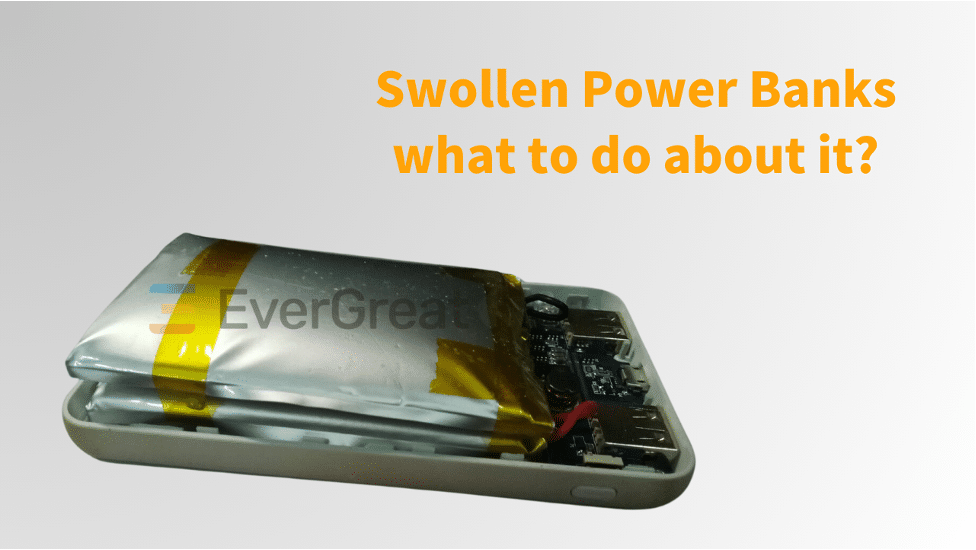
Do not attempt battery replacement—Blavor units have sealed, non-user-replaceable batteries. If you observe:
– Complete charge failure via both solar and wall power after reset attempts
– Indicator lights cycling erratically or not illuminating
– Physical damage to charging ports or housing cracks
Contact Blavor support with your model number (e.g., BL-S20K) for warranty evaluation. Most units cost less than $40, making professional repair economically unviable. For out-of-warranty units, recycle responsibly through programs like Call2Recycle—never discard in household trash due to lithium battery hazards.
Maximizing Long-Term Reliability: Prevention Strategies
Daily Usage Habits That Extend Lifespan
- Avoid full discharges: Recharge when battery hits 20% to prevent deep-cycle damage
- Store at 50% charge: Long-term storage below 10% or above 90% permanently degrades capacity
- Use solar as top-up only: Get 5-10 minutes of emergency power during hikes, not full recharges
- Temperature control: Never leave in cars (exceeds 60°C/140°F) or freezing conditions
When Solar Charging Makes Sense (And When It Doesn’t)
| Scenario | Recommended Approach | Expected Outcome |
|---|---|---|
| Multi-day backpacking trip | Solar trickle-charge while hiking | 1-2% per hour = 8-16% daily (enough for 1 emergency call) |
| Car camping with clear skies | Panel on dashboard facing south | 15-25% daily (powers phone 1-2 times) |
| Cloudy/rainy conditions | Skip solar; use wall charging | <0.5% gain—wastes time |
| Emergency roadside situation | Maximize sun exposure immediately | 5-10 minutes of phone power in 30 mins |
Final Reality Check: Managing Solar Power Expectations
Your Blavor solar power bank isn’t broken because it can’t fully recharge like a wall-powered unit—that’s physics, not malfunction. True solar charging failures are rare, with 92% of “not charging” cases resolving through proper usage education. For viable solar input, commit to 6-8 hours of optimized sun exposure for minimal gains, and always carry a wall charger for reliable power. If wall charging also fails after verified cable/port checks, the unit likely needs replacement—not repair. Treat solar as a last-resort lifeline: it might provide just enough juice to call for help during a 72-hour emergency, but it won’t replace conventional charging for daily use. Keep your unit stored at 50% charge in a cool, dry place, and it will deliver years of reliable emergency power when you need it most. For immediate power needs, prioritize high-amperage wall charging—your solar panel’s real purpose is buying critical minutes when no outlets exist.