You’ve probably stared at that compact 5000mAh power bank wondering, “Will this actually get me through my day?” If your phone dies during an important work call or your navigation fails on a road trip, you’ll wish you’d understood exactly how long your 5000mAh power bank lasts before it was too late. The truth is, that small power bank won’t give you the full 5000mAh you paid for—and the actual runtime depends entirely on what you’re charging and how you’re using it.
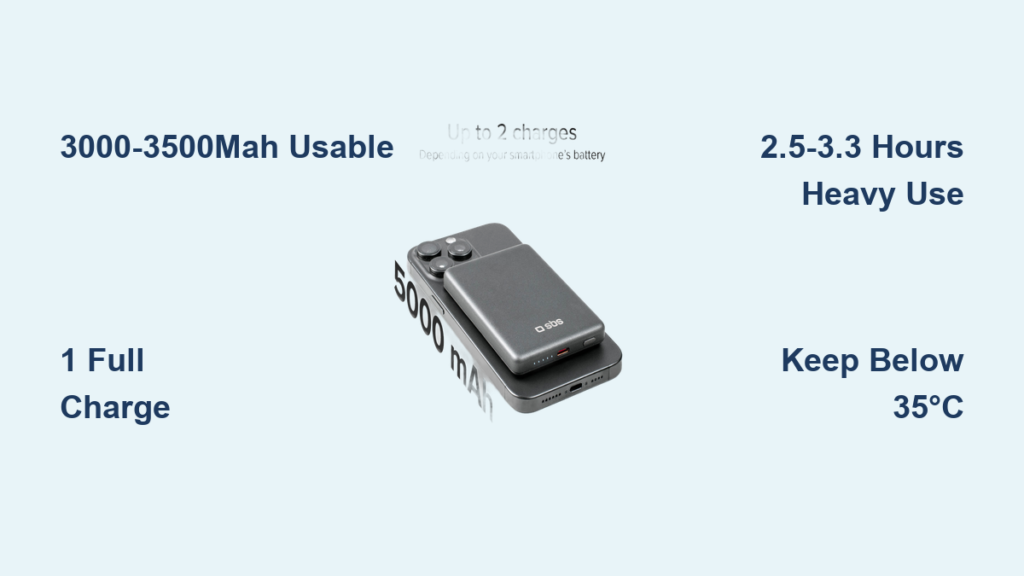
While manufacturers advertise 5000mAh capacity, real-world performance typically delivers only 3000-3500mAh to your device due to energy conversion losses. For most modern smartphones with 3000-4000mAh batteries, this means you’ll get approximately one full charge plus a bit extra—perfect for daily emergencies but not for extended trips.
This guide cuts through the marketing hype to show you exactly how long your 5000mAh power bank will last with your specific devices and usage patterns, so you can make informed decisions before your next outing.
Precise Runtime Estimates for Different Phone Usage Scenarios
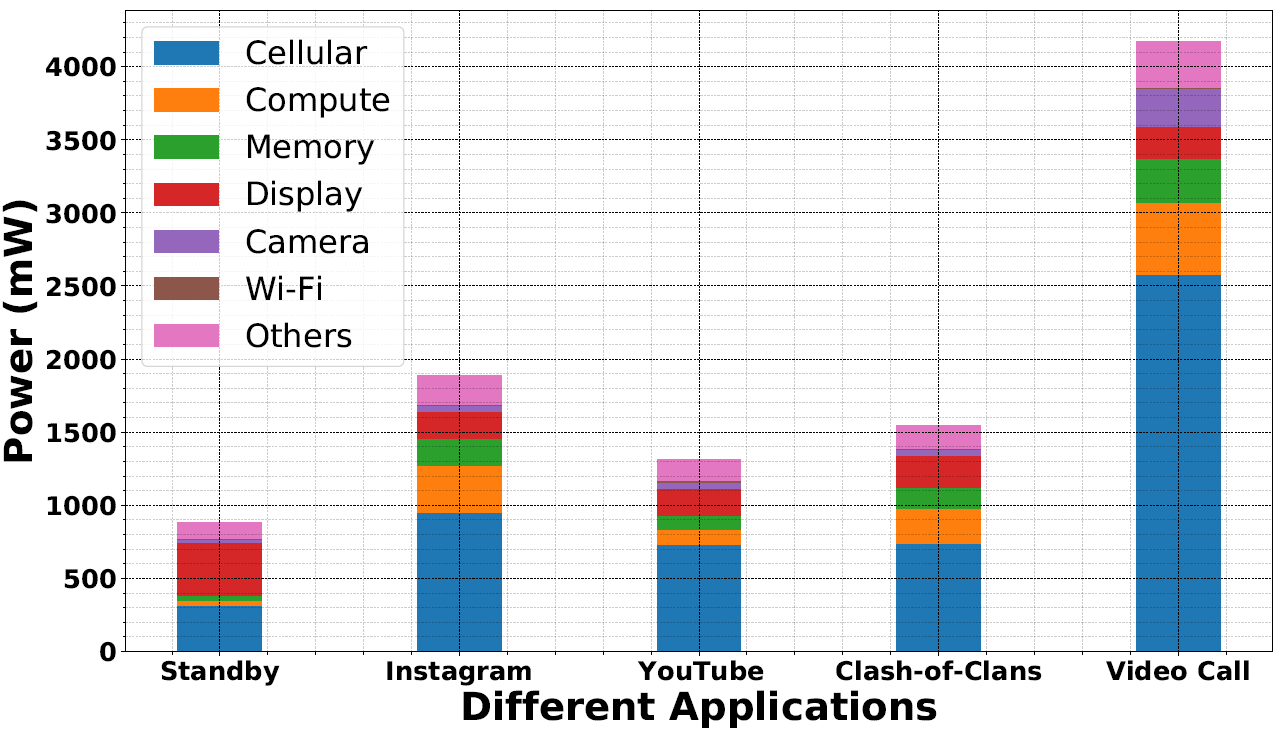
Your actual power bank runtime varies dramatically based on what you’re doing with your phone. Don’t trust generic “full charge” claims—know exactly what to expect for your specific habits.
Light Usage: Texting, Music, and Occasional Browsing
When you’re mostly texting, listening to music, and checking social media occasionally with your screen at moderate brightness, your phone draws about 500mA. In this scenario, your 5000mAh power bank delivers approximately 10 hours of screen-on time.
Real-world example: This is perfect for a workday where you’re mostly in the office with your phone on your desk, checking messages between meetings. You could comfortably get through a full workday plus evening relaxation without worrying about your phone dying.
Moderate Usage: Social Media, Email, and Video Streaming
If you’re actively scrolling through Instagram, watching YouTube videos, using navigation apps, and responding to emails throughout the day, your phone consumes about 800mA. Here, your 5000mAh power bank provides roughly 6 hours and 15 minutes of active screen time.
Pro Tip: Streaming just one hour of video consumes as much power as three hours of texting. If you notice your power bank draining faster than expected during a trip, check your video streaming habits first.
Heavy Usage: Gaming, 4K Video, and GPS Navigation
When you’re gaming intensely, streaming 4K video at full brightness, or using GPS navigation for extended periods, your phone can pull 1500-2000mA. Under these conditions, your 5000mAh power bank lasts only 2.5 to 3.3 hours before it’s completely depleted.
Critical Warning: Using your phone while charging it dramatically reduces effective runtime. If you’re gaming while charging, you might only get 1.5 hours from your power bank instead of the theoretical 3 hours.
Standby Mode: When Your Phone is Idle but Connected
If you’re using your phone primarily for emergency calls and notifications while keeping the screen off, your device might draw only 10-20mA. In this scenario, your 5000mAh power bank could theoretically last over 13 days in standby mode.
Realistic Note: Modern smartphones rarely stay in true standby—background apps and notifications will reduce this to about 5-7 days in practical use.
Why Your 5000mAh Power Bank Never Delivers 5000mAh
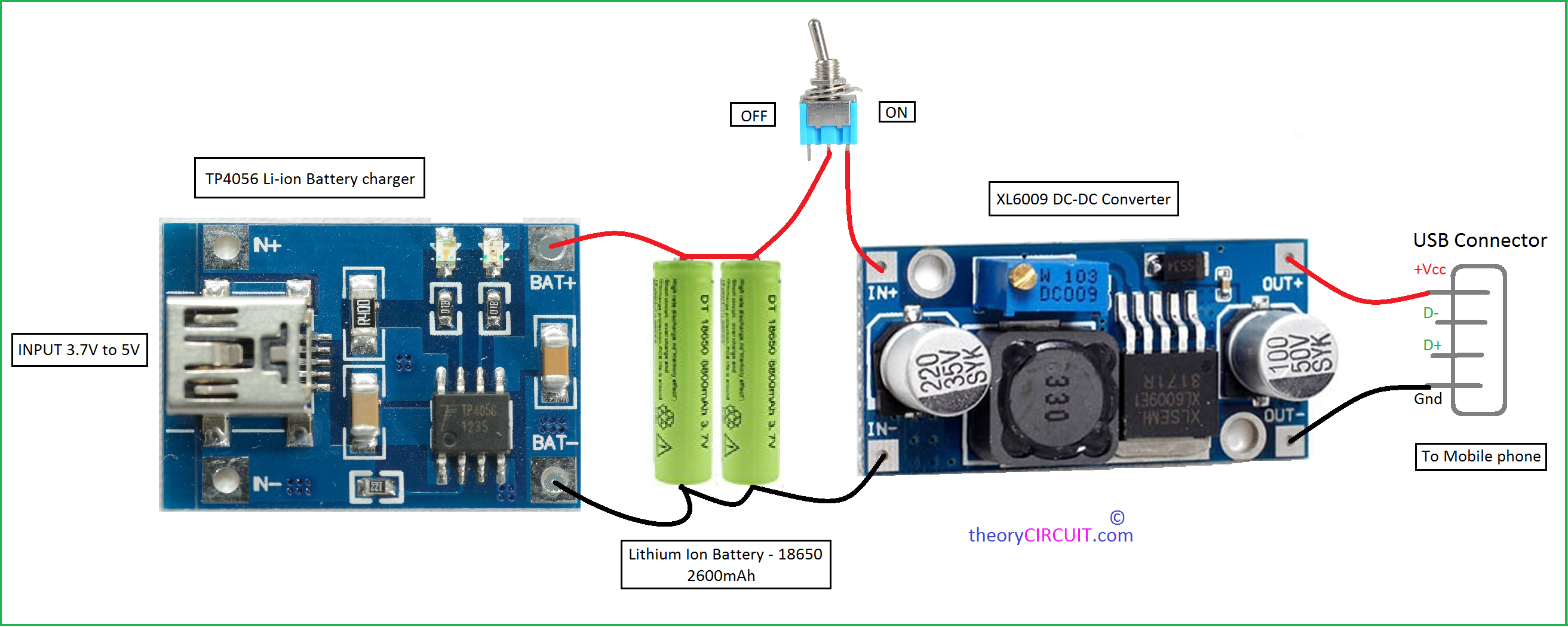
The biggest misconception about power banks is that the advertised capacity equals what your device receives. Understanding these conversion losses is crucial for setting realistic expectations.
The Voltage Conversion Reality Check
Power banks store energy at 3.7V but output at 5V for USB devices. This conversion alone reduces your usable capacity significantly:
(5000mAh × 3.7V) / 5V = 3700mAh of actual usable energy
This simple calculation shows why you never get the full 5000mAh—physics dictates that only about 74% of the rated capacity is theoretically available at the USB output.
Efficiency Losses You Can’t Avoid
Beyond voltage conversion, additional energy is lost as heat during the transfer process:
- Basic power banks: 15-25% efficiency loss (delivering only 70-85% of theoretical output)
- High-quality power banks: 10-15% efficiency loss (delivering 85-90% of theoretical output)
- Wireless charging: Adds another 10-20% loss on top of standard efficiency issues
What this means for you: A premium 5000mAh power bank might deliver 3300mAh to your phone, while a budget model might only provide 2600mAh—nearly a 25% difference in real-world performance.
How to Calculate Exactly How Long Your Power Bank Will Last
Stop guessing and start calculating precise runtime for your specific devices using this proven method.
Step-by-Step Calculation Process
-
Determine your power bank’s effective capacity: Multiply rated capacity by efficiency factor
– Example: 5000mAh × 0.85 = 4250mAh effective capacity -
Find your device’s actual battery capacity: Check your phone’s specifications (typically 3000-4000mAh for modern smartphones)
-
Calculate available charges: Divide power bank’s effective capacity by your device’s capacity
– Example: 4250mAh ÷ 3500mAh = 1.21 full charges -
Adjust for your usage pattern: Multiply by your typical usage efficiency
– Example: 1.21 charges × 0.8 (for moderate use) = 0.97 “usable” charges
Real-Device Examples You Can Relate To
- iPhone 13 (3227mAh battery): Your 5000mAh power bank provides approximately 1.1-1.3 full charges
- Samsung Galaxy S22 (3700mAh battery): Expect about 0.9-1.1 full charges
- Google Pixel 6 (4614mAh battery): Get roughly 0.7-0.9 full charges
Expert Note: These calculations assume your phone starts at 0%—in reality, you’ll rarely drain your phone completely before using the power bank, so actual usage typically yields more “top-up” value than these numbers suggest.
5 Critical Factors That Determine Your Power Bank’s Real Runtime
Temperature Extremes That Cripple Performance
Using your power bank in temperatures below 10°C (50°F) or above 35°C (95°F) can reduce effective capacity by 20-50%. Winter travelers often experience this dramatically—your power bank might deliver only half its rated capacity when used outdoors in freezing conditions.
Pro Tip: Keep your power bank close to your body in cold weather to maintain optimal temperature, but avoid direct sunlight in hot climates.
Battery Age and Health Degradation
A 5000mAh power bank loses capacity with each charge cycle:
– After 1 year (about 300 cycles): 90-95% capacity remaining (4500-4750mAh)
– After 2 years (about 500 cycles): 85-90% capacity (4250-4500mAh)
– After 3 years (about 800 cycles): 80-85% capacity (4000-4250mAh)
Warning: Power banks left unused for extended periods degrade faster—use yours at least once every 3 months to maintain battery health.
Your Device’s Screen Technology Matters
AMOLED screens (common in premium phones) save significant power when displaying dark content, while LCD screens consume consistent power regardless of content. If your phone has an AMOLED display and you use dark mode, your power bank will last noticeably longer than with a standard LCD display.
Quick Fix: Enable dark mode on AMOLED devices to potentially extend your power bank’s runtime by 15-25%.
Network Conditions That Drain Power Unexpectedly
Poor cellular signal forces your phone to work harder, potentially doubling power consumption. If you’re in an area with only 1-2 bars of signal, your power bank might last only half as long as expected.
Solution: Enable airplane mode in areas with extremely poor signal, then turn on Wi-Fi if available—this can reduce power consumption by up to 20%.
Charging Speed and Technology Compatibility
Using a power bank with Quick Charge or USB-PD technology compatible with your device can improve efficiency by 5-10% compared to standard charging. However, fast charging generates more heat, which can reduce overall efficiency if temperatures rise too high.
Maximizing Your 5000mAh Power Bank’s Real-World Performance
Smart Charging Habits That Extend Usable Runtime
- Charge your power bank to 80-90% for daily use instead of 100%—this maintains battery health longer
- Keep your power bank between 20-80% when storing it for extended periods
- Avoid charging in direct sunlight or hot cars, which accelerates battery degradation
Device Optimization Before Using Your Power Bank
Before connecting your power bank, maximize its effectiveness with these quick steps:
1. Dim your screen brightness to 50% or lower
2. Disable Bluetooth, GPS, and Wi-Fi if not needed
3. Close all background apps, especially social media and navigation
4. Enable battery saver mode on your device
Time-Saver: These four steps can extend your power bank’s effective runtime by 25-40%—potentially adding an extra hour of usage when you need it most.
When to Choose a Larger Capacity Power Bank
While a 5000mAh power bank is perfect for daily top-ups, consider upgrading if:
– You regularly use your phone for gaming or 4K video
– You travel frequently without access to outlets
– You need to charge multiple devices simultaneously
– You often find yourself with less than 20% battery by midday
For these scenarios, a 10,000mAh power bank provides significantly more peace of mind while still remaining pocketable.
Is a 5000mAh Power Bank Right for Your Daily Needs?
A 5000mAh power bank delivers exactly one full charge for most modern smartphones under moderate usage conditions, making it ideal for daily commuters, short trips, or as an emergency backup. If your typical day involves checking email, social media, occasional calls, and light web browsing, this capacity will comfortably get you through until you can reach an outlet.
However, if you’re a heavy user who streams video, plays games, or relies on navigation throughout the day, you’ll find a 5000mAh unit depletes faster than expected—often requiring midday recharging of the power bank itself. In these cases, stepping up to 10,000mAh provides much-needed breathing room without significantly increasing size.
Final Recommendation: For 90% of users, a quality 5000mAh power bank is the perfect balance of portability and practicality. Just remember to manage your device’s power consumption while using it, and you’ll consistently get through your day without anxiety about your phone dying. When traveling or expecting heavy usage, pair it with good battery habits or consider a slightly larger capacity model for true peace of mind.