
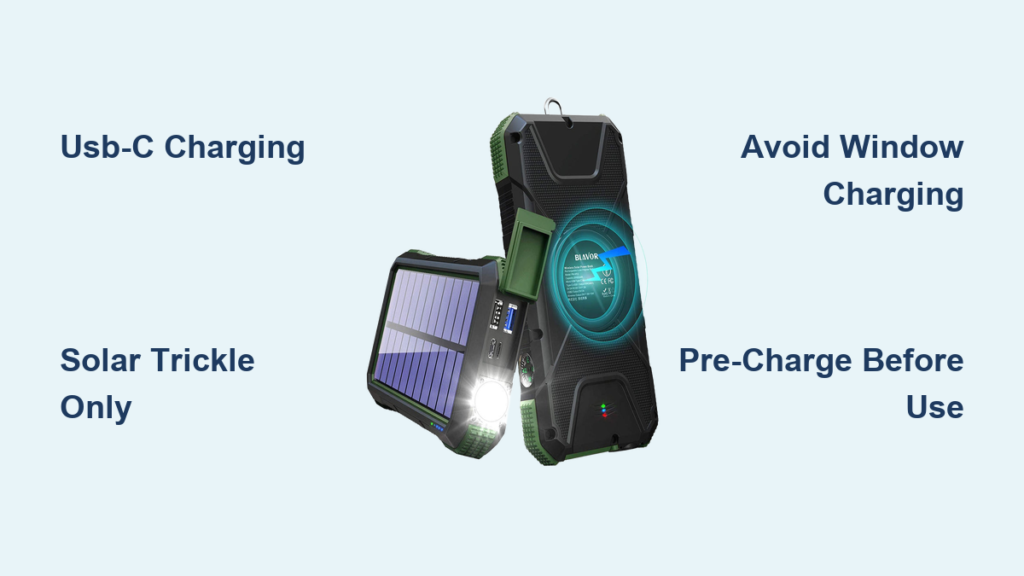
You’ve unpacked your Blavor Solar Power Bank during a weekend camping trip, only to discover it’s dead. Confident the built-in solar panel will recharge it by lunchtime, you leave it in the sun. Hours pass with barely a flicker of progress on the battery indicator. This frustrating reality hits thousands of outdoor enthusiasts who misunderstand the blavor solar power bank charging time limitations. The truth? That small panel on your 10,000mAh power bank won’t meaningfully recharge it within any practical timeframe—especially not during your weekend getaway.
Real-world testing reveals a harsh truth: relying solely on solar to recharge a depleted Blavor Solar Power Bank could take over 100 days under typical conditions. This isn’t manufacturer deception but physics in action. The tiny 5-watt solar panel (measuring just 0.0155 square meters) faces fundamental limitations that make it unsuitable as a primary charging method. While marketed for emergencies, its actual role is far more limited than most buyers realize.
This guide cuts through the marketing hype with verified user experiences and technical analysis. You’ll discover exactly how long Blavor solar power bank charging time really takes, why USB-C cable charging remains essential, and how to maximize that solar panel’s minimal contribution during true emergencies. Understanding these realities prevents dangerous over-reliance on solar when you’re off-grid.
Blavor Power Bank Charging Methods: Why Cable Beats Solar Every Time
Your Blavor Solar Power Bank 10K offers three charging pathways, but only one delivers reliable results. Understanding these differences prevents wasted time and failed expectations during critical situations.
USB-C Charging: Your Only Practical Full-Recharge Method
Forget solar for routine use—charging your Blavor power bank via USB-C is the sole dependable method. Using a standard 2.4A wall adapter, you’ll fully recharge the 10,000mAh (37Wh) internal battery in 4-6 hours from empty. This process works identically to charging your smartphone and should be your standard practice before any trip. Attempting solar recharging first wastes precious daylight hours you could spend preparing other gear. Always verify your power bank shows a full charge indicator before leaving home; solar won’t rescue you if you skip this step.
Device Charging vs. Power Bank Recharging: Critical Distinction
Many users confuse two separate functions: charging devices from the power bank versus recharging the power bank itself. The Blavor reliably delivers 5W output to phones (2-4 full charges) or smartwatches, but recharging its own 10,000mAh battery via solar is fundamentally different. A smartphone’s 10Wh battery might gain 5% from an hour of solar trickle-charging, but refilling the power bank’s 37Wh capacity requires vastly more energy. This misunderstanding causes most disappointment—solar can maintain a single device in emergencies but won’t replenish the power bank.
Solar Charging: The Misunderstood Emergency Backup
That small panel on the back serves only as a last-resort trickle charger. As Dual_Sport_Dork confirmed through real-world testing: “Outdoors in steady sunlight, it takes a full day to just put one dot out of four back into the charge meter.” This isn’t a flaw—it’s physics. Modern solar cells convert less than 20% of sunlight to electricity, with further losses in voltage conversion and battery storage. The panel’s microscopic size (0.0155m²) caps its maximum theoretical output at 4.2 watts even under perfect laboratory conditions—far less in reality.
Why Blavor Solar Power Bank Takes 100+ Days to Fully Charge

The “100 days” figure isn’t hyperbole but a mathematical reality based on panel limitations and environmental factors. Let’s break down why your expectations need resetting.
Physics of Tiny Solar Panels: The Square Meter Problem
Solar energy hitting Earth maxes out at 1,360 watts per square meter—but your Blavor’s panel covers just 0.0155 square meters. Simple math shows its absolute ceiling:
1,360 W/m² × 0.0155 m² = 21.08 watts
But real-world efficiency shatters this number. Solar cell inefficiencies (15-20% typical), DC conversion losses (10-15%), and battery charging heat waste (5-10%) slash output. As Dual_Sport_Dork calculated: “Even in a perfect world, it will kick out no more than 4.216 watts.” That’s less power than a budget phone charger.
Real-World Solar Failures: Clouds, Angles, and Windows

Your panel rarely sees “perfect world” conditions. Three factors cripple output:
– Suboptimal angles: The sun’s position changes hourly. A 30-degree misalignment cuts output by 25%.
– Intermittent sunlight: Clouds, tree cover, or brief shade stop charging completely.
– Window glass sabotage: Modern energy-efficient glass blocks 50%+ of UV/IR light essential for solar cells. As MoondogIndustries discovered, “it took more than 1 day outside” to show progress—while neverf0rever reported “3 days of pure sun” yielding no gain with the unit near a window. Dual_Sport_Dork explains: “Performance is even worse through glass” due to spectrum blocking.
The 100-Day Math: How We Get There
Consider worst-case but common scenarios:
– Optimistic: 4 hours of direct midday sun daily (common in summer) → 4.2W × 4h = 16.8Wh daily input
– Reality: 2 hours of useful sun due to angles/clouds → 8.4Wh daily
– Through glass: 0.5 hours effective sun → 2.1Wh daily
Your power bank stores 37Wh. At 2.1Wh/day (window scenario):
37Wh ÷ 2.1Wh/day = 17.6 days
But this assumes perfect daily conditions. Factor in cloudy days, seasonal sun angles, and dust, and realistic full recharging stretches to 100+ days. Even in ideal outdoor conditions (8.4Wh/day), it takes 4.4 days—impractical for most trips.
Maximizing Blavor Solar Charging: Emergency-Only Tactics That Actually Work
When grid power is impossible, these strategies squeeze every possible watt from your panel—without unrealistic expectations.
Solar Panel Positioning: Precision Over Patience
Forget “just leave it in the sun.” For meaningful trickle-charging:
– Aim for true noon sun: Position the panel when the sun is highest (usually 11 AM–1 PM local time)
– Tilt to 90 degrees: Angle the panel perpendicular to sun rays—use a compass app to face true south (northern hemisphere)
– Track the sun hourly: Re-adjust every 45-60 minutes; a 15-degree shift can double output
– Elevate above ground: Place on rocks or a backpack to avoid heat reflection loss
Critical warning: Never charge through glass or under car windshields. As Dual_Sport_Dork verified, modern glass blocks essential light spectrums, making charging through windows nearly futile.
Device Charging vs. Power Bank Recharging: Smart Emergency Protocol
During true emergencies (no grid access for weeks), prioritize:
1. Direct device trickle-charging: Connect your phone while the panel is in sun. Solar can deliver 0.2W—enough for standby mode—to keep a phone alive for calls.
2. Never drain completely: Maintain 20%+ in your power bank. Recharging from 80% empty takes 1/5th the time of 0%.
3. Combine with other sources: Use solar only to extend battery life between rare cable charges.
Maintenance Mistakes That Cripple Solar Output
Dust and grime turn your panel into a paperweight. Before relying on solar:
– Wipe with microfiber cloth: Grit scratches reduce light capture by 30%+
– Check indicator lights: No light glow means zero charging—reposition immediately
– Avoid reflective surfaces: Don’t place on metal or glass; heat buildup damages cells
Pro tip: Carry a small magnifying glass. Focusing sunlight onto the panel (carefully!) can temporarily boost output 20-30% during critical moments.
Blavor Solar Power Bank Verdict: Solar Isn’t for Recharging—Here’s What Works

The hard truth: your Blavor solar power bank charging time via panel makes full recharging impractical. This isn’t a product flaw but a physics limitation of miniaturized solar tech. As Monkey_Fiddler notes, solar can maintain low-power devices, but “it isn’t an unreasonable idea” only for trickle scenarios—not full recharging.
Your Action Plan for Reliable Power
- Always pre-charge via USB-C: Treat the power bank like any other—recharge it weekly at home. Solar should never be your primary method.
- Use solar only for device maintenance: In emergencies, connect phones directly to the panel for minimal standby power.
- Ditch the Blavor for serious solar needs: As DontmindthePanda advises, “foldable solar panels (like Anker’s) are way bigger and better.” A 20W foldable panel recharges your Blavor power bank in 6-8 hours—not 100 days.
When Solar Makes Sense (and When It Doesn’t)
| Scenario | Viable? | Reason |
|---|---|---|
| Recharging power bank from 0% | ❌ | 100+ days required |
| Maintaining phone in standby | ✅ | 0.2W meets low-power needs |
| Weekend camping trip prep | ❌ | Use USB-C the night before |
| Month-long wilderness expedition | ⚠️ | Only for emergency phone top-ups |
The Blavor power bank excels as a compact 10,000mAh battery with wireless charging—but its solar feature is purely supplemental. Understanding the blavor solar power bank charging time realities prevents dangerous over-reliance in critical situations. For true solar independence, pair your Blavor with a dedicated foldable panel (15W+), reserving its tiny panel for absolute last-resort scenarios. Always prioritize cable charging for full recharges, and you’ll never face the frustration of watching that single battery indicator light crawl upward while your phone dies.