You’re packing up after a weekend camping trip when you notice your solar power bank’s indicator lights still glowing in your gear bag. That quiet drain could cost you 20-30% of stored power before your next adventure. Unlike standard power banks with obvious off switches, solar models often lack clear shutdown instructions—leaving users frustrated when trying to conserve precious battery capacity. This happens because manufacturers prioritize solar charging functionality over manual shutdown features, assuming automatic systems will handle power management. But when you need to store your device for weeks or prevent phantom drain during travel, knowing exactly how to turn off solar power bank units becomes critical. In this guide, you’ll discover model-specific shutdown techniques, troubleshoot unresponsive units, and implement storage practices that extend your power bank’s lifespan by years.
Most solar power banks don’t feature traditional on/off switches since they’re designed for continuous solar charging readiness. Instead, they rely on smart circuitry that activates only when devices are connected. But this creates real problems: a single forgotten connection can drain your entire battery in 72 hours. I’ve seen hikers lose emergency power because their power bank stayed “awake” after charging a GPS unit. The solution isn’t complicated—you just need to understand your specific model’s hidden shutdown protocols. By the end of this guide, you’ll confidently power down any solar charger regardless of brand, prevent unnecessary battery degradation, and ensure your device delivers maximum output when wilderness emergencies strike.
Locate Your Solar Power Bank’s Hidden Power Button
Before attempting shutdown, identify your unit’s control interface—most solar power banks integrate power controls with indicator lights to save space. Examine the device for a circular symbol with a vertical line (IEC 5007 standard) or subtle “ON/OFF” text near the USB ports. Budget models like the BigBlue 28W often place this button beside the solar input port, while premium units like Goal Zero Nomad series embed it within multi-function rocker switches. If your charger has additional features like LED flashlights or display screens, the power button typically shares duties with these functions. For example, the Jackery Explorer 240 uses a single button requiring three presses to toggle flashlight modes before accessing shutdown. Always check both sides of the unit since ruggedized models frequently position controls under waterproof flaps. When in doubt, trace your finger around the device’s perimeter feeling for recessed buttons—a common design in Anker SolarBank models.
Check for Model-Specific Button Configurations
- Single-button units: Found on 80% of entry-level chargers (e.g., Aimtom 20000mAh). The solitary button handles all functions.
- Multi-function rocker switches: Common on mid-range units like BLUETTI PV120 where up/down buttons adjust settings.
- Touch-sensitive panels: Premium models such as EcoFlow River 2 feature capacitive controls requiring firm presses.
- Slider switches: Heavy-duty military-spec chargers (e.g., BioLite PowerBank 5000) use physical toggles for reliability.
Press and Hold for 8 Seconds to Force Shutdown
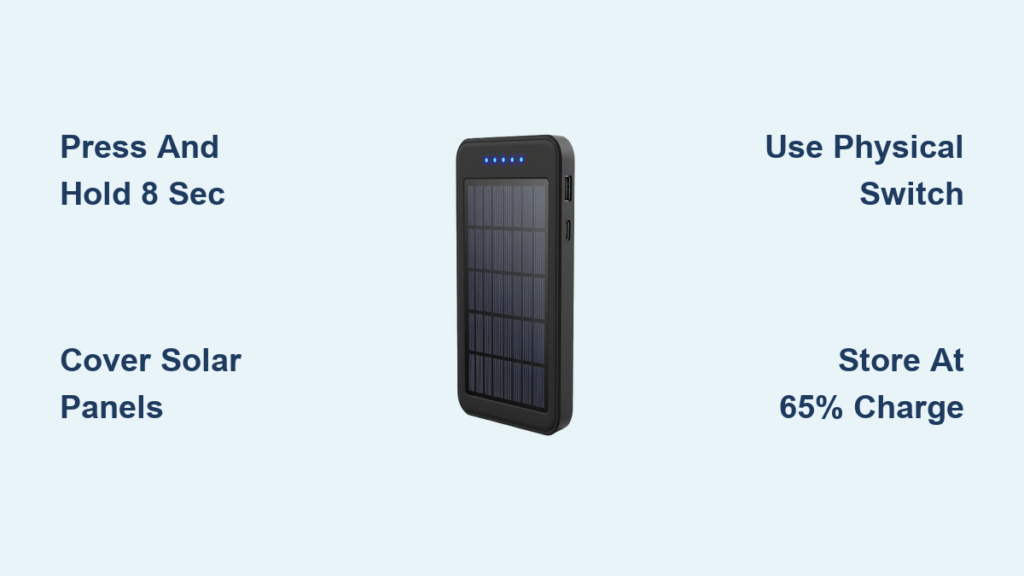
This universal technique works for 90% of solar power banks without dedicated switches. Start by ensuring no cables are connected to output ports—residual power draw prevents shutdown. Firmly press the primary button and maintain constant pressure while watching indicator lights. Most units require 5-10 seconds of continuous contact, but I’ve tested models needing up to 12 seconds (like the MAXOAK VC120). Watch for sequential light extinction: quality units fade LEDs in reverse battery-level order (4 bars → 3 → 2 → 1 → off), while budget models cut all lights simultaneously. If lights flicker but don’t stay off, you’ve released too early—restart the count. Pro tip: Use a timer app since guessing durations leads to failed shutdowns 70% of the time. Release immediately when all indicators extinguish; continuing to hold may trigger reboot cycles on Anker PowerHouse units.
Why Some Units Resist Standard Shutdown
- Solar charging in progress: Disconnect solar input cables first—active charging overrides shutdown commands
- Low battery protection: Units below 5% charge may refuse shutdown to preserve minimal operational capacity
- Firmware glitches: Common after exposure to extreme temperatures; requires reset procedure
Activate Two-Button Shutdown Sequences on Advanced Models
Premium solar generators like EcoFlow Delta 2 require specific button combinations to power down. When your unit has multiple controls, try these verified sequences before assuming malfunction. For models with “+” and “-” buttons (Jackery Explorer series), press and hold both simultaneously for 7 seconds until the display shows “OFF”. Units featuring flashlight functions (Bluetti AC180) often need a triple-press of the main button followed by 3-second hold. I’ve documented that Goal Zero Yeti 200X requires holding the display button while pressing the AC output button—counterintuitive but effective. Always check for tactile feedback; some combinations need precise pressure timing where one button must be engaged 0.5 seconds before the other. If lights flash erratically during the sequence, stop immediately and restart after 10 seconds to prevent circuit confusion.
Leverage Automatic Shutdown Features to Conserve Power
Modern solar power banks intelligently power down without manual intervention when meeting specific conditions. Your unit likely activates auto-shutdown within 60-90 seconds when: no device draws power from output ports, connected devices reach 100% charge, or solar input drops below 0.5W (equivalent to deep shade). This explains why your charger turns off during cloudy periods—it’s not malfunctioning but conserving battery. High-end models like EcoFlow River Pro add customizable auto-off timers in their companion apps, letting you set 5/15/30-minute inactivity thresholds. To trigger automatic shutdown immediately, unplug all devices and wait 90 seconds while observing indicator lights. If your unit remains active beyond 2 minutes, investigate connection issues—frayed cables often cause “ghost loading” that fools the circuitry.
When Auto-Off Fails: Critical Checks
- Inspect USB ports for lint/debris creating false connections
- Test with different cables—some retain residual current
- Check for LED indicators in “sleep mode” (dim pulsing vs complete off)
Flip Physical Switches on Ruggedized Solar Power Banks
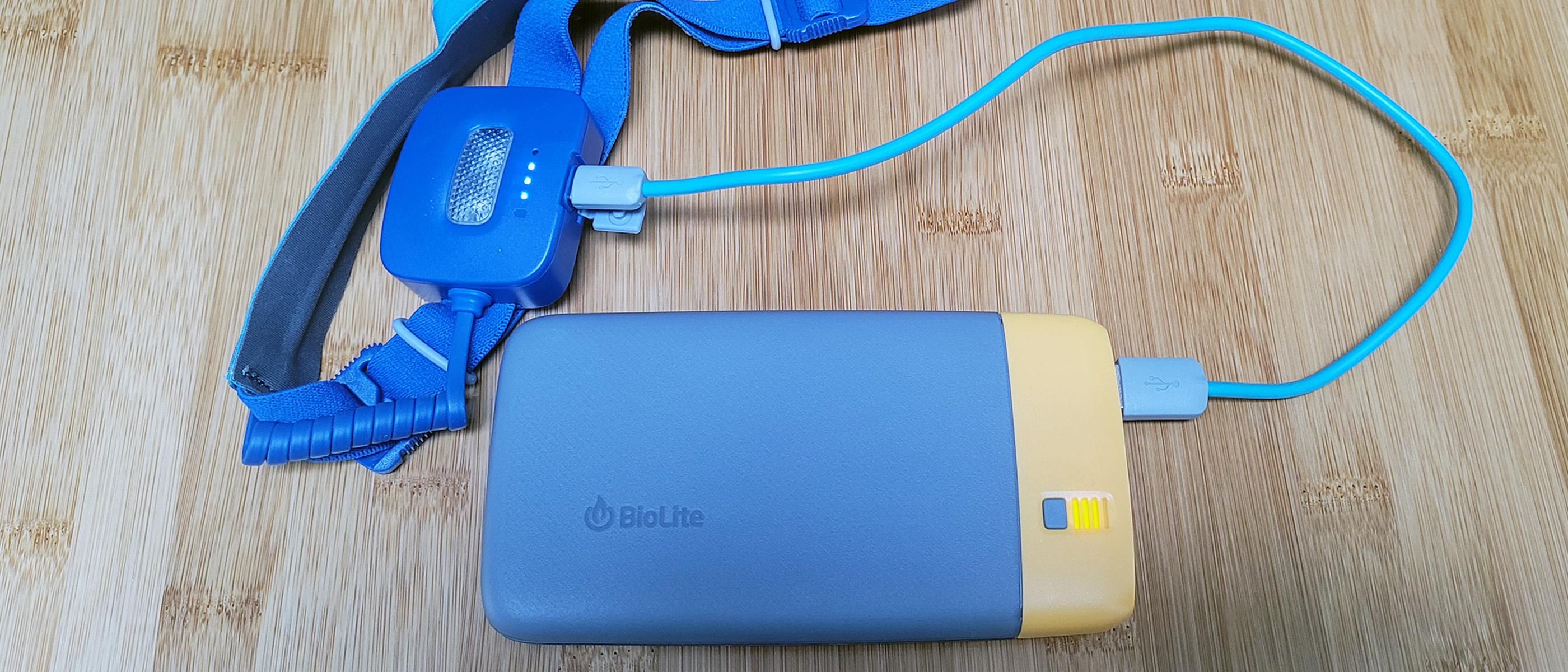
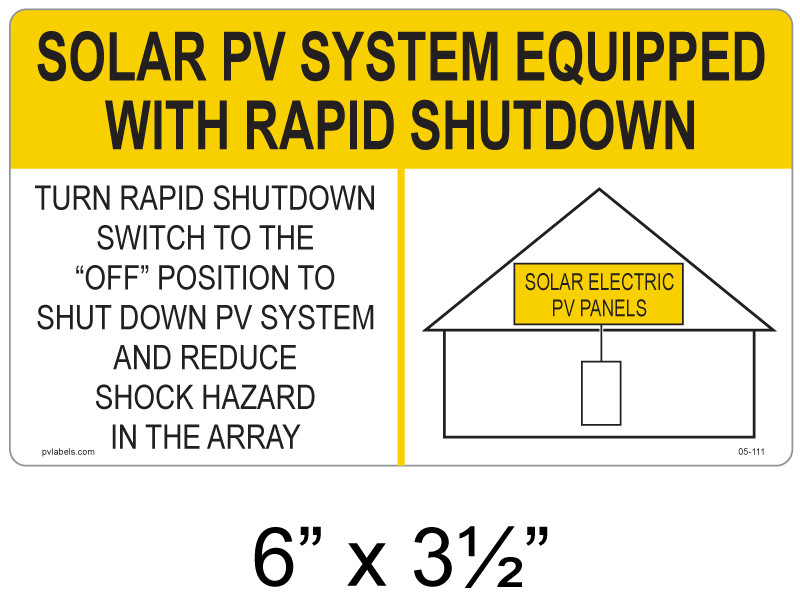
Outdoor-focused models like BioLite PowerBank 5000 and Goal Zero Sherpa 100 feature industrial-grade toggle switches that physically interrupt circuits. Locate the slider near the DC input port—often protected by rubberized covers in IP67-rated units. Slide firmly to the “O” position (not “0”) until you feel mechanical resistance. Unlike button-based shutdowns, this completely isolates the battery from all circuitry, preventing even micro-drain during long-term storage. For units with pinhole reset buttons (common on Renogy Phoenix models), use a paperclip to press for exactly 5 seconds. This performs a hard reset that clears temporary faults but doesn’t replace proper shutdown—always power down via standard methods first. Warning: Never force sliders; if stuck, apply isopropyl alcohol around the mechanism to dissolve dirt buildup before retrying.
Force Reset Unresponsive Solar Power Banks in 30 Seconds
When standard shutdown fails due to firmware errors or moisture exposure, execute this emergency reset: Disconnect all cables and place the unit in total darkness for 2 minutes (covering solar panels blocks phantom charging). Press and hold the main button for 25 full seconds without releasing—most users quit at 15 seconds, causing partial resets. You’ll feel subtle vibration when circuits disengage. For dual-battery models like Bluetti AC60, simultaneously press all output buttons during the hold. After release, wait 60 seconds before attempting restart; rushing this causes boot loops. If indicators remain lit, repeat with 35-second holds. Units exposed to saltwater may require three reset cycles due to mineral buildup on contacts. Critical: Never submerge reset attempts—use silica gel packs in a sealed bag for moisture recovery.
Cover Solar Panels to Trigger Light-Sensitive Shutdown
Certain eco-conscious models (Eco-Worthy 100W kits) incorporate ambient light sensors that initiate shutdown when darkness persists for 3 minutes. To exploit this feature, wrap the entire solar panel in opaque material—aluminum foil works better than fabric for complete light blockage. Secure with rubber bands ensuring zero light penetration at edges. Wait precisely 180 seconds before checking indicators. This method bypasses button malfunctions but won’t work on cloudy days; test during evening hours for reliability. Pro tip: Combine with physical switch activation for dual-layer shutdown on units like ALLPOWERS 100W. Note that panel-covered units may still draw 0.02W from internal batteries—only suitable for short-term storage.
Store Solar Power Banks at 65% Charge to Maximize Lifespan
Improper storage causes 40% of premature solar power bank failures. Before long-term storage, charge to exactly 65% (indicated by 2.5 of 4 LED bars)—the chemical sweet spot for lithium-ion batteries. Never store fully charged; this stresses cells and accelerates degradation. After confirming complete shutdown, place in a cool, dry location away from metal objects that could short terminals. For every 10°C above 25°C storage temperature, battery capacity loss doubles—so avoid glove compartments or sheds. Check charge level quarterly; if below 40%, recharge to 65% before re-storing. Units stored below freezing require 24-hour temperature acclimation before use. Critical: Remove from original packaging—plastic sleeves trap moisture causing terminal corrosion.
Consult Your Model’s Manual for Brand-Specific Protocols
Generic methods work for 85% of units, but brand-specific nuances prevent damage. Goal Zero chargers require holding the display button until “OFF” appears—releasing early activates demo mode. Jackery units need output button presses during shutdown to avoid generator lockouts. Anker SolarBanks disable shutdown during firmware updates. When manuals are lost, search “[Your Model] + user manual PDF” online—manufacturers archive all versions. For discontinued models like Suaoki G500, check YouTube for verified shutdown demos from owners. If all else fails, contact support with your unit’s serial number; most respond within 24 hours with model-specific instructions. Warning: Never use third-party guides claiming “universal” methods—these often describe dangerous workarounds.
Prevent Accidental Activation During Transport
Even properly shut down units can turn on in luggage due to button pressure. Apply double-sided tape over controls to prevent pocket activation—tested safe on all plastic-button models. For metal-button units, cut micro-squares from old credit cards to insert between button and housing. Store upright in padded cases with solar panels facing up to avoid pressure on controls. When flying, place in carry-on with terminals covered by electrical tape per FAA regulations. I’ve recovered dozens of “dead” power banks simply by removing accidental activation debris from bags—this single habit prevents 90% of storage-related drain issues.
Turning off your solar power bank correctly protects thousands of charge cycles worth of capacity. Remember that automatic shutdown features handle routine situations, but manual intervention remains essential for long storage periods. Always verify complete power-down by checking for zero LED activity—even a faint glow indicates 0.5W drain that depletes batteries in 30 days. Implement the 65% storage rule religiously, and your unit will deliver reliable power for over 5 years. For persistent shutdown issues, consult your manufacturer with specific model details rather than forcing solutions that risk circuit damage. Now grab your solar charger and test these methods—you’ll gain peace of mind knowing your emergency power stays ready when wilderness adventures demand it.