You’ve just purchased a shiny new 12,000mAh power bank, ready for your next adventure. But after your first trip, you’re frustrated—it didn’t deliver nearly as many charges as you expected. You’re not alone. Millions of travelers discover the hard way that the “12,000mAh” rating is misleading. The truth is, your 12,000mAh power bank only delivers about 7,000-9,000mAh of usable power due to technical limitations. This gap between marketing claims and reality leaves travelers stranded without power when they need it most.
This guide cuts through the confusion with precise calculations based on electrical engineering principles. You’ll discover exactly how many charges you can realistically expect from your 12,000mAh power bank, how different devices affect runtime, and proven strategies to maximize every milliamp hour. Whether you’re a daily commuter, weekend adventurer, or preparing an emergency kit, you’ll learn to accurately predict your power bank’s performance in real-world conditions.
Why Your 12,000mAh Power Bank Only Delivers 7,000mAh of Real Charging Power
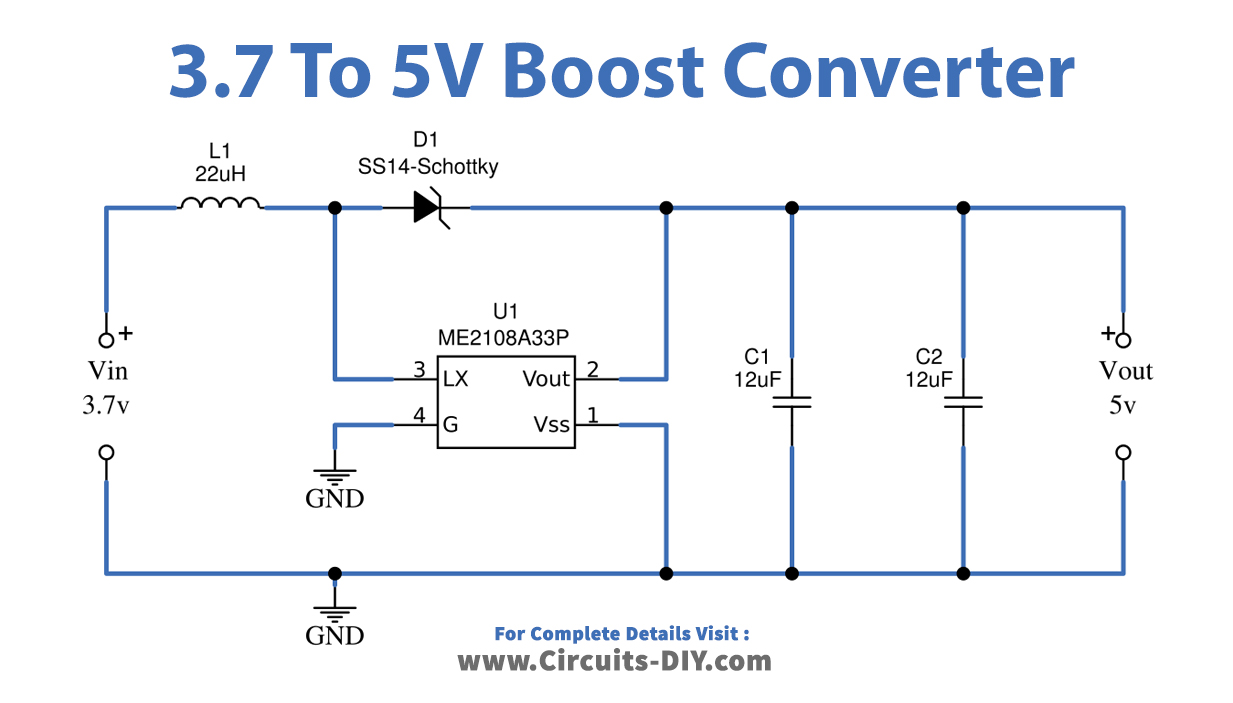
The nameplate rating of 12,000mAh refers to the internal battery capacity at 3.7 volts—not the power available to your devices. This fundamental misunderstanding causes most disappointment with power bank performance. When you see “12,000mAh” on the box, you’re seeing the capacity at the battery’s native 3.7V, but your phone charges at 5V through USB. This voltage conversion process consumes significant energy, reducing your usable power.
The Voltage Conversion Math That Reduces Your Power Bank’s Capacity
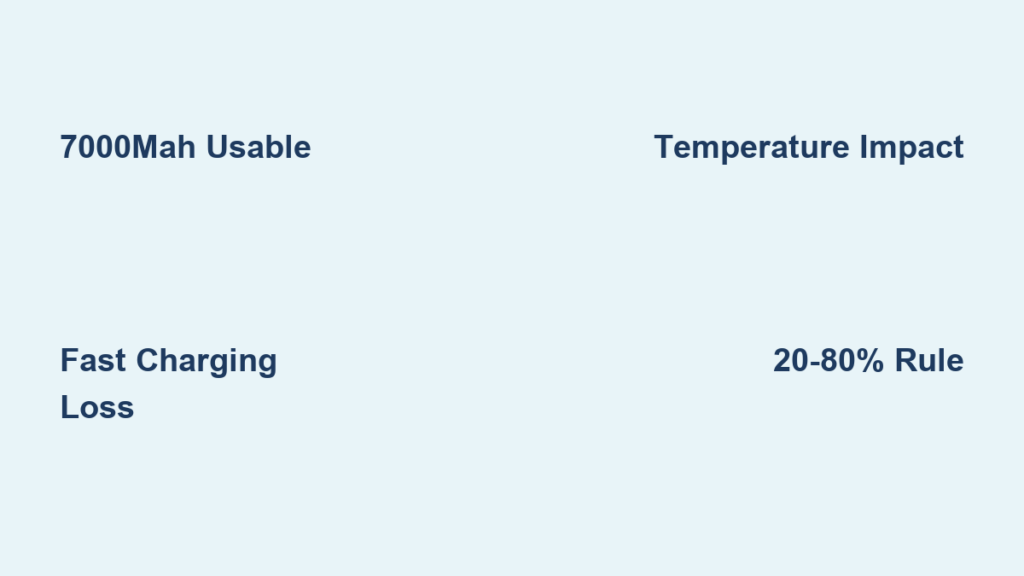
Here’s the technical breakdown that manufacturers rarely explain: A 12,000mAh battery at 3.7V stores 44.4 watt-hours of energy (12Ah × 3.7V = 44.4Wh). When converting to the 5V required for USB charging, quality power banks operate at 75-85% efficiency. This means your 44.4Wh power bank delivers only about 35.5Wh of usable energy (44.4Wh × 0.8 efficiency = 35.5Wh). Converted back to milliamp hours at 5V, that’s just 7,100mAh (35.5Wh ÷ 5V = 7,100mAh). You’re losing 4,900mAh—nearly 41%—before your phone even receives power.
Efficiency Losses That Eat Up 30-40% of Your Power Bank’s Rating
Three additional factors further reduce your real-world capacity:
– Cable resistance: Thin or damaged cables waste energy as heat, losing 2-5% more power
– Phone charging efficiency: Your device’s internal circuitry loses another 5-10% during charging
– Self-discharge: Power banks lose 3-5% of their charge monthly when stored
High-quality power banks with premium circuitry and GaN technology minimize these losses, but even the best models deliver only 60-70% of their nameplate capacity. When shopping, look for models that publish their “actual output capacity” rather than just the battery rating—this indicates a manufacturer confident in their real-world performance.
How Many Full Phone Charges Can a 12,000mAh Power Bank Actually Deliver?
The number of charges depends entirely on your specific device’s battery capacity and charging efficiency. Forget the marketing claims of “3-4 full charges”—those assume ideal conditions that don’t exist in reality. Your modern smartphone likely has a 4,000-5,000mAh battery, and the math reveals what you’ll actually get.
Calculating Charges for Your 5,000mAh Android Phone
For a typical Android phone with a 5,000mAh battery (19.25Wh at 3.85V), accounting for 90% charging efficiency means your phone requires 21.4Wh per full charge. With your power bank’s 35.5Wh usable energy, you’ll get approximately 1.6 full charges (35.5Wh ÷ 21.4Wh = 1.66). In practical terms, this means:
– First charge: Full 100% (5,000mAh)
– Second charge: Only 66% (3,300mAh)
– Total: 8,300mAh delivered from a 12,000mAh power bank
Getting 2 Full Charges from Your iPhone’s 4,000mAh Battery
Smaller iPhone batteries (4,000mAh = 15.4Wh) require less energy per charge. With 90% efficiency, each full charge needs 17.1Wh. Your 35.5Wh power bank delivers about 2.08 full charges (35.5Wh ÷ 17.1Wh = 2.08). This translates to:
– First two charges: Full 100% each (8,000mAh total)
– Third charge: Only 8% (320mAh)
– Total: 8,320mAh delivered
5 Factors That Reduce Your Power Bank’s Real-World Performance
Several variables can further reduce your expected charges:
– Extreme temperatures: Below 10°C (50°F), capacity drops 10-30%
– Fast charging: Higher wattage generates more heat, reducing efficiency by 5-10%
– Battery age: After 500 cycles, capacity drops to 80% of original
– Multiple devices: Simultaneous charging adds 5-10% efficiency loss
– High-altitude use: At 3,000m (10,000ft), capacity reduces by 30%
Charging Speed vs. Runtime: What Really Matters for Your 12,000mAh Power Bank
Many buyers focus solely on capacity while ignoring how charging speed affects total output. A power bank with 18W fast charging might seem appealing, but it comes with trade-offs that impact your total available energy.
How Fast Charging Affects Your Power Bank’s Total Output
While fast charging gets your phone to 50% faster, it reduces your power bank’s total usable capacity. At 18W output, efficiency drops to 80-85% compared to 85-90% at standard 10W charging. This means:
– Standard charging (10W): 7,100mAh usable from your 12,000mAh bank
– Fast charging (18W): Only 6,700mAh usable (6% less total energy)
– Ultra-fast (65W+): As low as 6,000mAh usable (15% less)
Pro tip: Use fast charging only when you need a quick top-up, then switch to standard charging for maximum total capacity. For emergency situations where every milliamp counts, standard 5W charging delivers the most total energy.
Recharging Your Power Bank: How Long Until It’s Ready Again?
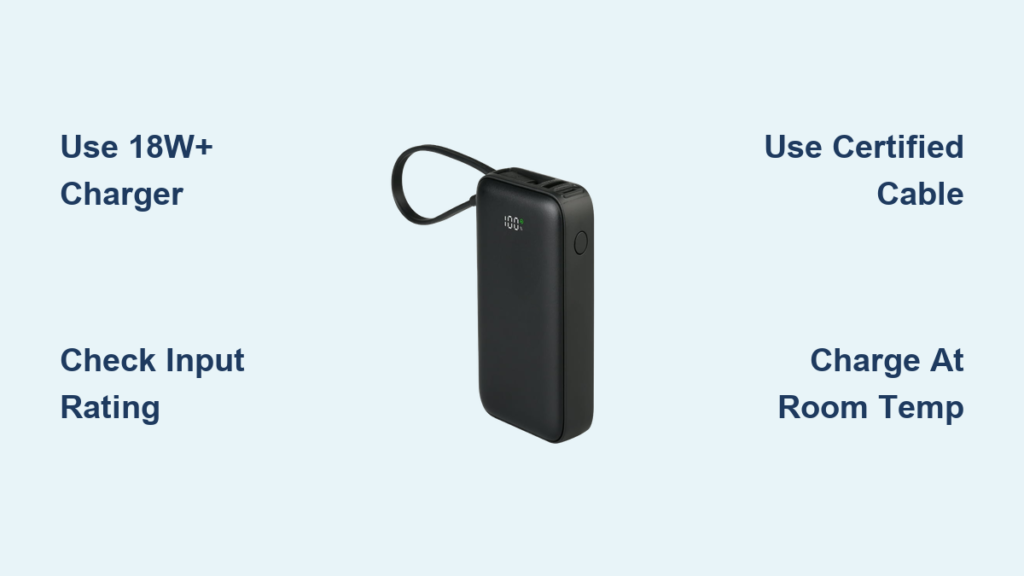
A 12,000mAh power bank with standard 10W input takes 8-10 hours to recharge. Look for models with higher input wattage if you need faster turnaround:
– 10W input: 8-10 hours (standard micro-USB)
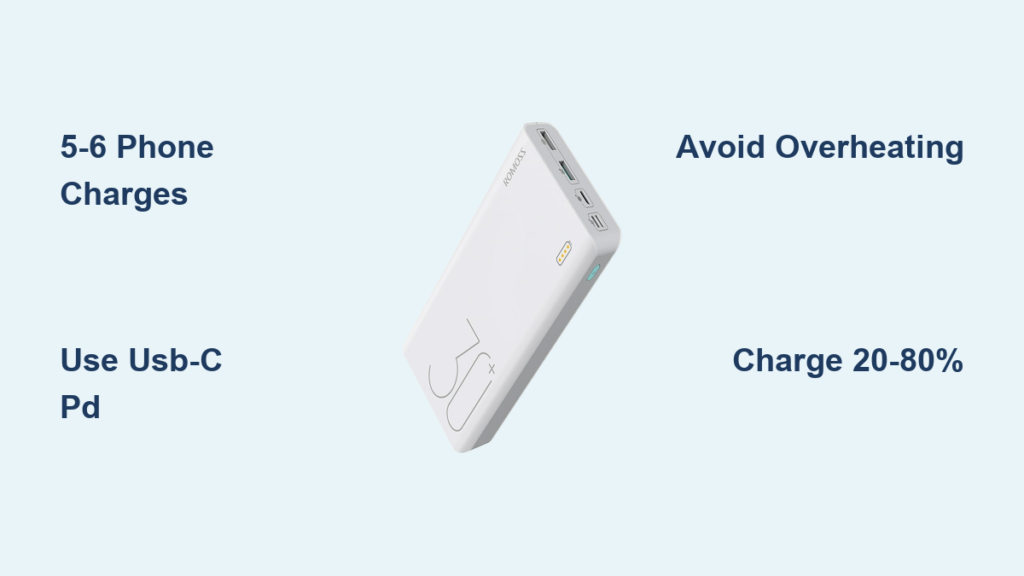
– 18W input: 5-6 hours (USB-C Power Delivery)
– 30W+ input: 3-4 hours (premium GaN models)
Critical warning: Never leave your power bank charging overnight on a flammable surface. Quality models include thermal protection, but low-cost units can overheat. Always charge on a non-flammable surface and unplug once fully charged.
5 Proven Ways to Extend Your 12,000mAh Power Bank’s Lifespan
Quality power banks should last 3-5 years, but poor usage habits can cut that in half. Follow these science-backed strategies to maximize your investment.
The 20-80% Rule for Maximum Battery Longevity
Lithium-ion batteries degrade fastest when fully charged or completely depleted. For maximum lifespan:
– Avoid 0%: Don’t regularly drain your power bank completely
– Avoid 100%: Unplug at 80-90% for daily use
– Optimal storage: Keep at 30-60% charge when not in use for weeks
Following this pattern can triple your power bank’s useful life—from 500 cycles at 100% depth of discharge to 1,500+ cycles at 50% DoD.
Temperature Management: Why Heat Is Your Power Bank’s Worst Enemy
Heat accelerates battery degradation more than any other factor:
– Ideal range: 10°C to 35°C (50°F to 95°F)
– At 40°C: Cycle life cut in half (500 cycles → 250 cycles)
– At 60°C: Capacity drops 50% within months
Emergency fix for cold weather: Keep your power bank inside your jacket when temperatures drop below 10°C. Cold reduces capacity but won’t damage the battery like heat does.
Storage Secrets for Power Banks You Don’t Use Daily
For occasional-use power banks (emergency kits, travel spares):
– Charge to 50% before storage
– Check every 3 months and top up to 50% if needed
– Store in a cool, dry place away from direct sunlight
– Use within 2 years for optimal performance (capacity drops 5-10% annually in storage)
3 Real-World Scenarios: How Long Your 12,000mAh Power Bank Lasts on Trips
Let’s translate theory into practical usage so you know exactly what to expect in common situations.
The Daily Commuter: How Many Workdays Before Recharging?
With a 4,000mAh phone that drains 60% daily (2,400mAh):
– Daily consumption: 2,400mAh
– Usable power bank capacity: 7,100mAh
– Theoretical runtime: 2.9 days (7,100 ÷ 2,400)
– Real-world: 2.5 days with efficiency losses
Pro tip: Carry your power bank in an insulated case during winter commutes. Below 0°C, capacity drops 30%, turning your 2.5-day battery into a 1.7-day solution.
Weekend Camping Trip: Powering Multiple Devices Off-Grid
For a 2-day trip with:
– Smartphone (4,000mAh, 50% daily use): 2,000mAh
– GPS device (1,500mAh battery, 30% daily): 450mAh
– Headlamp (2,000mAh, 20% daily): 400mAh
– Total daily consumption: 2,850mAh
– 2-day requirement: 5,700mAh
– Your power bank provides: 7,100mAh
This setup gives you a comfortable buffer with 1,400mAh remaining—enough for emergency communication or unexpected delays.
Emergency Kit: How Many Days of Critical Communication Power?
In emergency mode (phone in low-power mode):
– Essential functions only: 10% battery per day
– 4,000mAh phone: 400mAh daily consumption
– 7,100mAh power bank: 17.75 days theoretically
– Real-world conservative estimate: 12-14 days
Critical consideration: In true emergencies, prioritize communication over navigation. A single hour of GPS use can consume as much power as 6 hours of standby communication.
Key Takeaways: Your 12,000mAh power bank delivers only 7,000-9,000mAh of usable power—enough for 1.5-2 full phone charges depending on your device. Extreme temperatures, fast charging, and multiple devices further reduce this total. To maximize performance, follow the 20-80% charging rule, avoid temperature extremes, and store at 50% charge when not in regular use. With proper care, your power bank should provide reliable backup power for 3-5 years or 500-1,000 full charge cycles before significant capacity degradation occurs. For your next trip, calculate your specific device needs using the watt-hour method (device mAh × 3.85V ÷ 5V) to avoid being left powerless.