You’ve got a camping trip coming up, a business conference spanning multiple days, or maybe you’re setting up a remote IoT project. You’re staring at that 20,000mAh power bank wondering: “How long will this actually keep my devices running?” That big number looks impressive, but the truth is, your 20,000mAh power bank won’t deliver anywhere near 20,000mAh of usable power to your devices.
The reality is far more complex than the marketing suggests. Between conversion losses, minimum load requirements, and device-specific power consumption patterns, the actual runtime varies dramatically depending on what you’re powering. Let’s cut through the marketing hype and give you the precise calculations you need to determine exactly how long your specific devices will run.
Why Your 20,000mAh Power Bank Only Delivers 12,000-16,000mAh of Real Power
That 20,000mAh rating on the box is technically accurate—but it measures the internal battery capacity at 3.7V, not the usable 5V output you get from USB ports. This critical distinction explains why you never get the full advertised capacity.
The Double Whammy of Voltage Conversion and Efficiency Losses
When your power bank converts its 3.7V battery output to the standard 5V USB output, two major efficiency hits occur:
* Voltage Conversion Loss: 20,000mAh × 3.7V = 74,000mWh of total energy. When converted to 5V, this becomes just 14,800mAh (74,000mWh ÷ 5V)
* Circuit Efficiency Loss: The DC-DC conversion circuit typically operates at 85-90% efficiency, further reducing usable capacity to 12,580-13,320mAh
Hidden Reality of Minimum Load Requirements
Most users don’t realize their power bank has a minimum load requirement of 50-150mA. If your device draws less current (like an ESP32 in deep sleep at 10-150µA), the power bank automatically shuts off after 30-60 seconds—making it useless for low-power IoT projects without modifications.
Precise Runtime Calculation: How Many Charges Will You Actually Get?
Forget the oversimplified “divide by your phone’s battery size” approach. For accurate results, you need to factor in multiple efficiency layers between the power bank and your device.
Step-by-Step Calculation Method
- Determine real-world capacity: 20,000mAh × 0.85 (efficiency) = 17,000mAh
- Account for device charging circuit: Most phones operate at 80-90% charging efficiency
- Calculate net usable capacity: 17,000mAh × 0.85 = 14,450mAh
Real-World Device Runtime Examples
For a standard 4,000mAh smartphone:
* Net usable capacity: 14,450mAh
* Actual charges: 14,450mAh ÷ 4,000mAh = 3.6 full charges
* Not the 5 charges many expect from basic calculations
For ESP32 IoT devices:
* With 10-minute active periods and 50-minute deep sleep: ~12.6mA average
* Theoretical runtime: 20,000mAh ÷ 12.6mA = 1,587 hours (66 days)
* Actual runtime: ~18 days due to auto-shutoff and efficiency losses
Why Your Power Bank Shuts Off During Low-Power Device Operation
If you’ve tried using a 20,000mAh power bank with an ESP32 or similar low-power device, you’ve probably encountered the frustrating auto-shutoff problem. This happens because:
The Minimum Current Threshold Problem
- Most power banks require 50-100mA minimum load to stay active
- ESP32 in deep sleep draws only 10-150µA (0.01-0.15mA)
- Result: Power bank detects “no load” and shuts off within minutes
Fixes for IoT Projects Using 20,000mAh Power Banks
- Add a pulldown resistor: A 10Ω resistor creates enough constant load to prevent shutoff
- Install a capacitor: 1,000µF capacitor near your device handles WiFi current spikes
- Shorten sleep cycles: Wake every 30 seconds instead of hours to maintain minimum load
- Consider alternatives: Direct 18650 battery packs deliver 2-3x longer runtime for IoT
How Long to Fully Recharge Your 20,000mAh Power Bank
You can’t ignore the time it takes to refill that massive capacity. Charging speed depends entirely on your input method:
Standard vs. Fast Charging Comparison
- With 18W USB-C PD charger: 6-8 hours (30W+ cuts this to 4-5 hours)
- With standard 5W USB-A charger: 12-15 hours (nearly a full day)
- With car charger (12V/2.4A): 8-10 hours
Pro Tip: Always use the highest wattage charger your power bank supports—many 20,000mAh models now accept 65W input for dramatically faster recharging.
Choosing the Right 20,000mAh Power Bank for Your Needs
Not all 20,000mAh power banks deliver equal performance. These features make the biggest difference in real-world runtime:
Must-Have Features for Maximum Usable Capacity
- USB-C Power Delivery (PD) input/output: Enables faster charging and better efficiency
- Low minimum load specification: Look for models that work with <50mA loads
- No auto-shutoff feature: Critical for IoT and low-power devices
- High-quality Japanese or Korean cells: Lasts 500+ cycles vs. 200 for cheap cells
Capacity Reality Check Table
| Power Bank Rating | Real Usable Capacity | Smartphone Charges | IoT Device Runtime |
|---|---|---|---|
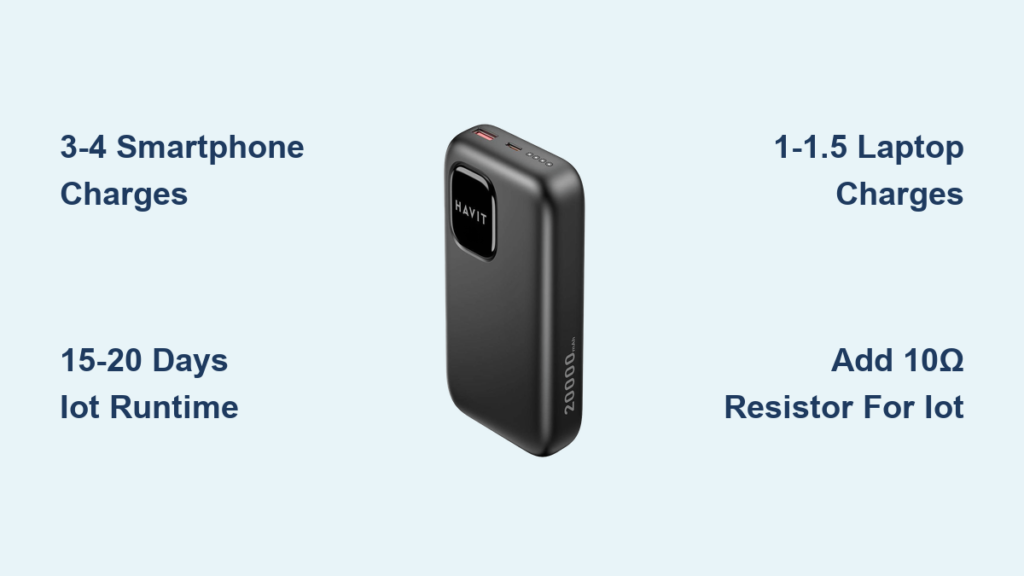
| 20,000mAh | 12,000-16,000mAh | 3-4 full charges | 15-20 days (ESP32) |
| 10,000mAh | 6,000-8,000mAh | 1.5-2 charges | 7-10 days |
| 26,800mAh | 16,000-21,000mAh | 4-5 charges | 20-25 days |
Troubleshooting Power Bank Performance Issues
When your 20,000mAh power bank underperforms, these common issues are usually to blame:
Why You’re Getting Fewer Charges Than Expected
- Using cheap cables: Poor quality cables add 5-10% resistance loss
- Extreme temperatures: Capacity drops 5% per 10°C below 25°C
- Old power bank: After 300 cycles, capacity degrades by 15-20%
- Simultaneous charging: Charging multiple devices reduces overall efficiency
Critical Fix: If your power bank shuts off during use, add a 10Ω resistor across the output to maintain minimum load—this simple $0.10 component solves 90% of IoT power bank issues.
Can a 20,000mAh Power Bank Charge a Laptop? The Reality
Yes—but with significant limitations most reviews don’t mention:
Laptop Charging Requirements
- Minimum: 45W USB-C PD output (many 20,000mAh banks only offer 30W)
- Real-World Performance: A MacBook Air (49.9Wh battery) gets about 1.5 charges
- Critical Limitation: Laptops draw more power while in use than the power bank can supply
Important Note: While a 20,000mAh power bank can technically charge a laptop, you’ll get only 1-1.5 full charges for most ultrabooks—not the 2-3 charges manufacturers imply.
Maximizing Your 20,000mAh Power Bank’s Actual Runtime
These proven strategies can boost your usable capacity by 15-25%:
Efficiency-Boosting Techniques
- Use USB-C to USB-C connections: Eliminates unnecessary voltage conversion steps
- Avoid daisy-chaining devices: Each additional device reduces overall efficiency
- Keep power bank at room temperature: Cold environments reduce capacity by 10-20%
- Store at 50% charge: Extends overall battery lifespan for future use
Pro Tip: For smartphone charging, enable airplane mode during charging—this reduces power consumption by 15-30% during the process.
When to Avoid 20,000mAh Power Banks Altogether
Despite their popularity, 20,000mAh power banks aren’t always the best choice:
Better Alternatives for Specific Use Cases
- For IoT projects: Direct 18650 battery packs provide 2-3x longer runtime
- For daily commuting: 10,000mAh offers better portability with sufficient capacity
- For laptop-focused travel: Consider a dedicated laptop power bank with 60-100Wh capacity
Expert Insight: For most travelers, a 20,000mAh power bank represents the “sweet spot” between capacity and portability—but only if you understand its real-world limitations.
Final Note: A quality 20,000mAh power bank delivers 3-4 full smartphone charges, 15-20 days for IoT devices, and 1-1.5 charges for ultrabooks—not the inflated numbers manufacturers advertise. By understanding the efficiency losses, minimum load requirements, and proper selection criteria, you’ll avoid the frustration of unexpected shutdowns and get maximum value from your investment. Always test your specific device-power bank combination before relying on it for critical applications.