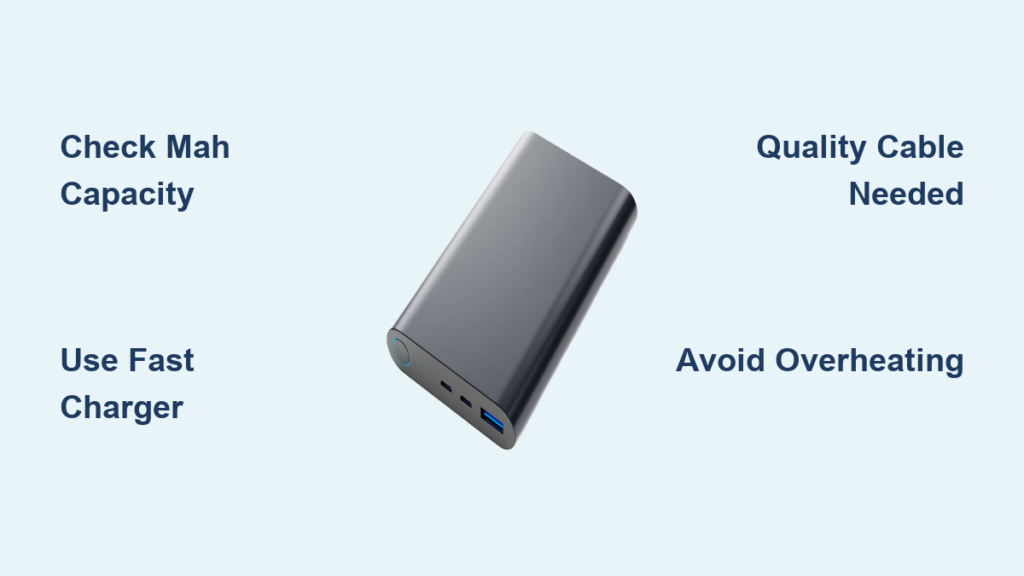
You’re headed out the door with your fully charged smartphone, but your power bank is dead. You plug it in, only to realize you have no idea how long it will take to recharge. This frustrating scenario happens to millions of travelers, students, and professionals who rely on portable power. Understanding exactly how long to charge a power bank is crucial for ensuring you never get caught with dead devices when you’re away from an outlet. This guide breaks down every factor that impacts your power bank’s charging time so you can plan your recharging routine with confidence and keep your devices powered when it matters most.
Most people assume all power banks charge at roughly the same speed, but nothing could be further from the truth. A small 5,000mAh model might be ready in just a few hours while a high-capacity 26,800mAh unit could take most of a day. Without knowing what affects charging duration, you’ll constantly be guessing when your backup power will be available. By the end of this guide, you’ll understand precisely how long to charge your specific power bank model, how to dramatically reduce charging time with the right equipment, and how to establish a charging routine that keeps you powered up without constant guesswork.
Why Your Power Bank Takes Hours to Recharge Fully
The frustrating wait for your power bank to recharge stems from fundamental physics and technological limitations. Unlike your phone that might charge in under an hour, power banks contain significantly larger battery capacities designed to charge multiple devices. This means they require substantially more energy input to reach full capacity. Understanding these core principles helps set realistic expectations about how long to charge power bank units of various sizes.
How Battery Capacity Directly Determines Charging Time
Your power bank’s milliamp hour (mAh) rating is the single most important factor in determining how long to charge power bank devices. Think of mAh as the size of your vehicle’s fuel tank—larger tanks naturally take longer to fill. A 5,000mAh power bank contains half the energy of a 10,000mAh model, meaning it requires approximately half the charging time under identical conditions.
When comparing different capacity models, consider these realistic charging time ranges from empty to full:
– 3,000-5,000 mAh models: 2.5-5 hours with standard charging
– 10,000 mAh models: 4-8 hours (the most common capacity)
– 20,000 mAh models: 7-12 hours
– 26,800+ mAh models: 9-14+ hours
Pro Tip: Don’t be fooled by marketing claims of “fast charging” without checking the actual input specifications. A large capacity power bank will always take longer to charge than a smaller one, regardless of branding.
The Critical Role of Input Charging Technology
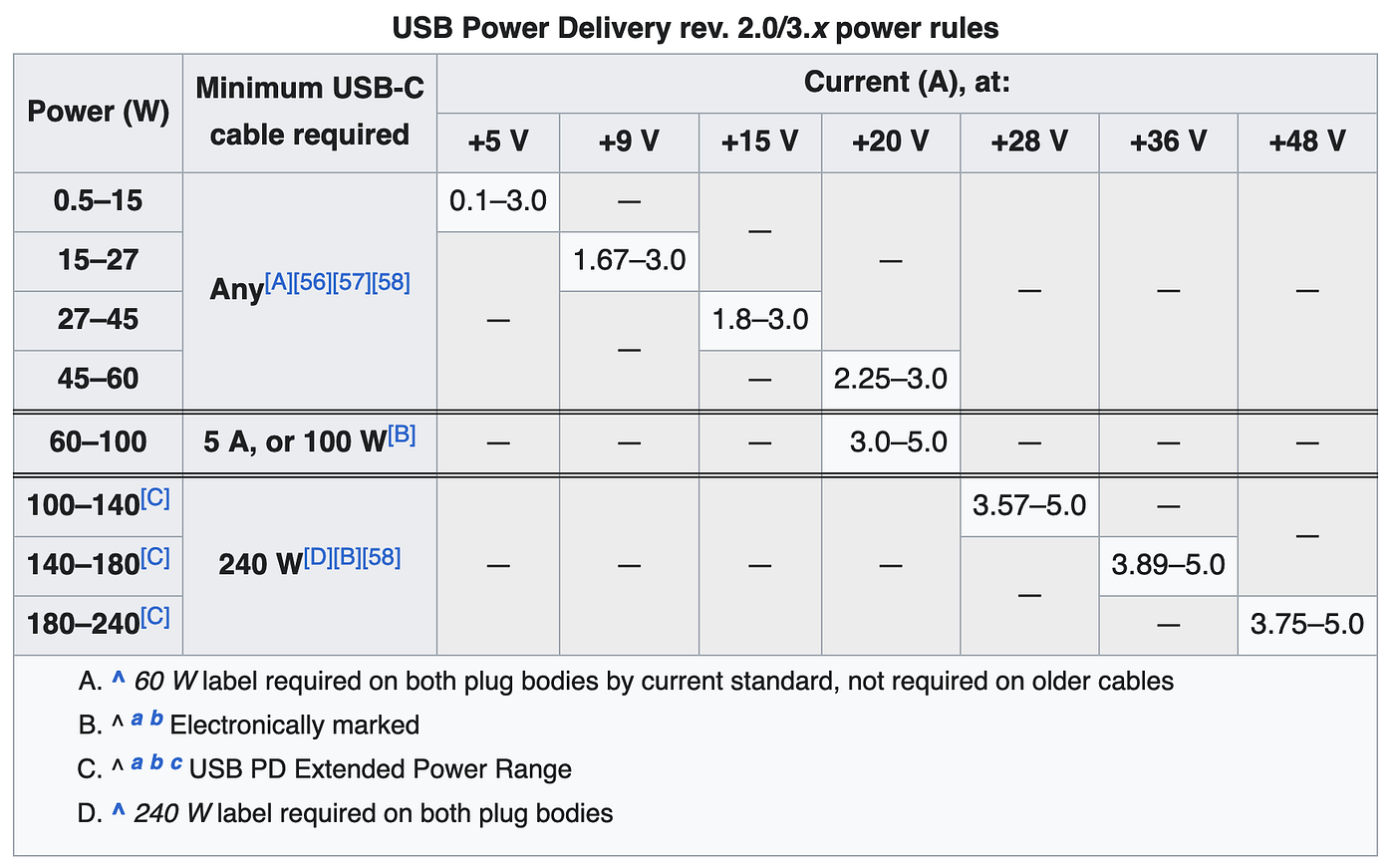
Your power bank’s ability to accept fast charging depends entirely on its input specifications, which many users overlook when calculating how long to charge power bank units. Most standard power banks accept 5V/2A (10W) input, but modern models increasingly support higher wattage standards that dramatically reduce charging time.
Look for these key input technologies that affect charging speed:
– Basic USB input (5V/2A): Standard charging at 10W—slowest option
– USB Power Delivery (PD): Accepts up to 100W on premium models
– Quick Charge (QC) 3.0/4.0: Qualcomm technology supporting up to 18W input
– Proprietary fast charging: Some brands like Anker have their own systems
Warning: Using a fast charger with a power bank that only supports standard input won’t speed up charging—it simply won’t utilize the higher wattage capabilities. Always match your charger to your power bank’s maximum input rating.
Charger and Cable Quality: The Hidden Bottleneck
Many users waste hours waiting for their power bank to charge because they’re using inadequate charging equipment. The wall adapter and cable you select create the pathway for energy transfer, and any weakness in this chain severely limits charging speed. This is why understanding how long to charge power bank units requires examining your entire charging ecosystem, not just the power bank itself.
Here’s what to check for optimal charging speed:
Wall Adapter Requirements
– Must match or exceed your power bank’s maximum input wattage
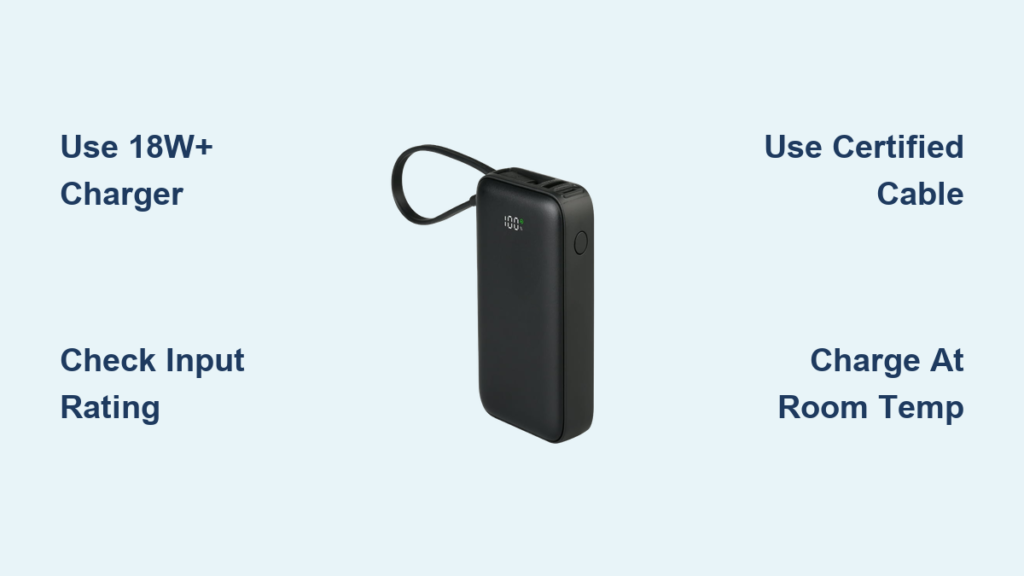
– For fast charging: 18W minimum (for PD/QC support)
– Premium option: 30W+ GaN chargers for fastest possible charging
Cable Specifications You Can’t Ignore
– USB-C to USB-C for PD charging (supports highest wattage)
– Must be rated for the wattage you’re using (e.g., 60W cable for 60W charger)
– Avoid cheap, thin cables that can’t handle high current
Expert Note: That old cable from your first Android phone likely supports only 5W charging. Replace it with a certified high-wattage cable to potentially cut your charging time in half.
How to Calculate Your Exact Power Bank Charging Time

Rather than guessing how long to charge power bank units, you can calculate precise charging durations using a simple formula. This eliminates uncertainty and helps you plan when to start charging based on when you’ll need your portable power available. The calculation accounts for your specific power bank capacity and charging setup.
The Power Bank Charging Time Formula
To determine exactly how long to charge power bank devices, use this practical calculation:
1. Find your power bank’s capacity in watt-hours (Wh) = (mAh rating ÷ 1000) × 3.7V
2. Divide by your charger’s output wattage
3. Multiply by 1.2-1.3 to account for energy loss during charging
For example, charging a 10,000mAh (37Wh) power bank with an 18W charger:
37Wh ÷ 18W = 2.05 hours × 1.25 = approximately 2.56 hours (2 hours 34 minutes)
Important: This is the theoretical minimum. Real-world factors like battery age, temperature, and charge efficiency typically add 15-25% to actual charging time.
Real-World Charging Time Examples
Let’s apply this formula to common scenarios so you can estimate how long to charge power bank units in your specific situation:
Scenario 1: Standard Charging
– 10,000mAh power bank (37Wh)
– 10W charger (5V/2A)
– Calculation: 37Wh ÷ 10W × 1.25 = 4.6 hours
– Actual time: 4.5-5 hours
Scenario 2: Fast Charging
– 20,000mAh power bank (74Wh)
– 30W PD charger
– Calculation: 74Wh ÷ 30W × 1.25 = 3.08 hours
– Actual time: 3-3.5 hours
Scenario 3: Ultra-Fast Charging
– 10,000mAh power bank (37Wh)
– 65W GaN charger
– Calculation: 37Wh ÷ 65W × 1.25 = 0.71 hours (43 minutes)
– Actual time: 45-50 minutes
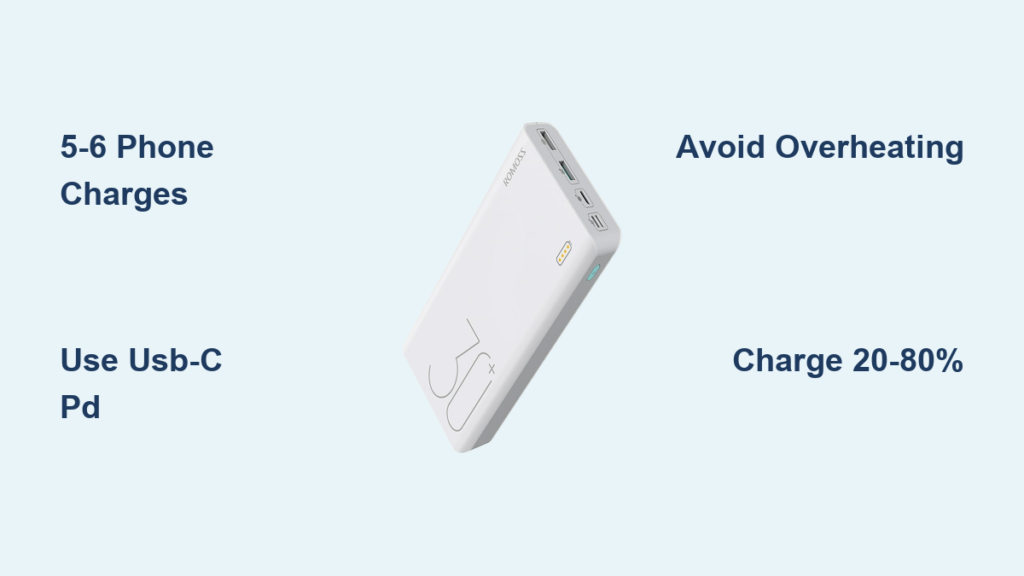
Pro Tip: Most power banks charge fastest between 0-80%, then slow down for the final 20% to protect battery health. Don’t expect linear charging throughout the entire cycle.
Smart Strategies to Reduce Your Power Bank Charging Time
Waiting hours for your power bank to recharge isn’t necessary with the right approach. These practical techniques help minimize downtime and ensure your portable power is ready when you need it, effectively solving the “how long to charge power bank” dilemma through smart preparation rather than just waiting.
Optimizing Your Charging Setup for Maximum Speed
To significantly reduce how long to charge power bank units, implement these equipment upgrades:
– Invest in a quality GaN charger: These compact chargers deliver high wattage efficiently
– Use manufacturer-recommended cables: Third-party cables often don’t support maximum wattage
– Charge from a wall outlet, not a computer: USB ports on computers typically deliver only 2.5-7.5W
– Avoid charging multiple devices simultaneously: This splits the input power and slows recharging
Warning: Never use damaged or frayed cables, as they create fire hazards and charge inefficiently. Replace cables showing any signs of wear immediately.
Smart Charging Habits That Save Hours Weekly
Your charging routine matters as much as your equipment when determining how long to charge power bank units effectively:
– Charge at consistent intervals: Recharge when at 20-30% rather than waiting until completely drained
– Establish a nightly routine: Plug in your power bank while you sleep for morning readiness
– Keep a charging station: Designate one outlet specifically for power bank recharging
– Maintain two power banks: While one charges, use the other—eliminates downtime
Expert Note: Lithium-ion batteries (used in all modern power banks) degrade fastest when kept at 0% or 100% for extended periods. For optimal lifespan, keep your power bank between 20-80% when possible.
Troubleshooting Slow Power Bank Charging
If your power bank takes longer to charge than expected, check these common issues:
– Check the input specification label: Verify your charger matches the power bank’s maximum input
– Test different outlets: Some wall circuits deliver inconsistent power
– Inspect for physical damage: Swelling or dents indicate battery problems
– Try a different cable: Faulty cables are the #1 cause of slow charging
– Reset the power bank: Some models have a reset button to clear charging errors
Pro Tip: If your power bank charges significantly slower than when new (more than 30% increase), the battery may be degrading and need replacement.
When to Replace Your Power Bank for Faster Charging
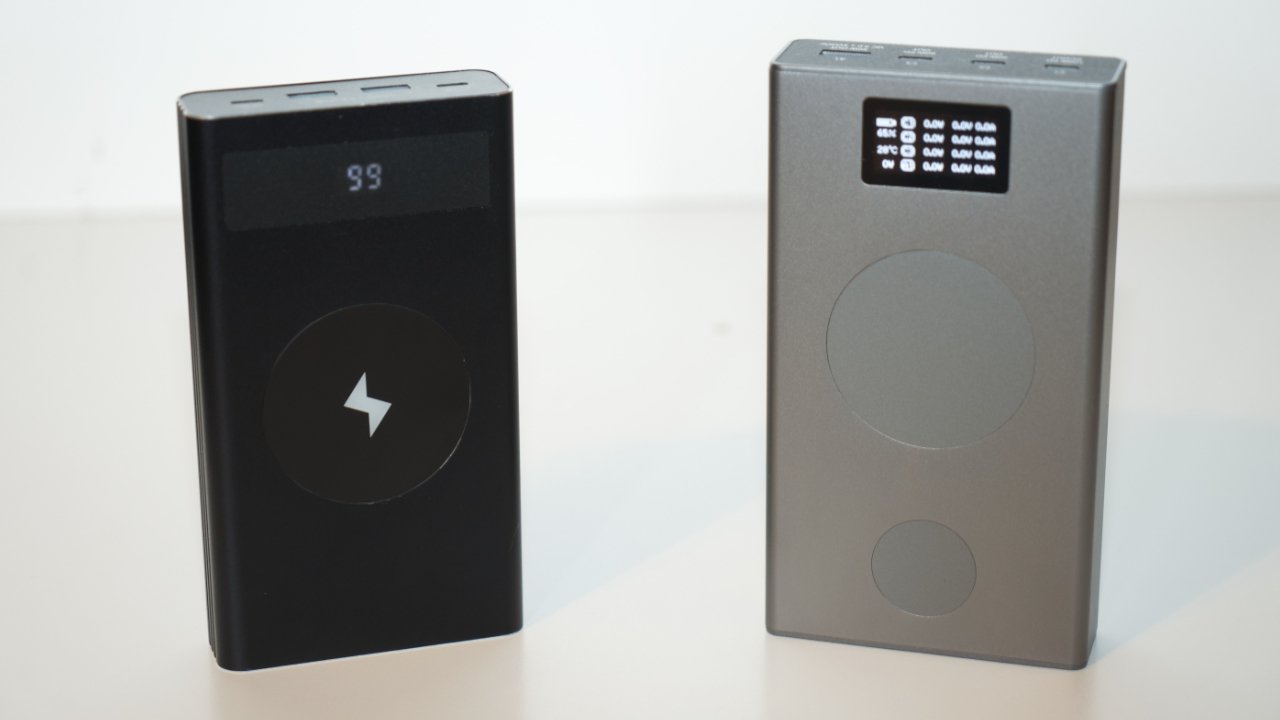
As power banks age, their charging speed naturally decreases due to battery degradation. Knowing when to upgrade prevents you from wasting time waiting for slow recharging and ensures you get the most from modern fast-charging technology. This directly impacts how long to charge power bank units over their lifespan.
Signs Your Power Bank Needs Replacement
Watch for these indicators that your power bank is taking too long to charge due to age:
– Noticeable increase in charging time (25%+ longer than when new)
– Reduced capacity (charges fewer devices than before)
– Excessive heat during charging (more than warm to the touch)
– Physical swelling or deformation
– Frequent failure to hold a charge
Warning: A power bank that gets hot enough to burn your hand during charging poses a serious fire risk and should be replaced immediately.
Benefits of Upgrading to Modern Power Banks
Newer power banks offer dramatically faster charging compared to older models:
– Higher input wattage: Modern units accept 30-100W versus 10-18W on older models
– Improved battery chemistry: Newer lithium-polymer cells charge faster and last longer
– Advanced circuitry: Better power management reduces energy loss
– Smaller size for same capacity: Thanks to improved energy density
Pro Tip: When shopping for a replacement, prioritize input wattage over output specifications if fast recharging is your main concern. Look for power banks advertising “18W+” or “30W+” input charging.
Power Bank Charging Best Practices for Longevity
Understanding how long to charge power bank units is just the beginning—proper charging habits extend your device’s lifespan and maintain optimal performance. These science-backed practices ensure your power bank remains reliable and charges efficiently for years.
Optimal Charging Environment Conditions
For fastest, safest charging that preserves battery health:
– Temperature range: Charge between 10°C-30°C (50°F-86°F)
– Avoid direct sunlight: Heat dramatically slows charging and degrades batteries
– Don’t charge under pillows or blankets: Creates dangerous heat buildup
– Keep away from moisture: Humidity affects charging circuitry
Expert Note: Charging at temperatures below 0°C (32°F) can cause permanent battery damage. If your power bank gets cold, let it warm to room temperature before charging.
Maintenance Habits That Preserve Charging Speed
To maintain optimal charging performance over time:
– Discharge periodically: Run down to 10-20% every few months to calibrate
– Store at 50% charge: If not using for extended periods
– Clean charging ports: Use a dry toothbrush to remove lint buildup
– Avoid full discharges: Don’t regularly drain to 0% unless necessary
Pro Tip: For power banks you use infrequently, recharge to 50% every 3-4 months to prevent deep discharge damage.
By implementing these strategies, you’ll transform your understanding of how long to charge power bank units from frustrating guesswork to precise planning. You’ll spend less time waiting for recharging and more time with reliable portable power when you need it most. The key takeaway? Your charging time depends on three controllable factors: power bank capacity, input technology, and charging equipment quality. Master these elements, and you’ll never again wonder when your backup power will be ready. For immediate readiness, establish a routine of charging your power bank whenever it drops below 30%, using the highest-wattage compatible charger available. This simple habit ensures your portable power is always available when you need it most, eliminating the stress of dead devices during your busiest moments.