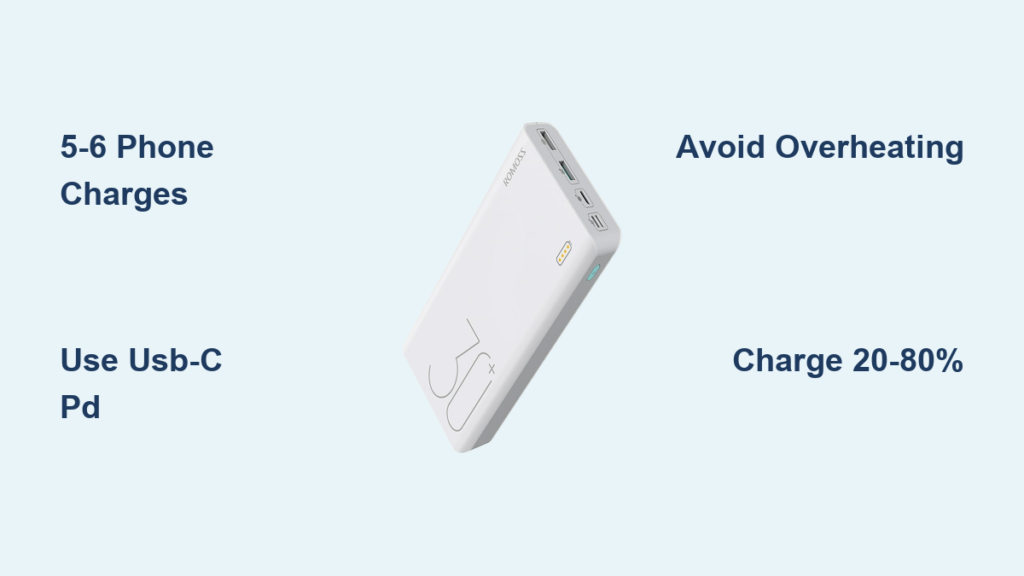
You’ve purchased a 24,000mAh power bank expecting six full charges for your smartphone, only to find you’re getting half that number in reality. This frustrating gap between advertised capacity and actual performance leaves many travelers and daily users wondering exactly how many charges they can truly expect from their high-capacity power bank. The truth is, a 24,000mAh power bank typically delivers just 3-5 full smartphone charges—not the 6 you’d calculate with simple division. Understanding why this happens and how to maximize your power bank’s real-world performance is critical for anyone relying on portable power.
The discrepancy stems from fundamental physics and battery technology limitations that manufacturers rarely highlight in their marketing. When you see “24,000mAh” on the box, that figure represents the internal battery’s capacity at 3.7 volts, but your devices charge at 5 volts, creating unavoidable energy loss during conversion. After accounting for efficiency losses, temperature factors, and proper battery maintenance practices, only about 65-75% of that advertised capacity actually reaches your devices. This guide cuts through the marketing hype to give you precise, real-world expectations for your 24,000mAh power bank across various devices.
Why Your 24,000mAh Power Bank Delivers Fewer Charges Than Advertised
The Voltage Conversion Trap That Steals 30% of Your Power
That “24,000mAh” rating refers to the internal lithium-ion cells operating at 3.7 volts, but your phone charges at 5 volts. This voltage step-up process through the power bank’s circuitry inevitably wastes energy as heat. Most quality power banks operate at 85-90% efficiency during this conversion, immediately reducing your 24,000mAh capacity to approximately 20,400mAh before your device even starts charging.
Your Device’s Hidden Charging Inefficiency
Even after power leaves the bank, your smartphone isn’t 100% efficient at storing that energy. Lithium-ion batteries typically convert only 80-85% of incoming power into stored energy, with the rest lost as heat. This double inefficiency means your 24,000mAh power bank effectively delivers just 16,320-17,340mAh of usable energy (24,000 × 0.85 × 0.85)—barely 70% of what the label promises.
The 80% Battery Health Rule That Further Reduces Capacity
To maximize your phone’s lifespan, experts recommend charging only between 20-80% capacity. If you follow this best practice, you’re using just 60% of your phone’s theoretical battery capacity. For a 4,500mAh phone, this means you’re only utilizing 2,700mAh per “full charge.” This battery preservation strategy further reduces the number of actual charges you’ll get from your power bank.
The Real Math Behind 24,000mAh Power Bank Capacity

Calculating Your Actual Usable Capacity
Let’s break down the realistic capacity of your 24,000mAh power bank using industry-standard efficiency figures:
- Advertised capacity: 24,000mAh (at 3.7V)
- Voltage conversion loss: -15% (leaving ~20,400mAh)
- Device charging efficiency: -15% (leaving ~17,340mAh)
- Battery health best practice: -40% (using only 60% of capacity)
- Real-world usable capacity: ~10,400mAh
This calculation explains why you’ll consistently get fewer charges than the simple “24,000 ÷ phone battery size” suggests. The math reveals why most users experience just 3-5 full smartphone charges from their 24,000mAh power bank.
Temperature’s Shocking Impact on Your Charge Count
.webp)
Cold weather below 50°F (10°C) can slash your effective capacity by 20-30%—turning your 24,000mAh bank into the equivalent of a 16,800mAh unit. Conversely, charging in hot conditions above 95°F (35°C) reduces efficiency by 10-15% due to thermal throttling. For optimal performance, keep your power bank between 68-77°F (20-25°C) during use and storage.
How Many Times Will a 24,000mAh Power Bank Charge Your Specific Device?

Smartphone Charge Estimates (Real-World Numbers)
| Device Category | Typical Battery Size | Actual Full Charges | Partial Charge Context |
|---|---|---|---|
| Standard Smartphone | 3,000-4,000mAh | 5-6 charges | Enough for 5-6 days of average use |
| Large-Battery Smartphone | 4,500-5,500mAh | 3.5-4.5 charges | Powers through 3-4 full days |
| iPhone 15 Series | 3,300-3,500mAh | 4.5-5.5 charges | Lasts 4-5 days for moderate users |
| Gaming Smartphone | 5,000-6,000mAh | 3-4 charges | Powers through 3 days of heavy gaming |
Pro Tip: For phones with 5,000mAh batteries, your 24,000mAh power bank delivers approximately 3.5 full charges—not the 4.8 suggested by basic math. This difference becomes critical during extended trips without power access.
Tablet and Laptop Charging Reality Check
Don’t expect your 24,000mAh power bank to fully charge tablets or laptops multiple times. Here’s what you’ll actually get:
- iPad (8,000-10,000mAh): 1.5-2 full charges (not the 2.4-3 suggested by simple math)
- Android Tablet (6,000-7,000mAh): 2-2.5 charges
- Ultrabook Laptop (USB-C, 5,000mAh): 2-3 partial charges (40-60% per session)
- Wireless Earbuds (500mAh): 20-25 full charges
- Smartwatch (300mAh): 35-45 full charges
5 Critical Factors That Slash Your Actual Charge Count
Power Bank Age and Cycle Degradation
After 300-500 charge cycles, even high-quality lithium-ion power banks retain only 70-80% of their original capacity. A two-year-old 24,000mAh unit might effectively function as a 16,800-19,200mAh bank. Check your power bank’s age—if it’s more than 18 months old, reduce expected charges by 15-25% compared to when it was new.
Simultaneous Charging Efficiency Loss
Using multiple ports at once creates additional circuit load and heat, reducing overall efficiency by 5-10%. If you’re charging your phone and earbuds simultaneously from your 24,000mAh bank, you’ll get approximately 10% fewer total charges than if you charged them sequentially.
Cable Quality and Resistance Losses
That cheap, thin cable from five years ago? It’s costing you 3-5% of your power bank’s capacity through electrical resistance. Invest in thick-gauge USB-C to USB-C cables (20-24 AWG) to minimize these losses, especially for fast charging sessions where current draw is highest.
How to Maximize Every Milliamp in Your 24,000mAh Power Bank
Optimal Charging Habits for Maximum Output
- Charge devices between 20-80%: This preserves both your power bank’s and device’s battery health while maximizing usable capacity
- Use USB-C PD ports for smartphones: Modern Power Delivery protocols operate at 90%+ efficiency versus 80% for standard USB-A
- Avoid extreme temperatures: Never charge in direct sunlight or freezing conditions
- Store at 50% charge: For long-term storage, this prevents accelerated degradation
Extending Your Power Bank’s Lifespan
Charge your power bank itself to only 80% for daily use—this simple habit can double its usable lifespan. When storing for more than a month, maintain 50-60% charge in a cool, dry place. Fully charged or depleted units degrade 3-5x faster during storage. After two years of regular use, expect to replace your power bank as capacity falls below 70% of original.
When Your Power Bank’s Age Starts Cutting Your Charge Count
Recognizing End-of-Life Indicators
Your 24,000mAh power bank is nearing retirement when you notice:
- Capacity drop: Providing only 2-3 smartphone charges instead of 4-5
- Swelling: Visible physical expansion of the unit
- Rapid self-discharge: Losing more than 5% charge per day when idle
- Extended charging time: Taking 50% longer to recharge than when new
Expert Note: Most quality power banks maintain 80%+ capacity for 300-500 full cycles. If you use your 24,000mAh bank weekly, plan for replacement after 6-8 years of regular use.
Final Reality Check: While the math suggests your 24,000mAh power bank should deliver six full smartphone charges, real-world efficiency losses mean you’ll consistently get just 3-5 full charges for modern devices. By understanding the physics behind capacity ratings, optimizing your charging habits, and recognizing when your power bank is aging, you’ll maximize every milliamp of portable power. For most users, this means planning for 4 smartphone charges as a reliable baseline—never counting on that theoretical sixth charge when you’re stranded without power. Always carry slightly more capacity than you think you’ll need, and your 24,000mAh power bank will keep you connected through even the longest travel days.