Plugging a space heater into a power strip is one of the most common yet dangerous shortcuts people take during cold weather. Despite widespread warnings, many believe that using a high-quality power strip or surge protector makes it safe. It does not. Space heaters draw massive amounts of power, typically between 1,000 and 1,500 watts, which equates to 8.3 to 12.5 amps on a standard 120-volt circuit. Most power strips are not designed to handle this load continuously, and doing so can lead to overheating, melting, or even fire.
In this guide, you will learn exactly why power strips fail under space heater loads, what the real dangers are beyond simple wattage math, and how to stay warm safely even when the nearest outlet is out of reach.
Why Power Strips Cannot Handle Space Heaters
The Overloading Problem
A 1,500-watt heater draws 12.5 amps, operating at 83% of a standard 15-amp circuit’s capacity. When routed through a power strip or extension cord, voltage drop forces the heater to draw even more current to maintain output, pushing the system beyond safe limits. Most consumer-grade power strips use 16 AWG wire, which is too thin for space heaters. Even briefly, this creates excessive resistance and heat buildup. Over days or weeks, the repeated thermal cycling loosens internal connections, raising resistance further, creating an invisible hazard until smoke appears.
The core issue is that power strips are not designed for continuous high-current operation. Their internal components heat up faster than they dissipate, leading to thermal runaway where rising temperature increases resistance, which in turn generates more heat, eventually melting insulation or igniting nearby materials.
Surge Protectors Provide False Security
Many people confuse surge protection with overload protection. A 3,000-joule surge protector shields electronics from voltage spikes but does nothing to prevent overheating from sustained current draw. In fact, plugging a space heater into a surge protector defeats its purpose and risks destroying both devices. Surge protectors are designed for TVs and computers, not heaters. Never use them with heaters.
Even if the breaker trips, the damage may already be done. Arcing or smoldering can start before the breaker reacts, especially if the strip is old or poorly made.
Real-World Fire Incidents

House Fire in Bangor, Maine
One user reported a full-room fire caused by a $15 to $20 ceramic heater plugged into a 10-foot yellow extension cord with a breaker. The cord began smoking on the fourth day of use, resulting in melting at the wall outlet. The extension cord fused to the outlet, and the user had to rip it out by hand, suffering near-amputation-level burns. The fire spread rapidly, destroying bedding, door frames, and personal belongings. The family escaped with trauma and total property loss.
Other Documented Cases
Another user reported that after four winters of safe use, the wall outlet itself caught fire when a heater was plugged into a high-quality extension cord. Fire department investigators attributed it to worn connections over time. These cases prove one thing: failure is unpredictable. A setup that works for years can fail catastrophically the next day due to a loose contact, dust buildup, or minor voltage surge.
Understanding Heater Power Draw

Watts, Amps, and Circuit Capacity
Not all space heaters are the same, but most fall into two categories. The low setting draws approximately 750 watts, which is 6.25 amps. The high setting draws 1,500 watts, which is 12.5 amps. Even at half power, the load is significant. Never assume a low setting makes a power strip safe. The risk is not just peak draw but continuous operation that degrades connections over time.
Check the heater’s label for exact specs. If it says 1500W, that is 12.5 amps, close to the limit of most circuits and power strips. A standard U.S. bedroom circuit is 15 amps, which is 1,800 watts. A 1,500-watt heater leaves only 300 watts for other devices. Add a lamp, phone charger, or TV, and you are overloading the circuit, even without a power strip.
Why Heater Cords Are So Short
Most space heaters come with 6-foot cords, too short for many rooms. This is intentional. Longer cords would require 14 AWG or 12 AWG wire, increasing cost. Manufacturers prioritize profit over convenience, forcing users into risky setups. The solution is to install a new outlet or choose a model with a longer cord.
The Only Safe Way to Plug In
Direct Wall Outlet Connection
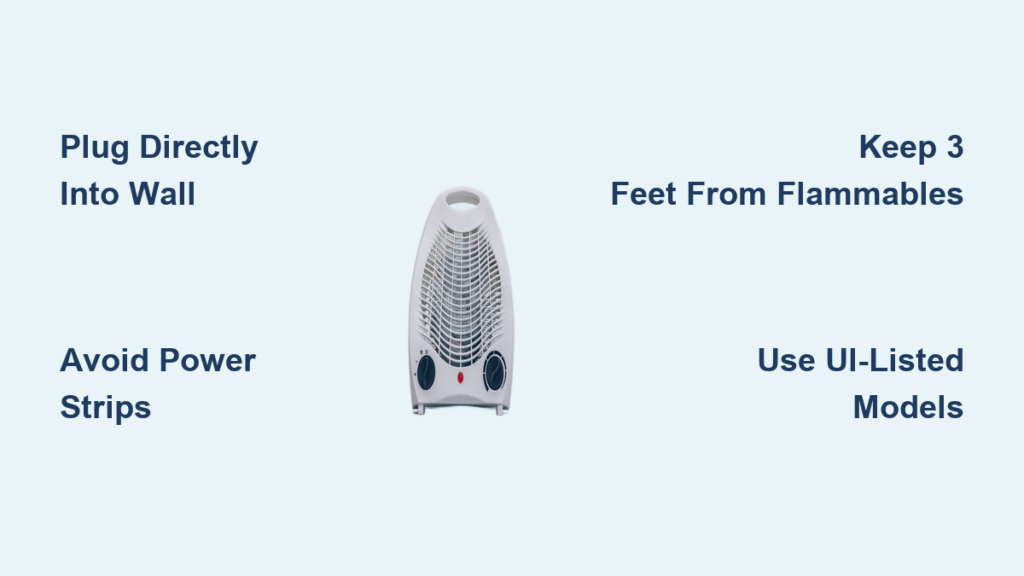
The safest and only recommended way to power a space heater is by plugging it directly into a grounded wall outlet. This ensures the heater receives stable, low-resistance power without intermediate connections that can degrade over time. Wall outlets are designed to handle continuous loads up to 15 or 20 amps, especially when on a dedicated circuit. Power strips, even those labeled heavy-duty, lack the internal construction to manage this safely over hours of use.
Even if a power strip is rated for 1,800 watts, that rating assumes short-term use, not the 8 to 12-hour cycles typical of space heating.
Signs of a Safe Wall Outlet
Before plugging in the heater, inspect the outlet. Look for no discoloration or scorch marks. Check that there is no warmth when touched after use. The plug should fit firmly without wobbling. The outlet should be grounded with three prongs and not damaged.
If the outlet feels warm, sparks, or smells burnt, do not use it. Have a licensed electrician evaluate it immediately.
Preventing Fire Hazards
Maintain 3-Foot Clearance Rule
Space heater surfaces can reach 500°F to 600°F, enough to ignite paper, fabric, or furniture instantly. Always keep the unit at least 3 feet from curtains, beds, sofas, and clothing. Place it on a level, non-flammable surface such as tile, stone, or metal. Keep it away from foot traffic to prevent tipping.
Never Leave Unattended or Overnight
Never run a space heater while sleeping or when leaving the room. Automatic shutoffs help, but they can fail. The NFPA reports peak space heater fires occur December through February, often during nighttime hours. Turn it off and unplug it before bed.
Inspect Cords and Plugs Monthly
Check for fraying or cracking, discoloration or melting, loose prongs, and warmth during use. Replace damaged heaters or cords immediately. Do not attempt repairs.
Choose the Right Equipment

Only Use UL-Listed Heaters With Safety Features
Not all heaters are created equal. Choose models with tip-over shutoff, overheat protection, thermostatic control, and cool-touch housing. These features reduce fire risk but do not eliminate electrical hazards from improper power sources. Brands like Lasko, De’Longhi, and Dreo are frequently recommended for reliable safety mechanisms. Avoid cheap, no-name units, especially those with short cords that tempt users to reach for extensions.
What to Look for in Power Strips If Absolutely Necessary
While never recommended, if you must use a power strip due to outlet inaccessibility, use only UL-listed and labeled heavy-duty strips. Look for 12 AWG or 14 AWG internal wiring, not 16 AWG. Choose strips rated for 1,875 watts or higher. Use a single outlet or minimal ports to prevent overloading. Avoid surge protection, which is irrelevant for heaters.
Even then, monitor temperature. If the strip or plug feels warm, unplug immediately.
Install Critical Safety Devices
Test Smoke and CO Detectors
Working smoke alarms cut fire death risk by 55%. For space heater safety, install both smoke and carbon monoxide detectors. Place them within 15 feet of the heater. Test monthly. Replace every 10 years.
Many fatal fires start at night when people are asleep. Early detection is the best defense.
Use Detectors Designed for Winter Risks
Some detectors have dual sensors, photoelectric and ionization, for faster response to smoldering and flaming fires. Look for models with hush buttons and battery backup. Interconnected alarms, hardwired or wireless, ensure all sound if one detects smoke, which is critical in multi-room homes.
Safer Alternatives
Install a New Wall Outlet
If outlets are too far, the safest long-term fix is installing a new one. Hire a licensed electrician to add a dedicated 15-amp or 20-amp circuit. Cost ranges from $200 to $500 depending on home layout. This eliminates the temptation to use unsafe cords and increases home value.
Consider Permanent Heating Solutions
For recurring heating needs, consider wall-mounted electric heaters, baseboard heaters, or ductless mini-splits. These are hardwired, eliminating cord risks entirely. While more expensive upfront, they are safer and more efficient over time.
Frequently Asked Questions About Using Space Heaters With Power Strips
Can I use a heavy-duty power strip with a space heater?
No. Even heavy-duty power strips are not designed for the continuous high-current draw that space heaters require. The 15-amp rating assumes intermittent use, not the 8 to 12-hour heating cycles typical of space heaters. Always plug directly into a wall outlet.
Why do surge protectors not make power strips safe for heaters?
Surge protectors protect electronics from voltage spikes, not from overheating due to sustained current draw. A surge protector does nothing to prevent the thermal buildup that causes power strips to melt or catch fire. In fact, using a heater with a surge protector can destroy both devices.
What happens if I use an extension cord with my space heater?
Extension cords, especially those with 16 AWG wire, can overheat and cause fires. User reports document cases where extension cords melted and fused to wall outlets, causing house fires. The risk increases with extended use and older, lower-quality cords.
Can I use a space heater on a low setting with a power strip?
No. Even at low settings, space heaters typically draw 750 watts, which is 6.25 amps. While this is lower than high settings, the continuous operation still poses electrical risks when routed through a power strip not designed for sustained loads.
How close should a space heater be to flammable materials?
Keep space heaters at least 3 feet away from all flammable materials, including curtains, bedding, furniture, and clothing. Heater surfaces can reach 500°F to 600°F, which can ignite these materials instantly.
What should I do if my power strip feels warm while using a space heater?
Unplug the heater immediately. Warmth indicates the power strip is exceeding its thermal limits. Do not continue using the setup. Plug the heater directly into a wall outlet instead.
Key Takeaways for Safely Using Space Heaters
The rule never plug a space heater into a power strip exists because the average user cannot safely assess all risk factors, including wire gauge, load duration, outlet condition, or circuit sharing. While a few may get away with it for years, the consequences of failure are too severe to gamble. Heat your space safely by plugging directly into the wall, keeping flammables at least 3 feet away, supervising use at all times, and installing working smoke alarms. Your life depends on making the right choice.