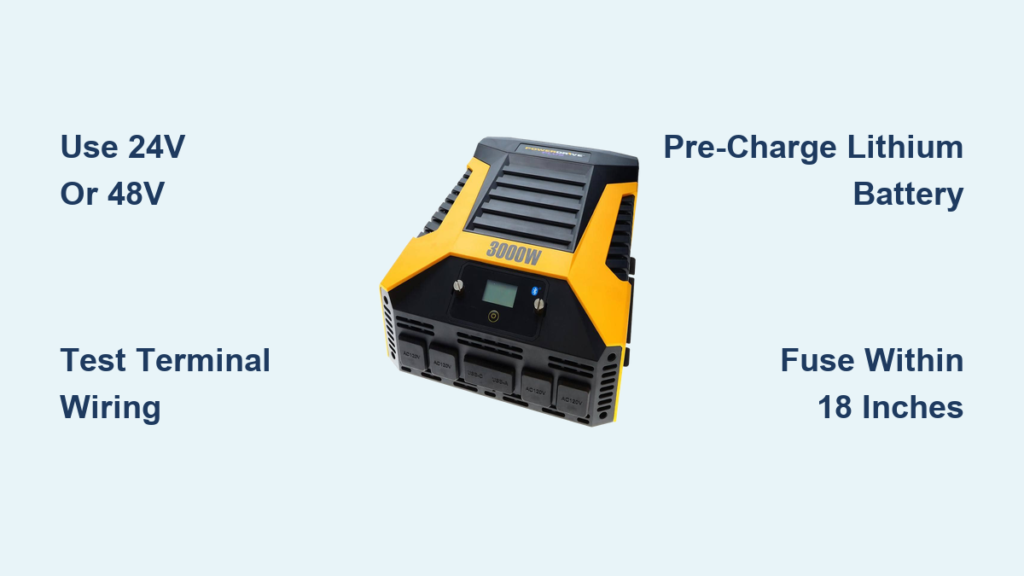
If you’re running power tools off-grid, living in an RV, or building a solar-powered cabin, a 3000 watt power inverter gives you the ability to use standard household appliances anywhere. But using it safely and effectively is not just about plugging in and turning on. It requires proper wiring, compatible batteries, surge awareness, and critical safety steps. Many users damage their systems by overlooking simple details like terminal labeling or skipping the pre-charge step for lithium batteries.
This guide walks you through selecting the right inverter, wiring it correctly, choosing batteries, avoiding common mistakes, and powering real-world loads without tripping or damaging your setup. You will learn how to mount, fuse, and test your inverter, what appliances it can actually run, and why voltage matters more than wattage alone.
Choose the Right Inverter Type
Use Pure Sine Wave Only
A pure sine wave inverter produces clean, grid-like AC power that runs all electronics smoothly. Laptops, medical devices, variable-speed tools, and audio equipment all work best with this waveform. Unlike modified sine wave models, pure sine wave units will not cause buzzing, overheating, or premature failure in sensitive devices.
Modified sine wave inverters are cheaper but output a choppy waveform that can damage modern appliances. They may work for basic resistive loads like incandescent bulbs or heaters, but microwaves, refrigerators, and electronics often behave poorly on them.
Bottom Line: Always choose a pure sine wave inverter for reliability, safety, and compatibility. The extra cost pays for itself in equipment protection and performance.
Match Voltage to Your System
Avoid 12V for 3000W Loads
A 3000W inverter on a 12V system draws nearly 280 amps at full load. That extreme current is comparable to a car starter. It demands massive cables, oversized fuses, and perfect connections. Even small resistance causes heat, voltage drop, or fire risk.
Higher voltage systems drastically reduce current. A 24V system draws approximately 139 amps. A 48V system draws only about 69 amps. Lower current means safer wiring, less energy loss, and easier scalability.
Expert Rule: Never use a 3000W inverter on 12V unless absolutely necessary. 24V or 48V is strongly recommended for efficiency, safety, and long-term reliability.
Verify Terminal Wiring Correctly

Test Before Connecting
Terminal labels on 3000W inverters can be misprinted or reversed. Trusting them without verification risks short circuits or damaged equipment. Always test before connecting wires.
For most pure sine wave inverters, the configuration follows this pattern. The top terminal is live (hot), the middle terminal is ground, and the bottom terminal is neutral. But you must confirm with a multimeter.
To verify with a multimeter:
- Set the multimeter to continuity mode.
- Check which terminal connects to the AC ground pin.
- Identify neutral by continuity testing (only one terminal will show it).
Critical Step: Never assume labeling is correct. Test with a multimeter before connecting any wires.
Install With Proper Clearance
Mount Inverter on Its Side
Mounting orientation affects cooling and safety. Most 3000W inverters allow flat, wall, vertical, or side mounting. But side-mounting is best for most installations.
Why side-mounting works best:
It prevents dust, dirt, or moisture from falling into cooling vents. It reduces risk of blockage in garages, RVs, or outdoor enclosures. It improves airflow when mounted with proper clearance.
Keep 6 inches (15 cm) of space around all sides for ventilation. Install in a dry, cool, enclosed area away from water, flammable materials, and direct sunlight.
Use Correct Cable Size

Upgrade Beyond Stock Cables
Many 3000W inverters ship with 4 AWG cables, which are dangerously undersized for full power on 12V systems. At 280 amps, these cables overheat fast and create fire hazards.
Use this minimum cable guide:
| System Voltage | Minimum Cable Size | Metric Equivalent |
|---|---|---|
| 12V | 4/0 AWG (0000) | ~107 mm² |
| 24V | 3/0 AWG | ~85 mm² |
| 48V | 2 AWG | ~33.6 mm² |
Pro Tip: Use multi-stranded, flexible copper cables, especially in RVs or boats where vibration can crack solid wire.
Keep Cables Short and Secure
Long cable runs increase resistance and voltage drop. Keep the inverter as close to the battery as possible, ideally under 6 feet.
Best practices for cable installation:
Use ferrules on stranded wires to prevent fraying under lugs. Add flat washers behind terminals for solid metal-to-metal contact. Torque connections to manufacturer specifications. Keep DC cables under 6 feet (1.8 m) total length.
Protect With Proper Fusing
Fuse Within 18 Inches of Battery
Install a DC fuse or breaker within 18 inches (45 cm) of the battery positive terminal. This protects the cable from short-circuit current that could cause fire.
Fuse size depends on cable rating, not inverter draw. For 4/0 AWG cable, use a 250A fuse. For 3/0 AWG, use a 200A fuse. For 2 AWG, use a 100A fuse.
Never oversize the fuse. It must protect the weakest cable segment, not the inverter.
Add Safety Disconnects
Install a DC main disconnect switch for emergency shutoff. Enclose all exposed terminals in a protective box to prevent accidental contact.
Arc Flash Warning: 12V systems at 280 amps can create explosive arcs. Always remove rings and watches. Use insulated tools. Disconnect negative terminal first. Reconnect negative terminal last.
Build a Suitable Battery Bank
Use LiFePO₄ for High Discharge
Lead-acid or AGM batteries cannot sustain 3000W loads safely. Their low discharge rate, voltage sag, and 50% depth-of-discharge limit make them impractical for this application.
LiFePO₄ (lithium iron phosphate) is ideal for 3000W inverters:
It handles 1C to 3C continuous discharge (300A from a 100Ah battery). It lasts 2000 to 5000 cycles. It supports 80 to 100% depth of discharge. It is lightweight and compact.
Example: Three 100Ah LiFePO₄ batteries in parallel equals 300Ah at 12V, supporting 300A continuous, enough for 3000W output.
Connect Batteries in Parallel Safely
To increase capacity for high-draw applications, use batteries of the same model, age, and charge level. Use equal-length interconnect cables. Charge all batteries fully before paralleling.
Imbalance causes uneven wear and potential failure. Mismatched batteries will degrade faster and may cause safety issues.
Pre-Charge Before Connection
Prevent Dangerous Sparks
Plugging a 3000W inverter directly into a LiFePO₄ battery causes a massive spark due to the inverter internal capacitors charging instantly. This can damage terminals and create a safety hazard.
To prevent this:
- Hold a 5-watt, 1kΩ resistor across the inverter positive and negative input leads.
- Wait 3 to 5 seconds for capacitors to charge.
- Remove resistor and make final connection.
Safety Benefit: Eliminates arcing, protects terminals, and prevents damage to inverter electronics.
Size Solar for Recharging
Pair With Adequate Solar Array
The inverter does not charge the battery. Your solar system does. To recharge after heavy use, you need properly sized solar panels.
Example: Running 2400W for 5 hours uses 12 kWh. At 12V, this requires approximately 1000Ah battery capacity. To recharge in 5 sun hours, you need a 2.4 kW solar array.
But higher voltage systems are better. At 48V, the same energy needs only 50A charge current (compared to 200A at 12V).
Use MPPT charge controllers. For 200A+ charge current, use multiple units in parallel. Or switch to a 48V system for easier scaling.
Expert Tip: Oversize solar first. It is cheaper and more efficient than expanding batteries later.
Know What Appliances It Can Run
Check Both Running and Surge Watts
A 3000W inverter can run most household devices, but surge (startup) power is the real limit. Motors and compressors often require 2 to 3 times their running watts to start.
Common appliance loads:
| Appliance | Running Watts | Surge Watts |
|---|---|---|
| Microwave (1000W) | 1000 | 1500 |
| Refrigerator | 150–800 | 1200–2000 |
| Window AC (10k BTU) | 1000–1500 | 2000–3000 |
| Table Saw | 1200–1800 | 3600 |
| Miter Saw | 1200–1500 | 3000 |
| Shop Vac | 1000–1400 | 1800 |
| Laptop | 50–100 | — |
Simultaneous Use Example: Microwave (1000W) + Fridge (800W) + Lights (100W) + Laptop (100W) equals 2000W, well within the 3000W limit.
Caution: Starting a table saw (3600W surge) while other loads run may trip the inverter.
Stage High-Surge Devices
To avoid overload, turn off non-essential loads first. Start high-surge devices like tools, AC, and refrigerators one at a time. Let motors stabilize before adding other appliances.
Pro Tip: For continuous workshop use, consider a 3500W or 4000W inverter to reduce thermal stress and improve reliability.
Test Output and Wiring
Verify AC Voltage and Polarity
After installation, power on the inverter and use a multimeter to check proper operation.
Verify these readings:
120V AC between live and neutral. Approximately 0V between neutral and ground. 120V between live and ground.
Some inverters show 124V on both live and neutral, which is normal for certain pure sine wave models. But if neutral shows full voltage relative to ground, wiring is incorrect.
Perform Load Testing
Test with increasing loads to verify system stability. Start with lights and laptop. Add microwave. Run power tools briefly.
Monitor for:
Voltage sag below 10.5V (indicates weak battery or bad cables). Overheating on the inverter case. Shutdowns or error beeps.
If inverter cuts out under load, check battery charge level, cable tightness, fuse integrity, and surge capacity.
Optimize for Real-World Use
Off-Grid Solar Cabin Setup
Best system configuration for permanent off-grid living includes a 48V battery bank with 3000W pure sine wave inverter. Solar array should be 3 to 5 kW with MPPT controllers. Battery capacity should be 400 to 600Ah LiFePO₄. Typical loads include fridge, lights, laptop, microwave, and washer.
Advantage: 48V reduces current, improves efficiency, and allows future expansion.
RV or Camper Setup
For mobile applications, use a 3000W pure sine wave inverter with 200 to 400Ah LiFePO₄ battery bank. Typical loads include rooftop AC, microwave, fridge, TV, and device charging.
Tip: Monitor battery percentage and limit AC and microwave use to extend runtime.
Mobile Workshop Setup
For job site power, use a 3000W inverter with 6000W surge capacity. Battery should be 300Ah or more LiFePO₄. Cables should be 4/0 AWG, properly fused, and kept short.
Best Practice: Start tools one at a time. Avoid running saws and vacuums together for extended periods.
Avoid Common Mistakes
Mistake: Using 12V for Full 3000W
High current causes heat, voltage drop, and fire risk with 12V systems at this power level.
Fix: Use a 24V or 48V system instead.
Mistake: Undersized Cables or Fuses
Leads to melted wires and complete system failure.
Fix: Use 4/0 AWG for 12V systems and fuse according to cable rating.
Mistake: Ignoring Surge Power
Inverter shuts down when motors start because startup watts exceed continuous capacity.
Fix: Calculate startup wattage for all motors and stage high-surge devices.
Mistake: Trusting Terminal Labels
Wrong wiring damages equipment and creates safety hazards.
Fix: Test with a multimeter before connecting any wires.
Mistake: Skipping Pre-Charge
Causes dangerous sparks when connecting to lithium batteries.
Fix: Use a 1kΩ resistor to pre-charge capacitors before final connection.
Frequently Asked Questions About 3000 Watt Power Inverters
Can a 3000W inverter run a refrigerator?
Yes, most refrigerators run fine on a 3000W inverter. Typical refrigerators use 150 to 800 running watts with 1200 to 2000 watts surge. Ensure your battery bank can handle the startup surge.
What battery size do I need for a 3000W inverter?
For a 12V system running 3000W continuously, you need at least 300Ah LiFePO₄ batteries. For longer runtime, calculate required capacity based on your specific load and desired runtime.
Can I use a 3000W inverter with a 12V battery?
You can, but it is not recommended. A 12V 3000W inverter draws 280 amps, requiring 4/0 AWG cables and creating significant heat. A 24V or 48V system is much safer and more efficient.
How do I know if my inverter is pure sine wave?
Check the product specifications. Pure sine wave inverters cost more but list “pure sine wave” or “true sine wave” in their description. Modified sine wave units are cheaper and usually advertised as such.
Can I run a microwave on a 3000W inverter?
Yes, most 1000W microwaves work well. They require about 1000 running watts and 1500 watts surge. This leaves plenty of capacity for other appliances simultaneously.
Do I need a fuse between battery and inverter?
Yes, always install a DC fuse or breaker within 18 inches of the battery positive terminal. This protects against short circuits and prevents fire hazards.
Key Takeaways for Using a 3000 Watt Power Inverter
A 3000 watt power inverter is powerful, but only if installed correctly. Focus on voltage selection first. Avoid 12V systems for this power level. Choose 24V or 48V for safety and efficiency.
Use pure sine wave inverters for compatibility with all modern electronics. Verify terminal wiring with a multimeter before connecting. Never trust manufacturer labels. Upgrade cables beyond stock options. Use 4/0 AWG for 12V systems and fuse to cable rating, not inverter capacity.
Pre-charge lithium batteries before connection to prevent dangerous arcing. Size your battery bank for surge capacity, not just running watts. LiFePO₄ batteries are the best choice for high-draw applications.
Stage high-surge devices when possible. Turn off non-essential loads before starting motors. Test your system incrementally after installation.
Following these steps ensures safe, reliable, and long-lasting performance whether you are setting up emergency backup, an RV system, or a full off-grid installation.