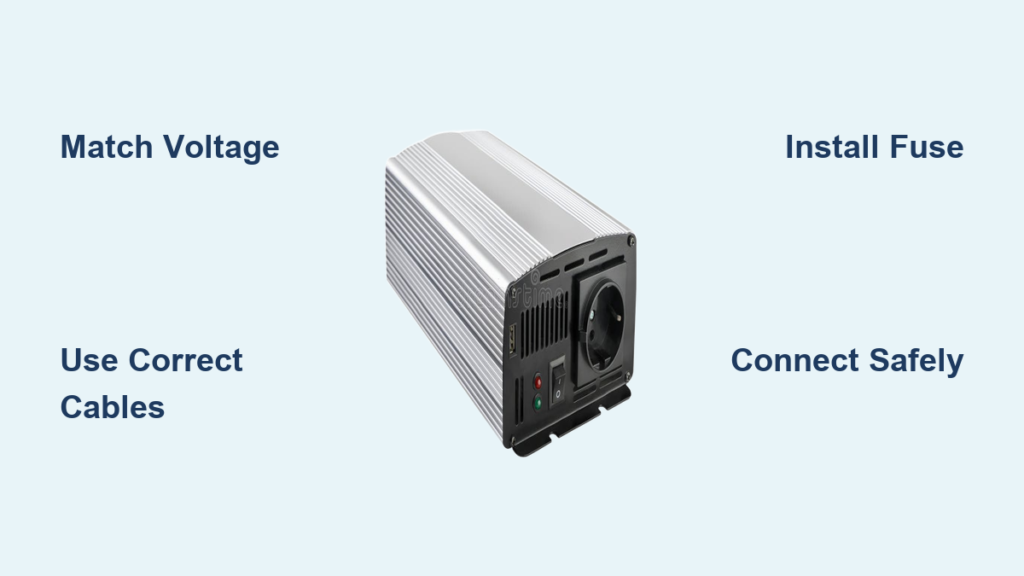
You’ve got a power inverter and a battery, but connecting them correctly is the difference between reliable power and potential disaster. Whether you’re setting up backup power for your home, outfitting an RV for boondocking, or running tools at a remote worksite, understanding how to connect power inverter to battery safely determines whether your system performs optimally or fails when you need it most. This guide covers every critical step, from matching voltages and selecting proper cables to making spark-free connections and maintaining your system for years of dependable operation.
Match Inverter and Battery Voltage
Your inverter and battery voltage must align perfectly. This is the foundation of any successful inverter-battery setup, and getting it wrong destroys equipment instantly.
Confirm 12V, 24V, or 48V Compatibility
Check the input voltage rating on your inverter and compare it to your battery’s output. A 12V inverter requires a 12V battery, a 24V inverter needs 24V, and so forth. Most portable and vehicle-based systems use 12V, while larger off-grid installations often run 24V or 48V for improved efficiency and reduced cable losses. If using multiple batteries, wire them in series to increase voltage or in parallel to increase capacity while maintaining the same voltage.
Avoid Automotive Starter Batteries
Standard car batteries deliver short bursts of high current for engine starting, then recharge immediately. They cannot handle the sustained discharge that inverters demand. Choose a deep-cycle battery instead, such as AGM, Gel, or Lithium LiFePO4. These batteries tolerate repeated charging and discharging cycles, making them ideal for powering inverters over extended periods.
Calculate Load and Select Inverter Size
Understanding your power requirements prevents overloads and ensures your system handles everything you need to run.
Add Up Device Wattages
List every appliance you plan to power simultaneously and record its continuous wattage. Add these values together to determine your total load. For example, a mini-fridge at 100W, LED lights at 20W, a laptop at 60W, and a phone charger at 10W equals 190W total.
Account for Surge Power
Motors and compressors require 2 to 3 times their rated wattage during startup. That 100W refrigerator might briefly draw 300W when its compressor kicks on. Your inverter must handle this surge without shutting down. Select an inverter with continuous rating at least 1.25 times your total load and surge capacity exceeding your peak startup demand.
Choose Correct Cable Gauge and Fuse

Proper wiring and fusing protect your system from overheating, voltage drop, and fire hazards.
Use Oxygen-Free Copper Cables
Never use copper-clad aluminum wires. These overheat quickly, degrade fast, and create fire risks. Use stranded oxygen-free copper cables with thick insulation, and keep lengths as short as possible. Every extra foot increases resistance and causes voltage loss. For a 1000W inverter on 12V, calculate current by dividing wattage by voltage: 1000 divided by 12 equals approximately 83 amps. At distances under 6 feet, use 4 AWG cable.
Install Proper In-Line Fuse
A fuse protects against short circuits and prevents fires. Size it based on inverter wattage using this formula: fuse rating in amps equals inverter wattage divided by 10 for 12V systems. A 350W inverter needs a 35A fuse, a 750W inverter needs 75A, a 1000W inverter needs 100A, and a 2000W inverter needs 200A. Use Class T, ANL, or MAXI fuses in sealed holders, and mount the fuse within 12 inches of the battery’s positive terminal to minimize unprotected wire length.
Prepare and Route Wiring

Proper cable preparation and routing prevent damage, interference, and connection failures.
Strip and Crimp Terminals Securely
Use a crimping tool and wire strippers to prepare cable ends. Attach ring terminals to both positive and negative wires for solid, vibration-resistant connections. Never rely on alligator clips for permanent installations. For marine or mobile environments, use tinned copper wire to resist corrosion.
Route Cables Safely
Run positive and negative cables separately from AC wiring to avoid interference. Avoid sharp edges, heat sources, and moving parts. Secure with plastic zip ties, never metal clamps. In vehicle installations, consider chassis grounding by connecting the inverter’s negative terminal to a clean, unpainted metal point on the frame using AWG 12 wire, then run only the positive cable to the battery.
Make Safe, Spark-Free Connections
The connection sequence matters tremendously for safety and equipment protection.
Follow Correct Connection Sequence
Sparks occur when connecting under load due to inverter capacitor charging. To minimize risk, connect inverter negative to battery negative or chassis ground first. Attach the positive cable to the fuse holder on the inverter side, then connect the fuse holder to battery positive. Insert the fuse last. This sequence limits arcing to the fuse point, which is designed to handle it.
Use a Pre-Charge Resistor
Eliminate sparking entirely using a 1k ohm, 5-watt resistor. Bridge the final positive connection point before tightening. Wait 2 to 3 seconds for capacitors to charge, then complete the connection and remove the resistor. This simple trick prevents damage and ensures smooth startup.
Ground the Inverter
Proper grounding reduces interference and provides a safe path for fault currents.
Connect Metal Enclosures to Ground
Some inverters have a dedicated grounding terminal. If yours includes one, connect it to the battery negative or vehicle chassis using AWG 12 stranded wire. Grounding reduces electromagnetic interference and provides a safe path for fault currents if internal wiring shorts.
Power On and Test the System
Testing before connecting loads verifies proper operation and catches problems early.
Verify Output Before Plugging Devices
With all AC loads unplugged, turn on the inverter and listen for a startup beep or fan activation. Check for a solid green power LED. Use a multimeter to test AC outlets, which should read approximately 120V in North America or 230V elsewhere. If readings are off or the inverter shuts down, check battery voltage. Most inverters shut off below 10.5V on 12V systems to prevent deep discharge.
Gradually Add Loads
Start with low-wattage devices like lights or phone chargers. Then add higher-draw appliances one at a time. Watch for overload warnings, voltage drops, and overheating. If the inverter beeps or cuts out, reduce the load immediately.
Disconnect Safely to Prevent Arcing
Proper disconnection order prevents sparks and protects your system.
Reverse the Connection Order
When shutting down, turn off all AC devices first, then switch off the inverter. Disconnect the negative black cable first, then disconnect the positive red cable. Removing negative first breaks the circuit safely. Reconnecting follows the reverse order: positive first, then negative.
Cover Terminals After Disconnection
Use insulating caps or electrical tape to cover exposed battery terminals. This prevents accidental short circuits from tools or metal objects.
Troubleshoot Common Issues
Knowing how to diagnose problems saves time and prevents damage.
Inverter Won’t Turn On
Possible causes include low battery voltage below 10.5V, a blown fuse, or reversed polarity. Recharge or jump-start the battery, check the fuse with a multimeter, and verify connections before retrying. Never attempt to bypass safety features.
Frequent Shutdowns
If the inverter cuts out under load, the total wattage may exceed capacity, the battery may be too weak or undersized, or the inverter may be overheating. Ensure vents are unobstructed and the location is cool. Check cable thickness, as undersized wires cause voltage drop triggering low-voltage shutdowns.
Fuse Keeps Blowing
This indicates a short circuit in wiring, a damaged inverter, or a loose connection causing arcing. Inspect all joints, test continuity, and verify wire gauge matches the load. Test the inverter isolated from the system if possible.
Maintain System for Longevity
Regular maintenance prevents premature failures and extends component life.
Monthly Inspection Checklist
Check for loose terminals and retighten to manufacturer torque specs. Look for corrosion and clean with baking soda and water mixture, then apply anti-corrosion spray. Inspect cables for fraying, melting, or abrasion. Test battery voltage at rest and under load. For flooded lead-acid batteries, check electrolyte levels monthly and top up with distilled water only.
Store Components Properly
Keep the inverter in a dry, dust-free area. Store the battery charged using a trickle charger for lead-acid types. For lithium batteries, store at approximately 50% charge and recharge every 3 to 6 months. Avoid freezing temperatures, as lithium batteries can suffer permanent damage below 32F.
Optimize for Efficiency and Safety
Maximizing efficiency extends runtime and protects your investment.
Monitor Battery State of Use a digital voltmeter or advanced monitor like Victron BMV-712 to track remaining capacity. For lead-acid batteries, do not discharge below 50% depth of discharge. For LiFePO4 batteries, you can safely use 80 to 100%. Calculate runtime using the formula: amps hours multiplied by voltage multiplied by 0.85, divided by watts.
Reduce Phantom Drain
Even when idle, inverters draw 1 to 3 watts. Turn off the inverter when not in use to preserve battery life, especially in solar or backup systems.
Frequently Asked Questions About Connecting Power Inverter to Battery
What size inverter do I need for my battery?
Select an inverter with continuous rating at least 1.25 times your total load wattage. Include extra capacity for surge power when motors or compressors start. For a 190W total load with 300W surge, a 300W continuous and 600W surge inverter provides safe headroom.
Can I use a car battery with a power inverter?
Standard car batteries work for very short, light loads only. They degrade rapidly under sustained inverter use because they are designed for brief high-current bursts, not deep cycling. Use a deep-cycle battery like AGM, Gel, or Lithium for reliable inverter power.
How close should the fuse be to the battery?
Mount the fuse within 12 inches or 30 centimeters of the battery’s positive terminal. This minimizes unprotected wire length that could short-circuit and cause fires.
Why does my inverter spark when connecting it?
Sparks occur because the inverter’s internal capacitors draw high inrush current when first connected. Use a pre-charge resistor to allow capacitors to charge gradually, or expect a small spark at the final connection point which is normal.
What happens if I reverse the positive and negative connections?
Reversing polarity destroys the inverter instantly and can damage the battery. Always verify polarity with a multimeter before making final connections.
Key Takeaways for Connecting Your Power Inverter to Battery
Successfully connecting a power inverter to battery requires matching voltages exactly, using properly sized oxygen-free copper cables with correct gauge ratings, and installing an appropriately rated fuse within 12 inches of the battery. Always connect negative first and disconnect negative first to prevent arcing and shorts. Use deep-cycle batteries rather than automotive starter batteries, and account for surge power when selecting inverter size. Following this guide ensures a safe, efficient, and durable inverter-battery system for emergency backup, mobile power, or off-grid living applications.