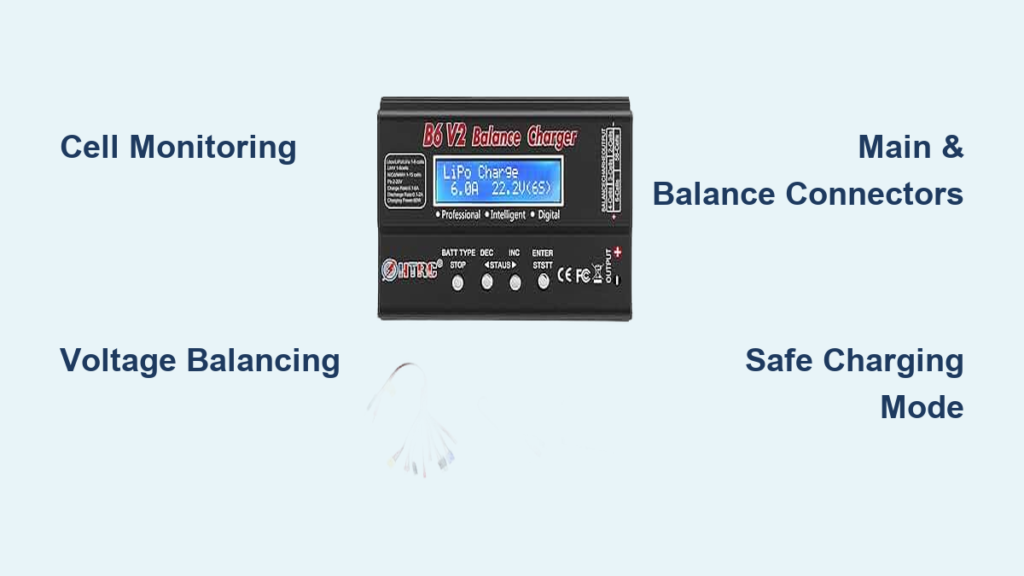
If you have ever charged a drone, RC car, or high-performance electric model, you have likely used a LiPo balance charger but might not understand how it actually keeps your battery safe and efficient. Unlike standard chargers that only monitor total voltage, a LiPo balance charger works by ensuring each individual cell in a multi-cell battery reaches exactly 4.20 V, preventing dangerous overcharging and extending battery life. Multi-cell LiPo packs like 2S, 3S, or 6S are made by connecting cells in series to increase voltage, but no two cells are perfectly identical, which is where balancing becomes critical.
In this guide, you will learn exactly how a LiPo balance charger works from its dual-connector design and passive balancing circuits to real-time voltage control and safety systems. You will discover why skipping the balance step leads to battery failure and how to use your charger the right way for maximum safety, performance, and longevity.
Why Cell Balancing Is Critical for Battery Safety
Cell balancing is essential because even small differences between cells compound over charge and discharge cycles. Tiny variations in internal resistance, age, or usage patterns cause cell imbalance, where one cell charges faster than others. Without correction, this leads to overvoltage in one cell while another remains undercharged, reducing runtime and creating serious safety risks. A balance charger actively monitors and equalizes each cell during charging to prevent these problems.
How Voltage Imbalance Causes Battery Failure
In a 3S LiPo pack with 11.1 V nominal voltage, each cell should charge to 4.20 V for a total of 12.6 V when fully charged. But if cells start at different voltages, say 3.0 V, 3.3 V, and 3.6 V, and you charge only via the main leads, the total voltage may reach 12.6 V while individual cells end at 3.9 V, 4.2 V, and 4.5 V. The third cell is now dangerously overcharged, risking thermal runaway. Even small imbalances of 0.1 V worsen over cycles, reducing capacity, increasing heat, and potentially causing swelling, fire, or total pack failure.
Safe Voltage Windows for LiPo Batteries
Understanding voltage thresholds helps you appreciate why balancing matters. The minimum safe voltage is 3.0 V per cell, below which pre-charge mode is needed. Nominal voltage sits at 3.7 V, while fully charged is exactly 4.20 V with an absolute maximum of 4.25 V. For storage, aim for 3.80 to 3.85 V per cell. A quality balance charger ensures all cells finish within ±0.01 V of 4.20 V, typically with less than 6 mV difference between the highest and lowest cells.
The Two Connectors Your Charger Requires
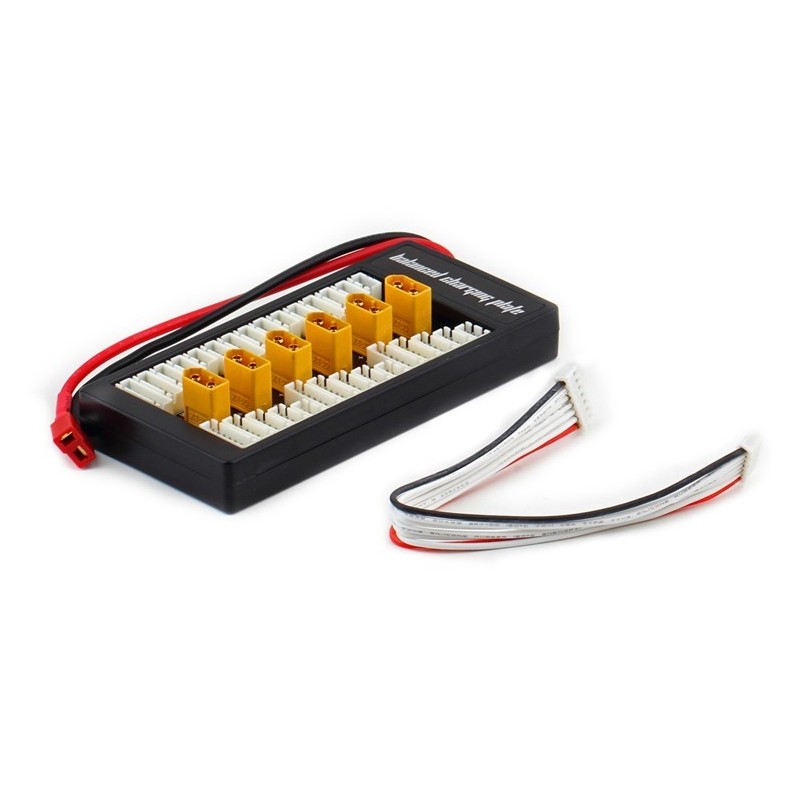
Every LiPo balance charger needs two distinct connections to work properly. The main power connector delivers high-current bulk charge, while the balance connector monitors individual cell voltages. Understanding what each does helps you avoid dangerous mistakes.
Main Power Connector for Bulk Charging
The main power connector handles the heavy lifting during charging. Common types include XT60, EC3, Deans, and XT90 connectors. These are built for high current and low resistance, typically handling 1 to 10+ amps safely. The main leads connect across the entire pack from positive to negative, delivering the bulk of charging current efficiently.
Balance Connector for Voltage Monitoring
The balance connector serves a completely different purpose. It connects to each voltage tap between cells, allowing the charger to see every individual cell’s state. Most balance connectors use the JST-XH type with a pin count equal to cells plus one. For example, a 3S pack uses 4 wires. These wires are thin, typically 28 to 30 AWG, and are designed for monitoring only, not power delivery. The maximum safe current through balance leads is about 1.5 A, far below what main connectors handle.
How Passive Balancing Actually Works

Passive resistive balancing is how 95% of consumer LiPo chargers work, including popular models like the IMAX B6, SkyRC MC6000, and HOTA D6 Pro. This method combines bulk charging with real-time cell monitoring to ensure all cells reach full charge simultaneously.
The Step-by-Step Balancing Process
The charging process follows distinct phases that work together to achieve balanced results. First, bulk charging occurs via main leads using constant current and constant voltage. Next, real-time monitoring tracks each cell via the balance connector. As cells near 4.20 V, those that reach full first are bled off using shunt resistors. Excess energy converts to heat in the charger. Finally, charging continues until all cells hit 4.20 V and current drops below the threshold.
Why Balancing Current Matters
The balancing current determines how quickly your charger can correct cell imbalances. Typical bleed rates range from 100 to 200 mA per cell, while high-end chargers offer up to 2.0 A. If your balancing current is below 0.5 A, correcting imbalances takes much longer than the actual charging time. A 1.0 A or higher balancing current ensures fast, effective correction, which is ideal for 4S and larger packs.
Why Both Connectors Are Necessary
You might wonder why you cannot simply charge through the balance plug if it monitors all cells. The answer lies in current limitations and safety.
Current Handling Differences
Balance wires are very thin, typically 28 to 30 AWG, and JST-XH pins are rated for less than 3 A, often derated to 1.5 A in practice. At 5 A charging current, resistance in these thin wires causes overheating, melting, or fire. Main connectors like XT60 are specifically designed for high-current, low-resistance power delivery. The hybrid design works because main leads handle fast, high-current charging while balance leads provide precision monitoring and correction.
The Four Charging Stages Explained
Modern balance chargers follow a standardized CC/CV charging profile adapted from lithium-ion protocols, enhanced with balancing at every stage.
Stage One: Pre-Charge Conditioning
When any cell drops below 3.0 V, the charger enters pre-charge mode. It applies a low current of about 0.1C, for example 0.33 A for a 3300 mAh pack, to safely bring weak cells up to 3.0 V. This prevents damage from fast-charging deeply drained cells that could otherwise suffer permanent capacity loss.
Stage Two: Constant Current Phase
During the constant current phase, the charger applies your set charge rate, such as 1C equals 5 A for a 5000 mAh pack. Pack voltage rises steadily while balancing circuits monitor but do not activate yet. This phase ends when the first cell hits 4.2 V, signaling that some cells are approaching full charge.
Stage Three: Constant Voltage With Balancing
In the constant voltage phase, pack voltage clamps at maximum, for example 12.6 V for a 3S pack, and current begins tapering down. This is when balancing kicks in actively. High cells get bled with resistors while lower cells continue receiving current. The phase ends when current drops below 0.05C and all cells are balanced within tolerance.
Stage Four: Cutoff and Storage
The charger beeps or displays “Done” when charging completes. At this point, you can switch to storage mode, which adjusts all cells to 3.80 to 3.85 V for long-term storage. This voltage level is optimal for batteries sitting unused for more than a few days.
Common Charging Modes Compared

Different situations call for different charging approaches. Understanding when to use each mode helps you maintain battery health.
Balance Charge serves as your go-to mode for all routine charging. It charges and equalizes all cells individually, making it the recommended choice for everyday use.
Fast Charge skips active balancing to charge quickly. Only use this in emergencies because it reduces battery lifespan significantly.
Storage Mode adjusts all cells to 3.80 to 3.85 V. Use this before storing batteries for more than three days to prevent degradation.
Discharge Mode drains the battery to a safe voltage for maintenance or transport. This helps when you need to rebalance a troubled pack.
Essential Safety Systems in Balance Chargers
Quality balance chargers include multiple layers of protection that work together to keep you and your batteries safe.
Per-Cell Voltage Monitoring
The charger stops charging if any cell exceeds 4.25 V or drops below 2.5 V. This prevents both overcharge and deep discharge damage that could cause permanent battery failure or safety incidents.
Temperature Sensing
An NTC temperature probe attaches to the battery and halts charging if temperature exceeds 50°C. This critical feature prevents thermal runaway, especially during fault conditions or when charging damaged batteries.
Timer and Polarity Protection
A user-defined timer stops charging after a set duration as a backup in case of sensor failure. Reverse polarity protection prevents damage from incorrectly connected batteries, while auto-detection identifies your cell count automatically.
Real-World Example: Charging a 6S 5000mAh Pack
Understanding practical parameters helps you select the right charger. A fully charged 6S pack reaches 25.2 V. At 1C charge rate, you need 5 A, which requires approximately 130 W of power. Your charger must provide at least 150 W input capability. With a balancing current of at least 1.0 A, charging takes about 60 to 75 minutes including the balance phase. The final result shows all cells within 0.01 V of 4.20 V, which is the ideal outcome.
A 50 W charger cannot deliver 5 A to a 6S pack. Maximum current drops to about 2 A due to power limits, extending charge time significantly.
Best Practices for Safe Charging
Following proper charging habits dramatically extends battery life and prevents accidents.
Always use balance charge mode even when you are in a hurry. The few extra minutes are worth the safety and longevity benefits.
Charge at 1C or lower unless your battery explicitly supports higher rates. This reduces stress on cells and maintains capacity over hundreds of cycles.
Use a LiPo-safe charging bag or metal fireproof container as an extra safety layer. Place the bag on a non-flammable surface away from flammable materials.
Never leave charging unattended and check on batteries regularly. Watch for swelling, excessive heat, smoke, or strange odors.
Store batteries at 3.80 V per cell when not in use for more than a few days. Full charge storage accelerates degradation.
Inspect balance leads regularly for damage or corrosion. Damaged connectors can cause poor contact or short circuits.
Frequently Asked Questions About LiPo Balance Chargers
Can I charge my LiPo battery without balancing it?
Charging without balancing is possible but strongly discouraged. Without balancing, cells become increasingly imbalanced over charge cycles. One cell may become overcharged while another remains undercharged, reducing capacity and creating fire risk. Always use balance charge mode for routine charging.
What happens if I only use the balance connector to charge?
Charging through the balance connector alone works only at very low currents, typically below 1.5 A. The thin wires and small pins cannot handle high current safely. At charging rates above 3 or 4 amps, the balance port wires overheat, potentially melting connectors or causing fire. Use both main and balance connectors for proper charging.
How long does balancing take during charging?
Balancing time varies based on your charger and the degree of imbalance. With a balancing current of 1.0 A or higher, minor imbalances of 0.1 V typically correct within 10 to 20 minutes. Larger imbalances of 0.3 V or more may require 30 minutes or longer after the bulk charge completes.
Why does my charger get warm during balancing?
Passive balancing converts excess energy from overcharged cells into heat through resistors. This is normal and expected, especially with larger packs or when correcting significant imbalances. The warmth comes from the charger electronics, not the battery. Ensure your charger has adequate ventilation and never place it on soft surfaces that block airflow.
Can I use any charger for any LiPo battery?
Your charger must support your battery’s cell count and chemistry. Most chargers handle 2S to 6S LiPo batteries, though some support up to 8S with adapters. Verify chemistry settings match your battery, whether standard LiPo at 4.20 V, LiHV at 4.35 V, or LiFePO4 at 3.6 V per cell. Using incorrect settings damages batteries.
What is a good balancing current for regular use?
A balancing current of at least 1.0 A is ideal for regular use with 3S to 6S packs. Lower balancing currents below 0.5 A result in longer correction times, especially for large or highly imbalanced packs. Higher-end chargers offer 1.5 to 2.0 A balancing currents for faster, more effective correction.
Key Takeaways for Understanding LiPo Balance Chargers
A LiPo balance charger works by combining high-current bulk charging through the main connector with real-time cell voltage monitoring through the balance connector. The charger applies constant current followed by constant voltage while actively bleeding excess charge from cells that reach full voltage first. This ensures every cell finishes at exactly 4.20 V, preventing the overvoltage and undervoltage problems that lead to battery failure.
Both connectors serve essential and distinct purposes. The main power connector handles high-current charging efficiently and safely, while the balance connector provides the precision monitoring needed to equalize cells. Using only one connector creates safety hazards or ineffective charging.
Balance charging takes slightly longer than fast charging, but this extra time is non-negotiable for battery safety, performance, and longevity. Skipping the balance step leads to reduced capacity, swelling, and fire risk over time. Always use balance charge mode, charge at 1C or lower, and store batteries at the correct voltage when not in use.
For optimal results, invest in a quality balance charger with at least 1.0 A balancing current, clear per-cell voltage display, and storage mode capability. Whether you are flying drones, racing RC cars, or building custom power systems, proper charging is the foundation of reliable, long-lasting batteries.