You’ve just bought a new phone, but the battery drains fast and you’re tired of waiting hours to recharge. You grab a charger from the drawer, plug it in, and wonder: Is this actually charging my phone quickly? How powerful is this thing? The answer lies in one simple number: watts. Knowing how to calculate the wattage of your mobile charger helps you choose the right one for faster, safer charging and avoid underpowered or potentially damaging alternatives.
The good news is that calculating wattage is easy. With just two numbers, voltage (V) and amperage (A), you can determine exactly how much power your charger delivers using a universal formula. Whether it’s a basic 5V adapter or a modern USB-C PD charger, this guide shows you how to decode the specs, calculate wattage accurately, and understand what it means for real-world charging speed.
Find Output Specifications on Your Charger
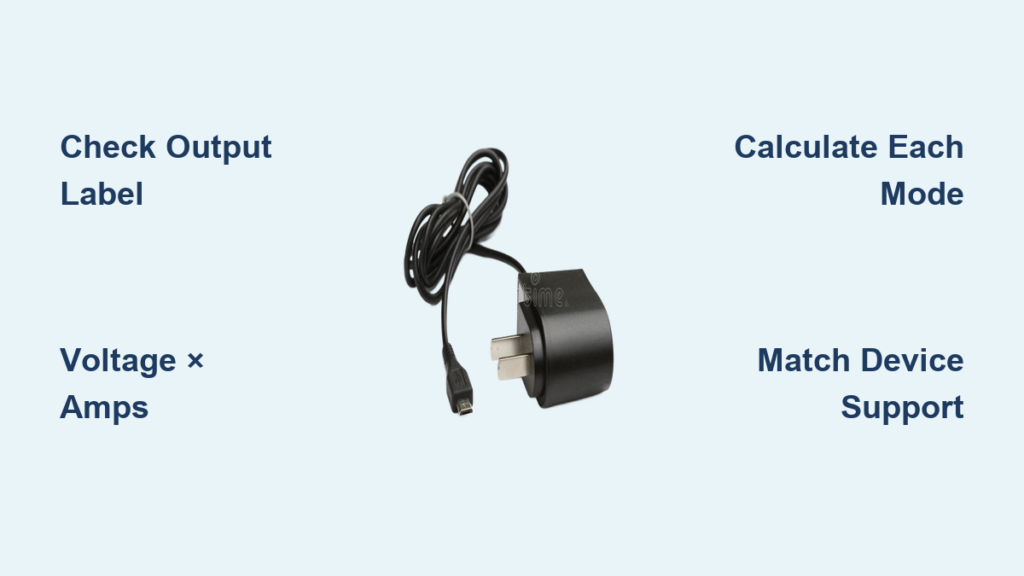
Before calculating wattage, you need to locate the technical details printed on your charger. Every legitimate power adapter includes an output label, typically on the side or base of the device.
Locate the OUTPUT Section
Look for the section labeled “OUTPUT” or “DC OUTPUT” on your charger. This area contains the essential electrical values you need for calculation. The two key numbers are voltage and current.
The output section typically displays values like these:
- Voltage (V): Usually 5V, 9V, 12V, or higher for fast chargers
- Current (A): Often 1A, 2A, 3A, or higher
- Example format: OUTPUT: 5V⎓2A (the ⎓ symbol indicates direct current)
You should not confuse input values with output values. Input refers to power coming from the wall outlet (typically 100-240V AC), while output refers to power going to your device. Only the output values matter when calculating charging wattage.
What If There Is No Label
You should avoid using unlabeled or counterfeit chargers entirely. These products often lack proper safety protections and may deliver unstable power that could damage your devices. Always use chargers that have clear, legible specifications printed on them.
Use the Power Formula: Watts Equals Volts Times Amps
The core equation for calculating power is simple and applies to all mobile chargers regardless of brand or technology.
Apply the Formula
The universal formula is straightforward: Wattage (W) equals Voltage (V) multiplied by Current (A).
When you multiply the output voltage by the output current, you get the total power in watts that the charger can deliver under those specific conditions. This formula works for all mobile chargers, including Android, iPhone, USB-C, and older micro-USB models.
Example Calculation
For a charger with output specifications of 5V and 2A, the calculation is:
5V × 2A = 10W
This tells you the charger can deliver up to 10 watts of power. This calculation method remains the same whether you’re dealing with a basic charger or an advanced fast-charging adapter.
Calculate Wattage for Single-Mode Chargers
Many basic chargers support only one fixed voltage-current combination. These are common with older phones and low-power devices.
Standard 5V Chargers
The most common charger types use 5V output with varying current levels. Here are typical examples:
- 5V, 1A delivers 5 watts (5 × 1 = 5W)
- 5V, 2A delivers 10 watts (5 × 2 = 10W)
- 5V, 3A delivers 15 watts (5 × 3 = 15W)
A common mistake is assuming all USB chargers deliver the same power. A 5W charger (1A) will charge much slower than a 10W (2A) version, even though both might be labeled as “USB charger.”
Low-Voltage Scenarios
Some chargers list unusual voltages during initial charging phases. For example, 3.5V might appear during battery trickle charge mode. Using the same formula:
3.5V × 1A = 3.5W
This low voltage is typically temporary. Full-speed charging resumes at standard voltages like 5V or 9V once the battery reaches a certain level.
Handle Multi-Profile USB-C Chargers

Modern fast chargers, especially USB-C Power Delivery (PD) models, support multiple voltage-current combinations. Each combination represents a different charging mode the charger can provide.
Read All Output Profiles
A typical high-speed charger might display several output configurations:
- 5V⎓3A (15W)
- 9V⎓2.77A (25W)
- 11V⎓2.27A (25W)
You need to calculate each mode separately to understand the full capabilities of the charger.
Calculate Each Mode Separately
For each output profile, apply the wattage formula:
- At 5V: 5V × 3A = 15W
- At 9V: 9V × 2.77A ≈ 24.93W (approximately 25W)
- At 11V: 11V × 2.27A ≈ 24.97W (approximately 25W)
The highest value among these calculations represents the charger is peak capability. In this example, the maximum wattage is approximately 25 watts.
Identify Maximum Possible Charger Output
Just because a charger can deliver a certain wattage doesn’t mean it always will. The actual power delivered depends on several factors.
Peak Versus Actual Power
Peak output refers to the highest wattage among all listed profiles. Actual output depends on your device is compatibility and charging protocol negotiation. A phone that only supports 5V charging will draw only 15W even when plugged into a 25W-capable charger.
Why This Matters
Manufacturers often label chargers by their maximum wattage. A charger might be marketed as a “25W Charger” based on its peak capability, but your specific device may not utilize the full power. Always check your phone is specifications to confirm supported charging standards.
Understand Charging Negotiation Protocols
Power delivery is not automatic. The charger and device communicate to determine the optimal power level.
How Voltage Is Selected
When you connect a phone to a compatible charger, the following happens:
- The device sends a signal via USB data lines
- The charger responds with available power profiles
- The device selects the highest compatible setting
This handshake happens instantly through protocols like USB PD or Qualcomm Quick Charge.
Real-World Impact
Even when using a 65W GaN charger, an iPhone 14 only draws about 20-23W because it caps at that level. Your device controls the limit, not the charger. This is why understanding the negotiation process helps set realistic expectations.
Match Charger to Device Capabilities
A powerful charger won’t speed up a device that cannot accept more power. Compatibility is essential.
Check Your Phone is Specs
Look for supported charging standards in these locations:
- User manual
- Manufacturer is website
- Settings > Battery > Charging (on some Android phones)
Common specifications include “Supports USB PD 3.0,” “25W Super Fast Charging,” or “QC 4+ Compatible.”
Use Diagnostic Apps
Android users can download apps like Ampere or AccuBattery to display real-time charging voltage, current draw, and estimated wattage. These apps help verify if your charger is delivering expected power or if a cable or charger combination is underperforming.
Recognize Fast-Charging Technologies

Not all high-wattage systems work the same way. Understanding these technologies helps you make better choices.
USB Power Delivery (PD)
USB PD allows dynamic voltage adjustment across multiple levels: 5V, 9V, 15V, and 20V. This standard supports up to 100W, making it common in laptops as well as iPhones and Android phones.
Programmable Power Supply (PPS)
PPS fine-tunes voltage in small increments of 20mV. This reduces heat and improves charging efficiency. You’ll find PPS in Samsung Galaxy and Google Pixel devices that support fast charging.
Proprietary Standards
Several manufacturers use modified versions of PD or QC with their own branding:
- Samsung Adaptive Fast Charging
- OnePlus Warp Charge
- Xiaomi Turbo Charge
These require compatible hardware on both the charger and device side.
Avoid Common Calculation Errors
Even small mistakes lead to wrong conclusions about charger performance.
Mistake 1: Using Input Instead of Output
The input rating (100-240V AC) refers to wall power compatibility. Only the output values (5V/2A, for example) affect device charging. Using input values will give wildly incorrect wattage calculations.
Mistake 2: Adding Multiple Outputs Together
Some chargers have dual ports with specifications like:
- USB-A: 5V/2.4A
- USB-C: 5V/3A
You should not simply add the wattages across ports. Total power is shared between ports. If both ports are used simultaneously, each may receive less than the listed maximum.
Mistake 3: Ignoring Device Limits
A 65W charger does not force 65W into your phone. The device decides what to draw based on its capabilities. Your phone will only accept the power it can handle safely.
Compare Chargers Using Wattage

Wattage serves as the best single metric for comparing charging speed potential across different chargers.
Charger Type Comparison
Different charger types serve different purposes:
- Basic USB chargers (5W, 5V/1A) work for slow charging and older devices
- Standard fast chargers (10-18W) suit most Android and iOS phones
- High-speed USB-C chargers (25-30W) target flagship Android devices
- Multi-device GaN chargers (45-65W) handle phones, tablets, and laptops simultaneously
Higher wattage generally means faster charging for compatible devices. However, speed improvements plateau. Going from 5W to 18W dramatically reduces charge time, but jumping from 30W to 65W offers diminishing returns on phones.
Choose the Right Charger for Your Needs
Selecting the appropriate charger depends on your specific situation and devices.
For Everyday Phone Charging
An 18W-25W USB-C PD charger works ideal for most users. These chargers work with most iPhones and Android phones and can charge modern devices from 0% to 50% in approximately 30 minutes.
For Travel or Multiple Devices
A 45W-65W GaN charger with multiple ports serves travelers well. These compact and efficient chargers can charge a phone, tablet, and earbuds simultaneously without sacrificing speed.
For Older Devices
Stick with 5V/2A (10W) chargers if your device has no fast charging support. Ultra-high-wattage chargers offer no benefit for older devices and simply add unnecessary cost.
Final Tips for Accurate Wattage Assessment
Follow these tips to get the most accurate picture of your charging setup.
Always Check the Label
Even if you know the brand, verify output specs directly on the charger. Marketing packaging may differ from actual device specifications.
Pair With Quality Cables
A poor-quality cable can block fast charging entirely. Use USB-C to USB-C cables for PD/PPS charging, E-Marked cables for 60W+ power delivery, and certified MFi cables for Apple devices.
Do Not Trust Marketing Alone
Terms like “Fast Charging” mean nothing without specific numbers. Always look for exact voltage and current specifications and supported standards like USB PD or PPS.
Key Takeaways for Calculating Mobile Charger Wattage
Calculating charger wattage is a straightforward process that puts you in control of your charging experience. The fundamental formula, watts equals volts multiplied by amps, applies universally to all charger types, from basic 5V adapters to advanced multi-profile USB-C chargers.
The most important steps are locating the output specifications on your charger, identifying the voltage and current values, and applying the formula correctly. For multi-mode chargers, calculate each profile separately and note the maximum wattage. Remember that actual power delivery depends on your device is compatibility and the charging negotiation between charger and device.
Understanding wattage helps you pick the right charger, troubleshoot slow charging issues, and ensure your devices receive the power they need safely and efficiently. No more guessing games. You can now make informed decisions when buying new chargers and get the best charging performance from your devices.
Frequently Asked Questions About Calculating Mobile Charger Wattage
How do I calculate the wattage of my phone charger?
Multiply the output voltage (V) by the output current (A). For example, a charger labeled 5V/2A delivers 10 watts (5 × 2 = 10W).
What if my charger has multiple output profiles?
Calculate the wattage for each profile separately using the same formula (V × A). The highest result represents the charger is maximum capability.
Does a higher wattage charger charge my phone faster?
Only if your phone supports the higher wattage. The device controls power acceptance, not the charger. A 65W charger will only deliver 20W to a phone that maxes out at 20W.
Can I use a higher wattage charger than my phone supports?
Yes, using a higher-wattage charger is safe. The charger and device negotiate power delivery, and your phone will only draw what it can handle. Higher-wattage chargers default to lower power when needed.
Where can I find my phone is charging specifications?
Check your user manual, the manufacturer is website, or your phone is Settings menu (usually under Battery or Charging settings). Look for supported standards like USB PD 3.0 or specific wattage ratings.
Why do some chargers feel warm during use?
Warmth is normal during fast charging because energy transfer generates heat. However, excessive heat may indicate a problem with the charger, cable, or device. Use only certified chargers and cables to avoid damage.